What Is Carpet Knot Count (Raj)?
Seyed Jalaleddin Bassam – Kourosh Zakeri-Fard
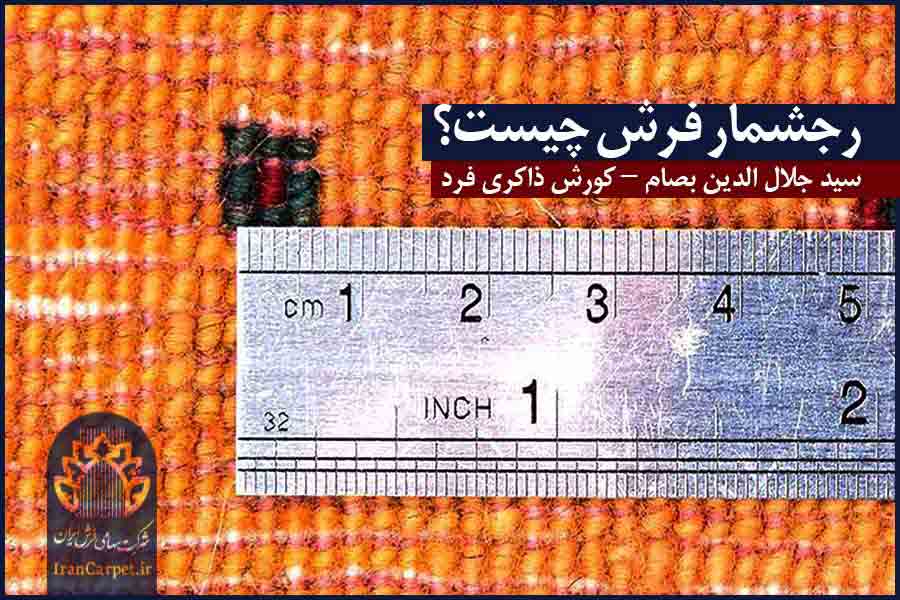
• What is carpet knot count (raj)? The fineness of two-dimensional textiles—that is, textiles made up only of warp and weft—is expressed by the number of warp or weft threads per unit of length, such as the number of warp threads per centimetre. Because a handwoven carpet is knotted, it forms a three-dimensional textile. Its fineness is expressed by its “knot count” (raj), meaning the number of knots woven across the carpet’s width within a specified unit of length. Since handwoven carpet-making is a traditional craft, several regional methods are used to measure this fineness.
• The zar' knot: In past centuries, the most common unit of length in Iran was the “zar'.” A zar' is the distance from the tip of the nose to the tip of the middle finger of the right hand when the arm is fully extended. Many of you may have seen older people measure the length of fabric in this way. In the Isfahan region, this distance is equivalent to 104 centimetres; in the Tabriz region, it is 112 centimetres. One quarter of a zar' is called a “charak.” A “zar' knot” is one quarter of a charak. Thus, in Isfahan and, by extension, throughout the Persian-knotting regions, a zar' knot is equivalent to 6.5 centimetres. In Tabriz and, by extension, the Turkish-knotting regions, it is equivalent to 7 centimetres. • Knot count (raj) To determine a carpet’s knot count, count the knots across its width from the back. For Tabriz and other Turkish-knotting carpets, the knot count is the number of knots in 7 centimetres of the carpet’s width. For example, when we say a carpet has a knot count of 50, we mean that 50 knots have been woven across 7 centimetres of its width. Since each carpet knot is tied around two warp threads, there are 100 warp threads across 7 centimetres of the carpet’s width. For Persian-knotting carpets, such as those from Kashan, the knot count is the number of knots in 6.5 centimetres of the carpet’s width. For example, a carpet with a knot count of 50 has 50 knots across 6.5 centimetres of its width. As the explanation above shows, a Tabriz carpet and a Kashan carpet with the same knot count are not equally fine: the Kashan carpet is finer. Counting the knots across one metre of width, we find that the Tabriz carpet has 714 knots, while the Kashan carpet has 769.• Knot density Knot count does not correspond directly to fineness: an increase in knot count does not necessarily mean a proportionate increase in a carpet’s fineness. For this reason, some countries use “density” to express carpet fineness. Density means the number of knots per unit of area, such as a square inch, square decimetre or square metre. For example, when we say a carpet has a knot count of 50, we mean that 50 knots have been woven across 7 centimetres of its width. Since each carpet knot is tied around two warp threads, there are 100 warp threads across 7 centimetres of the carpet’s width. • Common knot-count terms in Iranian handwoven carpets Different regions of Iran use their own customary terms and methods for describing knot count. A few are described below. • 6-ply and 9-ply: This terminology is common in Nain. It refers to the number of plies in the cotton yarn used for the carpet’s warp. The fewer the plies, the finer the warp yarn and, naturally, the finer the carpet. A 6-ply carpet is generally equivalent to a knot count of 60, and a 9-ply carpet to a knot count of 50. Iran Carpet Company consistently observes this standard. Carpets are also woven in 4-ply and 12-ply, equivalent to knot counts of 75 and 30, respectively. • “Hundreds”: This term is common for Isfahan carpets and refers to groups of 100 knots counted across the full width of the carpet. The term “khaft” is also sometimes used to mean the number of knots across the full width. For example, a 6-square-metre carpet described as “20 hundreds” (or 2,000 khaft) has 2,000 knots across its 2-metre width. This carpet is therefore equivalent to a 65-raj carpet. • “Khuneh”: This term is common in Kashan. Each “khuneh” comprises 10 knots, and the term refers to the number of khunehs across half the carpet’s width. For example, a 6-square-metre carpet with 46 khunehs has 460 knots across one metre of width. This carpet is therefore equivalent to a 30-raj carpet. • “Tun”: This term is common in Yazd. In this system, the number of tuns refers to the number of warp threads stretched across half the carpet’s width; accordingly, half that number of knots is woven across the same half-width. For example, a 6-square-metre carpet described as “840 tun” has 420 knots across one metre of width. This carpet is therefore equivalent to a 28-raj carpet. • “Joft”: This term is common for Kerman carpets and refers to the number of pairs of warp threads (or knots) in two zar' knots, or 14 centimetres. For example, a 100-joft carpet has 100 pairs of warp threads (or 100 knots) in 14 centimetres. This carpet is therefore equivalent to a 28-raj carpet.
At Iran Carpet Company, knot count is expressed by multiplying two numbers (for example, 75*75), referring to the number of knots in 10 centimetres across the carpet’s width and 10 centimetres along its length. For example, a 75-joft carpet (or 75*75) has 75 knots across 10 centimetres of its width and 75 knots along 10 centimetres of its length. This carpet is therefore equivalent to a 50-raj carpet.
• The difference between handwoven carpet knot count and machine-made carpet density Machine-made carpets are described as 350-shaneh, 500-shaneh or 700-shaneh. “Shaneh” refers to a reed in the weaving machine, and the number before the term indicates the number of reed dents per metre. Two warp threads pass through each reed dent, so one knot is woven into the carpet for each dent. A 500-shaneh carpet therefore has 500 knots across one metre of width, and its density can be considered equivalent to that of a 32-raj handwoven carpet. It should be noted, however, that machine-made carpets are produced using a “U” knot or a knotless construction.