Victoria and Albert: A Museum of the Finest Persian Carpets
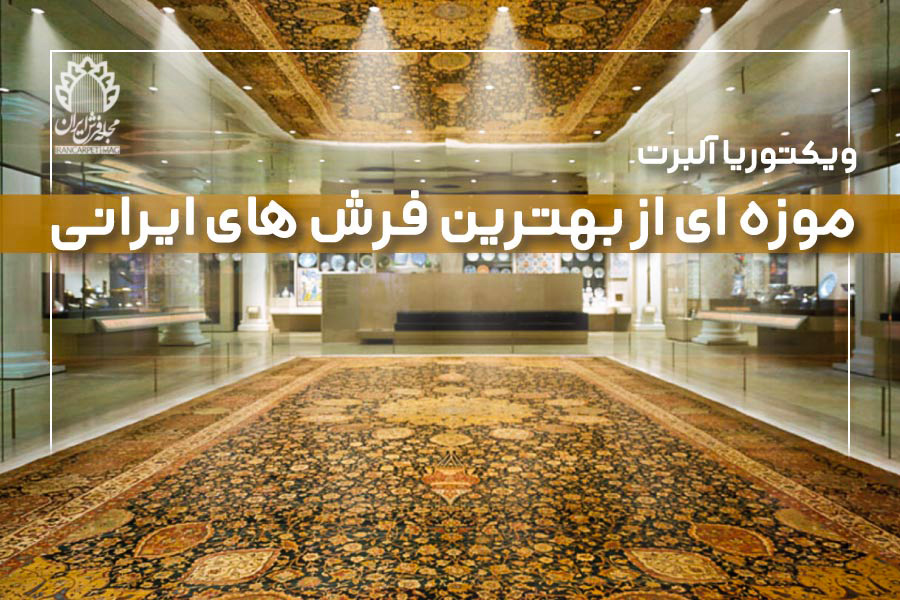
Alongside images and documents related to carpets, the Victoria and Albert Museum holds around 250 examples of handwoven carpets from Iran. Among the best known are the magnificent Ardabil Carpet and the celebrated Salting, Sanguszko and Chelsea carpets, as well as the carpet from the tomb of Shah Abbas II. The museum’s collection also brings us into contact with figures of importance in the histories of Iran and Britain, most notably Nasser al-Din Shah Qajar and William Morris. In this way, the Victoria and Albert Museum houses a treasure trove of some of Iran’s finest handwoven carpets.
The Origins of the Victoria and Albert Museum
The museum traces its origins to the Great Exhibition of 1851, which, from May to October, offered Londoners a spectacle of industry and progress. The first international exhibition of its kind, it was a grand display of manufactured goods, from steam engines to countless unusual objects from Britain, its empire and beyond. The Crystal Palace was built in Hyde Park to house the exhibition, and Queen Victoria and Prince Albert presided over its opening ceremony. When it closed, an estimated six million people—equivalent to one-third of Britain’s population—had visited, among them Charles Darwin and Charles Dickens.
 The Ardabil Carpet (Sheikh Safi), Victoria and Albert Museum, London
From South Kensington[i] to the Victoria and Albert
The Great Exhibition of 1851 was the most successful event of its kind held up to that time and became one of the defining milestones of the nineteenth century. In its wake, its creator and champion, Prince Albert, saw that British industry would need to preserve and raise its standards to compete in international markets. To this end, he insisted that the exhibition’s profits be used to develop a cultural district of museums and colleges in South Kensington, dedicated to the teaching of art and science. The museum was the first institution established there. Directed by Henry Cole, it opened in 1852 with a selection of objects purchased using a £5,000 grant from the Treasury. With a mission to educate designers, manufacturers and the public in art and design, it was known as the South Kensington Museum for more than 40 years. In 1899, Queen Victoria attended the opening of the museum’s new building, in what was to be her last public ceremony. The occasion honoured Queen Victoria and her late husband, Prince Albert (who had died in 1861), by giving their names to the museum, which has been known ever since as the Victoria and Albert Museum.
Housed in one of Britain’s finest ensembles of Victorian and modern buildings, the museum’s collections span more than 5,000 years of human creativity across almost every medium. Among them is an exceptional collection of handwoven carpets, crowned by the Ardabil Carpet, also known as the Sheikh Safi Carpet—the world’s oldest, largest and most beautiful dated carpet.
Collected at South Kensington, Displayed at the Victoria and Albert
The South Kensington Museum employed agents to acquire “works of art and decorative objects.” One was Major-General Robert Murdoch Smith (1835–1900), head of the Persian Telegraph Company in Tehran, who became the museum’s purchasing agent in 1873. He energetically acquired distinctive carpets from private collections and directly from mosques, competing with other European collectors and institutions that had joined the hunt for such treasures before their significance was widely appreciated, securing works at minimal cost. Carpet collectors, including Wilhelm von Bode of Berlin, author of scholarly books on the subject, sought to conceal their interest in the carpets’ value so they could quietly enrich their collections and buy before the works became widely sought after.
Carpets Donated by Nasser al-Din Shah to the South Kensington Museum
In 1877, Nasser al-Din Shah Qajar approved the donation of contemporary textiles and carpets to the South Kensington Museum. The gift, made directly to promote Iran’s textile industry in Britain, was organised through Robert Murdoch Smith and Amin al-Molk, the Qajar minister of the time. It comprised 14 carpets and 60 textile samples from Mashhad, Kurdistan, Sanandaj, Malayer and Hamadan.
Collectors’ Growing Interest in Oriental Carpets
In the late nineteenth century, a taste for the “Oriental” led to growing demand for Safavid carpets. Oriental weavings became popular and synonymous with creative artistry. The Victoria and Albert Museum was praised by the press for its foresight and for the low prices it had paid for many of the works in the 1876 Persian Art Exhibition. By 1884, the museum had begun collecting tribal weavings from Fars. Its first Iranian tribal weaving was a small carpet with a boteh motif, made by the Qobadkhani Arabs of Fars. The final two decades of the nineteenth century saw the 1891 Vienna Exhibition of Oriental Carpets and the 1892 London exhibition. Several substantial books adorned with full-colour carpet photographs were published to mark these exhibitions.
 Kelmscott Manor, William Morris’s retreat
Persian Carpets: Inspiration for Designers and a Passion for Collectors
Between 1873 and 1893, sixteenth-century Safavid carpets were recognised in Europe for the first time as significant and precious masterpieces. Previously, the South Kensington Museum’s collecting had focused solely on contemporary nineteenth-century weavings, acquired as examples of the different styles then in existence. Guided by artists, designers and enthusiasts such as William Morris (1834–96), the museum came to understand the importance of Safavid carpets and realised that their beauty and forms could not simply be reproduced in copies. Morris, a British designer, poet, craftsman and socialist, had a profound understanding of such works. He displayed the first Safavid carpet he had ever seen—a “Kerman vase carpet,” purchased in Paris in 1877 and later donated to the museum—in his home in Gloucestershire, Kelmscott Manor, and drew inspiration from it for his own work.
William Morris’s Recommendation of the Sheikh Safi Carpet
For many years, Morris supported the South Kensington Museum (V&A) by advising on its collections and made recommendations on numerous acquisitions. In 1893, he advised the museum to purchase the “Ardabil Carpet” (the Sheikh Safi), renowned worldwide as the oldest dated carpet in the world and one of Iran’s largest, finest and most magnificent carpets. William Morris praised the carpet’s intellectual qualities. He urged the government to increase the sum available for its purchase from £1,500 to £1,750 and, together with other benefactors, contributed funds to ensure that the carpet he described as “the finest Oriental carpet I have ever seen” would remain in England for public display.
The Ardabil Carpet is of great historical importance. Together with its companion piece,[ii] it was commissioned by Shah Tahmasp of the Safavid dynasty for the shrine of his ancestor, Sheikh Safi al-Din, in the city of Ardabil in north-western Iran. Its date is established precisely by its poetic inscription and signature: “The work of the servant of the court, Maqsud Kashani,” dated 946 AH (1539–1540 CE). The carpet’s central medallion design resembles the dome of the Sheikh Lotfollah Mosque in Isfahan and is framed by two elegant lamps of different sizes. This difference is a deliberate design irregularity, reflecting the belief that perfection belongs to God alone.

The Ardabil Carpet: The Crown Jewel of the Victoria and Albert Museum
The Ardabil Carpet was an innovative design among the Persian carpets of its time. Numerous copies in different sizes, from small rugs to large carpets, were woven after it, and came to adorn important places across Europe and elsewhere. For example, an “Ardabil Carpet” was found in the British Prime Minister’s office on Downing Street and even in Adolf Hitler’s office in Berlin.
For several decades, the Victoria and Albert Museum displayed the carpet hanging on a wall. In 2006, however, it created a large showcase at the centre of Room 42 in the Jameel Gallery, allowing visitors to see the carpet as it should be seen—laid on the floor. The showcase is illuminated for a few minutes each hour to preserve its rich colours and help ensure that it remains a jewel of the Victoria and Albert Museum for at least another 500 years.
Faezeh Ghaderi Carpet Specialist
[i] Museum of Manufactures, South Kensington Museum
[ii] Held at the Los Angeles County Museum of Art