Bessarabian Rugs Make Everything Bloom
Bessarabia is a region in southeastern Europe, north of the Caucasus Mountains in southwestern Russia. It borders Romania to the south and the Black Sea to the east, and lies between the Prut and Dniester rivers. Its capital was the city of Chișinău, but today the region is divided between Moldova and Ukraine. Depending on the political circumstances, the Bessarabian region has formed part of Romania, Moldova and Ukraine. From 1812 to 1918, it was within the Russian Empire; from 1918 to 1940, it was part of Romania; and from 1940 to 1991, it was part of the Soviet Union. In 1991, Moldova and Ukraine declared independence, and Bessarabia was divided.
The Bessarabian region has formed part of Romania, Moldova and Ukraine at different times, depending on the political circumstances. Around two-thirds of Bessarabia lies within present-day Moldova. The Ukrainian region of Budjak covers the southern coastal area, while a small area in the north lies within Ukraine’s Chernivtsi Oblast. The majority of Bessarabia’s population speaks the Moldovan dialect of Romanian. Today, Bulgarians are the region’s second-largest community after Ukrainians. People living in this area grow sugar beets, sunflowers, wheat, maize, tobacco, wine grapes and fruit, and raise cattle and sheep. Agriculture is the region’s principal occupation.
According to traditional accounts, the name Bessarabia (Basarabia in Romanian) derives from the Wallachian Basarab dynasty, which is said to have ruled the southern part of the region in the 14th century. Some scholars, however, reject this explanation and argue that:
- The region originally had no specific name; the name was assigned by Western cartographers.
- The name first appeared in local sources in the late 17th century.
- The idea that the name referred to Moldavian territories near the Black Sea was explicitly rejected as a cartographic ambiguity by the early Moldavian chronicler Miron Costin.
- The confusion may have originated with medieval Western cartographers and contemporary Polish interpretations that mistakenly understood Wallachia as “Bessarabia,” referring to a separate land between Wallachia and Moldavia. According to Dimitrie Cantemir, the name Bessarabia originally referred only to the part of the territory south of the Upper Trajan’s Wall—that is, an area only slightly larger than present-day Budjak.
Bessarabian rugs is a name generally given to pile rugs and kilims produced in the late 19th and early 20th centuries in the Russian provinces and in what are now Ukraine and Moldova. The term “Bessarabian” is also commonly used to describe handwoven Polish, Romanian and Bulgarian rugs. Some carpet specialists classify flatwoven rugs (kilims) as Bessarabian and knotted pile rugs as Ukrainian. Bessarabia is the source of kilims similar to those of Moldova. Some bear inscriptions, written in Cyrillic script.
Antique Bessarabian rugs, made in both pile and kilim techniques, are among the most beautiful rugs produced in Europe. Many Bessarabian kilims were woven in the late 18th and early 19th centuries. Their designs are often floral, with delicate motifs and earthy tonalities.
This style reflects both French and Eastern influences. Bessarabian rugs are almost always flatwoven kilims, woven on a wooden loom similar to those used for Aubusson rugs.
Pile-woven Bessarabian rugs are rare and highly valued. Unlike Savonnerie or Aubusson rugs, Bessarabian rugs do not follow a uniform convention. Most Bessarabian kilims are floral, although some feature predominantly geometric motifs.
Bessarabian rugs differ from antique Persian rugs in many respects. For example, unlike Persian rugs, Bessarabian rugs cannot be classified by weaving characteristics associated with a particular region. In the marketplace, the weave offers only a broad clue as to whether a rug was made in a village or a town; other characteristics are overlooked, and an unrelated classification is applied. The general term “Bessarabian” is used for all the rugs and carpets in this category.
Antique Bessarabian tapestry-woven and pile rugs hold a distinctive place among European rugs. They were produced in the late 19th and early 20th centuries under the new Ottoman Turkish rule, in an area corresponding to parts of present-day Bulgaria and Romania, and came to rank among the finest European and Oriental carpets.
The Russian Imperial Tapestry Workshop was where Romanian rugs were produced, and it was founded by none other than Peter the Great. After returning from England and France, he established the Russian Imperial Tapestry Workshop. In setting up the workshop, he drew inspiration from the sumptuous Aubusson rugs, Savonnerie carpets and Axminster rugs he had encountered abroad.
While in Europe, he had been struck by the beauty of its rugs. They had already captured the attention of his Russian contemporaries, and their import drained money from Russia. The Russian Imperial Tapestry Workshop therefore became a place where Peter the Great and the Russian aristocracy could have French and English rugs copied. Demand for these luxurious rugs grew, and more workshops were established in villages. It was in this region that the rugs came to be known as Bessarabian.
Bessarabian weavers were rural people with a village sensibility. Although they were expected to reproduce the intricate designs of European—English and French—rugs, they brought their own distinctive rural character to the borrowed motifs and patterns. This more traditional, or folk-inspired, interpretation of European designs gave the rugs a simple, local character. As a result, Bessarabian kilims continue to appeal to contemporary tastes.
In the 1700s, the Neoclassical style grew popular in Europe and was admired at the court of Catherine the Great, who ruled Russia longer than any other woman in its history. Many Bessarabian kilims made in this workshop incorporated Neoclassical elements. The provincial weaving workshops that produced these magnificent antique Romanian Bessarabian rugs knew of the style’s popularity, but preferred to weave their rugs informally, in the manner of village weavers. The Bessarabian kilims made in these provincial workshops combined Neoclassical and folk elements.
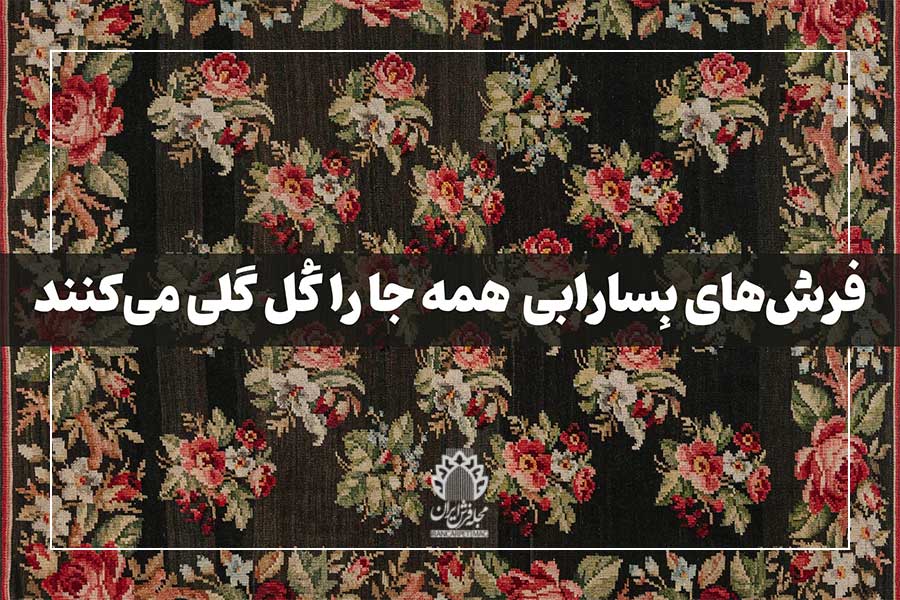
Bessarabian textiles are richly ornamented and are not unlike the rugs of Karabagh in the Caucasus. Many motifs woven into Bessarabian rugs feature the rose motif, known as farangi gul, or the cabbage rose. The rose is a common motif in Oriental rugs; it is prominent in Ottoman rugs of the Abdülmecid style, Senneh kilims and rugs, rugs from other parts of Iran, and Karabagh rugs from the Caucasus. Bouquets and single roses are also common in Aubusson and Savonnerie rugs. The designs usually appear against black or brown grounds and are rendered with a Western naturalism. Some pieces, particularly the flatweaves, resemble Anatolian Turkish kilims, but use a Bessarabian palette. The finest Bessarabian rugs were produced in the 18th century at the Russian Imperial Tapestry Workshop.
In floral designs, the motifs are highly sinuous and often feature a border of flowers and leaves, sometimes accompanied by cast-iron-like forms; in some cases, they fill the field like a frame. The influence of other regions can also be seen in Iranian rugs, and comparable designs are found in several areas: medallion designs (similar to the forest, Sharabeh and blanket-flower designs of Faradonbeh); panelled designs (similar to the frame-and-mirror repeat of Faradonbeh and the Gol-e Mirza Ali of Senneh); and bouquets, either detached (similar to the Mousakhani design of Esfandegheh, Afshar Kerman, the Gol-e Farang of Senneh and the Gol-e Farang of Faradonbeh) or joined and repeated across the field.
Romania
Modern rug production in Romania began with Armenian refugees after the First World War. During the 1920s and 1930s, workshops in Romania made convincing copies of Caucasian and Turkish pile rugs. These copies were so precise that some were acquired by major museums as authentic examples. Pile-rug production for export began around 1950 and increased significantly after the United States lowered tariffs in 1975.
Rugs were woven through cooperatives in different regions, in varying qualities and with Persian, Turkish and Caucasian designs, using metal looms. These looms enabled rugs to be produced with very regular shapes and a consistent, orderly weave. Knot density ranged from 25 to 200 knots per square inch, depending on the region. The asymmetrical Persian (Senneh) knot was commonly used for Persian designs, and the symmetrical Turkish (Ghiordes) knot for Turkish and Caucasian designs. Rugs were woven on wool or cotton foundations. Romanian kilims were woven using the slit-weave technique, with floral grounds dyed in vivid colors inspired by rural life. Their designs may be geometric or stylized, or exceptionally realistic and naturalistic. Many Romanian kilims use supplementary eccentric wefts, allowing the floral and animal motifs to appear more naturalistic. Some older examples depict folk interpretations of human figures. Typically, the field color contrasts with the colors of the side borders. Older kilims are made entirely of wool, while contemporary examples have wool wefts woven over cotton warps. Large quantities of Romanian kilims are now imported into the United States. Their designs adapt traditional motifs using nontraditional pastel colors. The oldest dated Romanian kilim was woven in 1789, although kilim weaving in this region is older. Romanian kilims were influenced by Turkish rule, which began in the 16th century. They are classified as Braila, Bran, Brașov, Bucharest, Dorna, Harmon, Milcov, Mureș, Olt and Postăvarul.
Kilims (scoarță in Romanian) were used in rural homes as tablecloths, bedcovers and wall hangings; only wealthier families used them as floor coverings.
Moldova
Moldova borders Romania to the west and Ukraine to the northeast and south. It is a landlocked country in Eastern Europe, situated between Romania and Ukraine. Most of Moldova was part of Romania between the two world wars. Two-thirds of Moldovans are of Romanian origin, and the two countries share traditions and folk culture, as well as a currency name: the Moldovan leu and the Romanian leu. The official language of Moldova is Romanian. A predominantly rural population has weakened workers’ bargaining power and hindered industrialization. However, its vineyards make Moldova Europe’s 11th-largest wine producer. According to Guinness World Records, the Moldovan wine collection, with nearly 2 million bottles, is the largest in the world. Moldova is also a source of kilims, whose designs are mostly geometric and abstract, although some become more sinuous through the use of supplementary eccentric wefts. Designs include the Tree of Life, alongside symbols drawn from the Bible, birds, flowers and other motifs. Kilims typically have green, brown, gray or black grounds, with floral designs in red, pink or purple. Some pieces are dated or bear inscriptions in the Latin alphabet. The region also has a rich tradition of embroidered household textiles and clothing.
In Image 2, both the lamp and the cosmic tree in the mihrab are drawn from traditional Turkish examples.
Shaheen Nemati Dehkordi Carpet specialist
*Bessarabian rugs
*Wallachia is a historical and geographical region of Romania, north of the lower Danube and the Southern Carpathians, also known as the Transylvanian Alps (a group of mountain ranges in southern Romania).
* The Basarab dynasty: Radu Negru (Basarab I) was the legendary founder of the Basarab dynasty of Wallachia, and Basarab’s descendants ruled Wallachia for at least two centuries.
*The Upper Trajan’s Wall is the modern name given to fortifications in the central region of present-day Moldova.
*The Cyrillic script, or Azbuka, is an alphabetic writing system used across Eurasia as a national script by various Slavic, Turkic, Mongolic and Iranian-speaking peoples in southeastern and eastern Europe, the Caucasus, Central Asia, and northern and eastern Asia.
* The Latin alphabet, also known as the Roman alphabet, is the world’s most widely used alphabetic writing system. It is the standard alphabet of English and most European languages, as well as of regions settled by Europeans.
* Supplementary eccentric wefts are additional, discontinuous wefts that do not run perpendicular to the warps, but instead travel at an angle to them. If a supplementary weft is removed, the kilim remains intact.
*Ottoman rugs in the Abdülmecid style: Sultan Abdülmecid ruled from 1839 to 1861. He was well acquainted with European culture, dressed in European fashion and decorated his palaces in the French style. The close relations between the Ottomans and French monarchs led to artistic exchange between the two nations. Abdülmecid commissioned rugs in the styles of Louis XV and Louis XVI, with Savonnerie designs. Details of the field are set within a double-sided mihrab form. These rugs are characterized by extensive use of beige, pastel shades, rose bouquets and Baroque elements. Rugs in the Abdülmecid style are sometimes also called Ottoman Baroque.