The Resilient Snail with a Purple Heart
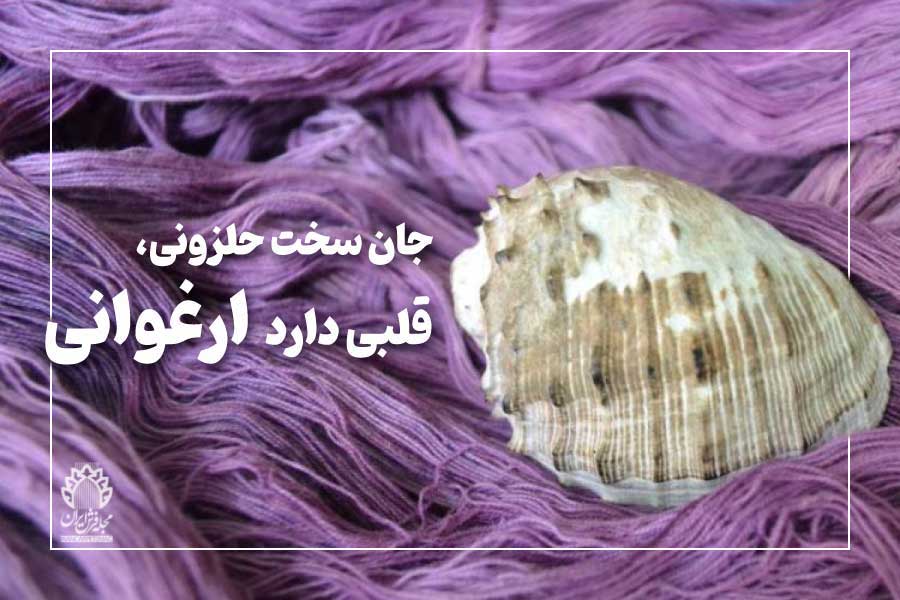
Animal-derived colorants include cochineal insects and spiny marine snails. In antiquity, two remarkable shades of purple were made from Mediterranean sea snails: red-purple and blue-purple.
The Roman mythographer Julius Pollux wrote in the second century CE that purple was first discovered by the philosopher Heracles—or, more accurately, by his dog, whose mouth turned purple after it chewed on snails along the shore at Tyre. According to John Malalas, this took place during the reign of the legendary Phoenix of Tyre, ancestor of the Phoenicians.
In the past, natural purple pigments were often difficult to obtain, and makers kept the details of their production secret. Tyrian purple is a pigment derived from the mucus of several species of Murex snail. The Phoenicians began producing Tyrian purple for use as a textile dye as early as 1200 BCE, and the Greeks and Romans continued production until the fall of Constantinople in 1453 CE. The pigment was expensive to produce, and its manufacture was complex. Items dyed with it became associated with power and wealth. The colours of textiles from this period offer insight into social and cultural relations in ancient societies, as well as technological achievements, fashion, social hierarchy, agriculture, and trade connections.
Tyrian purple may first have been used by the ancient Phoenicians in 1570 BCE. It has been suggested that the name Phoenicia itself means “land of purple.” The colour was highly prized in antiquity because it did not readily fade; instead, it grew brighter when exposed to air and sunlight. It came in various shades, the most valuable of which was a deep purple described as “black-tinted clotted blood.”
Because the dye was so difficult to make, Tyrian purple was expensive. The fourth-century BCE historian Theopompus wrote that in Asia Minor, “the purple dye was worth its weight in silver at Colophon.” This cost meant that purple-dyed textiles became symbols of rank and status, and their use was restricted by sumptuary laws. Rome’s highest-ranking magistrates wore a toga praetexta, a white toga with a border of Tyrian purple. The more splendid toga picta, solid Tyrian purple with a gold border, was worn by generals celebrating a Roman triumph.
By the fourth century CE, Roman sumptuary laws had become so restrictive that only the Roman emperor was permitted to wear Tyrian purple. As a result, “purple” sometimes came to signify high office—for example, the phrase “to assume the purple” meant “to become emperor.” The production of Tyrian purple was strictly controlled in the later Byzantine Empire. Later, in the ninth century, a child born to a reigning emperor was said to be porphyrogennetos, or “born in the purple.”
David Jacoby states that “12,000 Murex brandaris snails produce no more than 1.4 grams of pure dye, enough to colour the trim of just one garment.” The dye was collected by harvesting the snails and extracting the hypobranchial gland, located beneath the mollusc’s mantle—a process that required advanced biological knowledge. Murex-based dyeing had to take place close to where the snails were found, since the freshness of the material greatly affected the results. The colours emerged through a lengthy process of biochemical, enzymatic, and photochemical reactions, involving reduction and oxidation processes that could take several days. In his History of Animals, Aristotle described the shells from which Tyrian purple was obtained, as well as the extraction of the tissue that produced the dye. The best season to collect these snails was after the Dog Star had risen, or before spring.
Purple is an organic compound containing bromine, an element in a group of compounds often found in algae and some other marine animals, but rarely in land animals. Unlike purple dye, the colour produced by algae is a less expensive imitation, generally made using materials cheaper than those used to produce marine-snail dyes.
Sea snails of the family Muricidae—particularly the spiny snails of the genus Murex—contain dye-producing substances. The principal chemical compound is 6,6′-dibromoindigo (C16H8Br2N2O2), a derivative of indigo, as shown below:
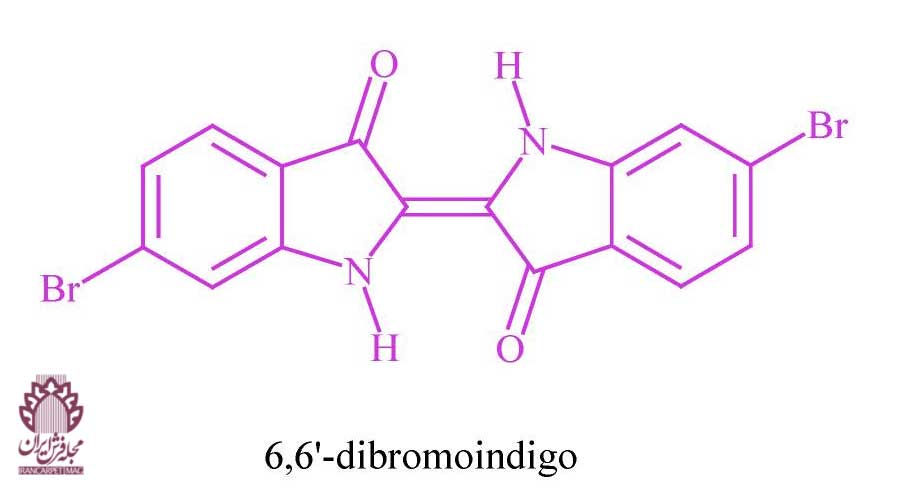
The range of shades in Tyrian purple from different snails relates to the presence of indigo (blue) or 6-bromoindigo (purple), in addition to the red pigment 6,6′-dibromoindigo. Subtle variations in colour can be produced through debromination, exposure to light, or heat treatment.
The shell of an adult Bolinus brandaris can reach approximately 60 to 90 millimetres in length. The shell is usually golden brown, with a very long siphonal canal and a rounded, spiralled body with a low spire. A dark row of spines runs along the back, marking the end of each growth stage.
The final purple colour is determined by chromatography and can be identified through HPLC analysis, which measures indigotin (IND) and indirubin (INR). These two compounds are found in plant sources such as woad (Isatis tinctoria L.) and the indigo plant (Indigofera tinctoria L.), as well as in several species of sea snails.
Types of Snail
Purple dye is obtained from the sea snail Hexaplex trunculus, formerly known as Murex trunculus. Before exposure to light, the pigment is indigo blue. Many other species worldwide in the family Muricidae—for example, Plicopurpura pansa from the tropical eastern Pacific and Plicopurpura patula from the Caribbean region of the western Atlantic—can also produce a similar substance, which turns into a lasting purple when exposed to sunlight.
This snail has been found in fossils dating to the Pliocene and Quaternary periods (between 3.6 and 0.012 million years ago), as well as in fossil shells in Morocco, Italy, and Spain. This marine snail is historically significant because its hypobranchial gland secretes mucus used to create an indigo-blue-purple dye. Ancient Mediterranean cultures, including the Minoans, Canaanites/Phoenicians, Hebrews, and Classical Greeks, obtained dyes from snails. One of the dye’s principal chemical compounds, red dibromo-indigotin, is a major component of Tyrian purple, or blue-purple/turquoise (tekhelet). This species lives in shallow waters off Spain, Portugal, Morocco, the Canary Islands, Africa, and elsewhere.
The dog whelk (Nucella lapillus), from the North Atlantic, can also be used to produce red-purple and purple dyes.
Bolinus brandaris (also called Murex brandaris and Haustellum brandaris) is commonly known as the purple dye-murex or spiny dye-murex. It is a medium-sized predatory sea snail, an edible marine gastropod in the family Muricidae, also known as the murex or rock snails. The species is known from the fossil record of the Pliocene (age range: 3.6 to 2.588 million years ago). Fossil shells of this species have been found in Cyprus, Spain, and Italy. In antiquity, the Phoenicians used it to extract the natural reddish-purple dye known as imperial Tyrian purple. In ancient times, extracting this dye required delicate and considerable labour, involving tens of thousands of snails, and the resulting colour was therefore highly valuable.
This snail lives in the central and western Mediterranean, and has also been found only along coral coasts in the Indian Ocean and South China Sea. Since ancient times, it has been known as a source of purple dye and as a popular food under various names, including sconciglio, derived from the word scungilli. In Spain, particularly along the Mediterranean coast and the Gulf of Cádiz, it is called cañaílla and is prized as food. These species live on rocks in shallow water. Like many other species in the family Muricidae, they can produce a secretion that is milky and colourless when fresh but becomes a strong, permanent colour when exposed to air.
Sea snails of the banded dye-murex species Hexaplex trunculus have also been used to produce blue-purple or indigo blue dye. In both cases, the molluscs (snails) secrete the colour in the mucus of their hypobranchial glands.
Murex, Hexaplex trunculus, Muricidae, and Neogastropoda are associated with purple dye.
Shaheen Nemati Dehkordi Handwoven Carpet Specialist
* Colophon (Greek: Κολοφών) was a city in ancient Greece.
* Bromine is a halogen element. At room temperature, it is a volatile, red liquid with a pungent odour and is reactive with chlorine and iodine. Bromine is highly soluble in water or carbon disulfide, producing a red solution. Bromothymol blue is used to make royal purple dyes.
* The Dog Star, Sirius, is the brightest star in the night sky. It is known in Europe as Sirius and lies in the constellation Canis Major; for this reason, it is also called the Dog Star in English. Its annual setting occurs in mid-June (before sunset), and after about two months out of sight, it rises annually in mid-August (before sunrise).
* The Quaternary is a division of geological time at the end of the Cenozoic Era. It began around 2.5 million years ago and continues to the present. During this period, the mountains of northern Europe, Canada, and a large part of North America were covered in ice. The Quaternary is characterised by the spread of elephants, camels, and other modern mammals, which had also existed in the Pliocene. The Quaternary is divided into two periods: the Pleistocene (from around 2 million to 12,000 years ago) and the Holocene (from around 12,000 years ago to the present).