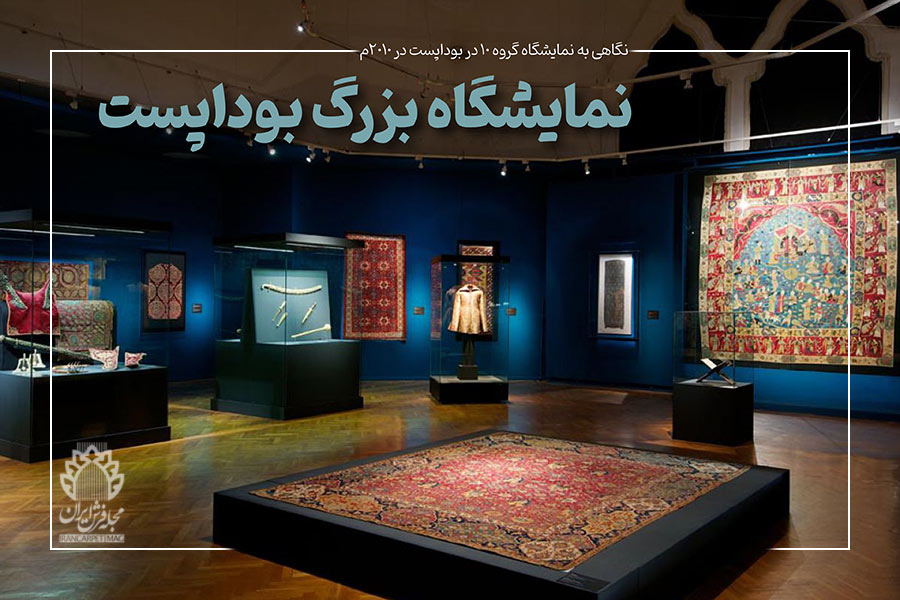
The Great Budapest Exhibition
 Medieval Budapest, woodcut from the Nuremberg Chronicle
In 2007, a group of Hungarian carpet and textile collectors who called themselves the “Ten” came together with the aim of reintroducing Oriental carpets to the people of Hungary. Although Hungarians have a long history of familiarity with Oriental carpets, the period of Communist rule in the country had, in practice, removed these carpets from people’s homes, and few families invested in buying one. The group held exhibitions in two small Hungarian towns in 2007 and 2008, but it was in June 2010 that they presented their largest exhibition of carpets at the Jewish Museum of Budapest. It was opened by Hungary’s culture minister at the time, Gábor Görgey, an admirer of Oriental carpets who passed away this April. The exhibition featured 35 carpets from the collections of Hungarian collectors around the world. Here, we take a closer look at several of them.

This carpet was woven in Kula in the 17th century and belongs to the collection of de Unger. Edmund de Unger was a celebrated Hungarian collector who lived in London. To learn more about de Unger and his collection, see “A Look at Pazyryk: The World’s First International Carpet Magazine.”

Another remarkable work in the exhibition is this 19th-century Isfahan carpet. Its owner, a Hungarian who lives in New York, has chosen to remain anonymous. Interestingly, visitors to the exhibition found the carpet reminiscent of a novel written by Gábor Görgey, Hungary’s culture minister.
Following an Isfahan hunting-scene carpet, Görgey tells the turbulent story of a Jewish family in Hungary from 1940 to 1956, against the backdrop of the Second World War. The novel, titled “The Hunting Carpet,” was warmly received by readers and has been reprinted seven times since its first publication in 1988. We will write about the novel in a future article.

Another carpet presented in the exhibition comes from a Hungarian collector living in Transylvania. Although Transylvania is now part of Romania, it was formerly part of Hungary. To learn more about Transylvanian carpets, see “Carpets from the Land of Dracula.”

As noted, the exhibition brought together a large number of carpets from private collections in Hungary and abroad, and was, in essence, a tribute to the passion of Hungary’s carpet enthusiasts. Denis Sandor, one of the founders of the Ten, says their wish is for Hungary to once again become a lively hub for carpet lovers. He adds that Budapest has been a city of firsts in the history of Oriental carpets: the world’s first carpet enthusiasts’ association was founded there in 1923, and the Budapest Museum of Applied Arts was the first major museum to hold a single-theme exhibition of Oriental carpets, presenting 352 Ottoman carpets in 1914.
Denis Sandor believes that the Hungarian people’s connection with carpets can be traced to their nomadic origins on the Eurasian steppes, where they covered the floors of their yurts with carpets. In explaining Hungary’s enthusiasm for carpets, Sandor asks why other European countries that were under Ottoman rule for long periods—such as Greece or Serbia—never developed the same passion for carpets as Hungary. His answer is that our connection with carpets predates the Ottoman era.

This carpet, presented at the Budapest exhibition, was woven in Hereke, Turkey, for the 2,500th anniversary celebrations of the Persian Empire in 1971, as a gift for Mohammad Reza Shah Pahlavi. One marker of its identity is the peacock motif, a symbol of the Pahlavi monarchy. A lion motif is woven into the border as well.
Compiled by Dr. Davoud Shadloo Faculty member, Carpet Department, Shiraz University of Arts
Photo Album (2)
Related Reading
All Journal & Blog Research Articles
Symbolism of the Neyriz Tree Carpet
Among researchers, Neyriz tree carpets are known as “three-trunk” carpets, since the tree’s trunk is formed from three sections, sometimes aligned uniformly and sometimes arranged unevenly. Read more about this carpet in this article.