The Forgotten Nazi Carpet
Few people around the world know how prominent a role carpets have played in German history. Adolf Hitler and the Nazi commanders were avid collectors of gold, jewellery, and works of art. Today, this is understood as part of what is known as “Nazi looting”: the systematic theft of artworks from European countries by the Nazis during the Third Reich. These acts of plunder took place from 1933 until the end of the Second World War, carried out in particular by military units known as the Kunstschutz. Alongside the theft of gold, silver, and foreign currency, cultural property was also looted on a vast scale, including paintings, ceramics, glass, manuscripts, and textiles. After the end of the Second World War and the fall of the Nazi Party, many of these works were scattered, and some disappeared. To this day, the German government and museums have been unable to bring a large proportion of them under proper control. Heritage-protection officials have made extensive efforts to recover these objects, but many remain missing. International efforts to identify Nazi looters and return stolen property to the countries or families from whom it was taken have largely come to nothing. Among the works once owned by Nazi Party members whose whereabouts are known today are several carpets, one of which is far better known than the rest.
Several famous carpets figure in German history, including a Sultanabad carpet that was laid in the library at Carinhall, the country estate of Reichsmarschall Hermann Göring, one of the most powerful and influential members of the Nazi Party. The carpet’s fate is as strange as its owner’s. After the end of the Second World War, Göring was tried at Nuremberg and sentenced to death. In 1946, before his execution could be carried out, he took his own life in prison by breaking a cyanide capsule he had hidden in his mouth.
The Sultanabad carpet first belonged to Göring. Then, in several photographs published in 1987, it can be seen in the apartment of Erich Honecker, leader of the Socialist Unity Party of Germany, beneath the feet of Honecker and several prominent Bavarian politicians, including Edmund Stoiber and Franz Josef Strauss. In other words, the carpet had made its way from the hunting estate of one of the most powerful Nazi leaders to the apartment of an anti-Nazi communist.
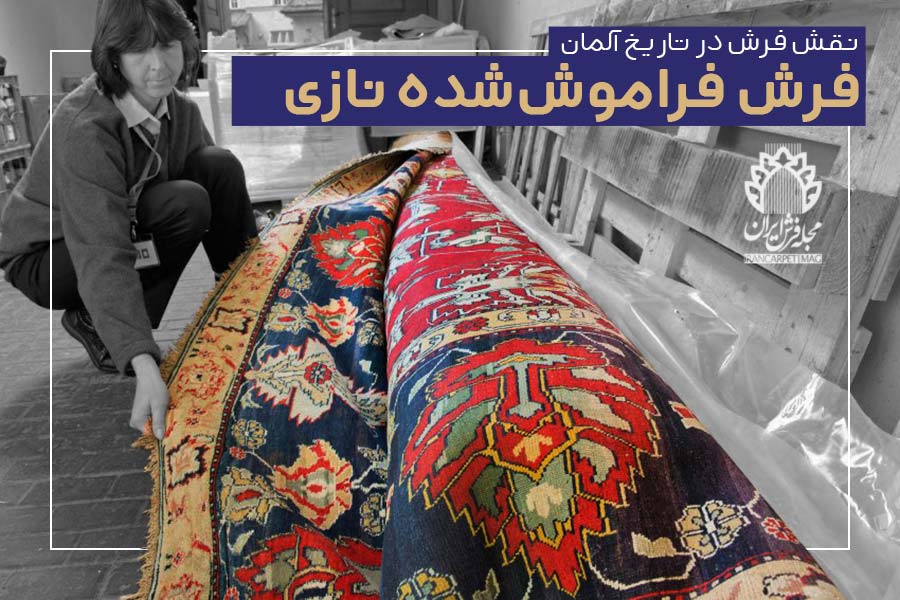
Today, the carpet lies rolled up and forgotten in the storeroom of Munich’s Schack Museum. Sometimes, forgetting is part of a strategy. No one wants to walk on a carpet that Hitler and Göring once walked upon. German media are also sensitive to any use by the German government of objects acquired through Nazi looting. Just a few years ago, for instance, Angela Merkel discovered that a French tapestry hanging in her office had once belonged to Göring. Outraged, she left her office until the tapestry was removed. This response may not seem entirely logical, but for some Germans, confronting and making use of the Nazi legacy—even when it consists of an Iranian or French carpet—is deeply unwelcome. The Schack Museum, for its part, has said it cannot sell a carpet so closely bound up with history. A few years ago, for example, an anonymous American buyer came to Germany to purchase it and left empty-handed. Now the forgotten Sultanabad carpet is wrapped in thick plastic, stored on wooden boards, and waiting for its own resurrection.
Compiled by Dr. Davood Shadloo Faculty member, Department of Carpet, Shiraz University of Art
Photo Album (2)
Related Reading
All Journal & Blog Research Articles
Symbolism of the Neyriz Tree Carpet
Among researchers, Neyriz tree carpets are known as “three-trunk” carpets, since the tree’s trunk is formed from three sections, sometimes aligned uniformly and sometimes arranged unevenly. Read more about this carpet in this article.