Lotto Carpets: Carpets Named After an Artist

The 16th and 17th centuries are known as the “Golden Age of Carpet Weaving.” Estimates based on trade records, dowries, and estate inventories suggest that hundreds of thousands of carpets were produced and traded during this period. Yet only around 2,000 to 3,000 carpets and fragments from that era survive today.
 Self-portrait of Lorenzo Lotto
Many of these masterpieces were incorporated into paintings by Renaissance artists; without those depictions, they would have been lost forever over time. Much of what we know today about a distinctive group of antique Anatolian carpets is thanks to the Italian artist Lorenzo Lotto (1480–1556/7). This group came to be known as “Lotto carpets”; were it not for Lotto’s paintings, they might have vanished from history.
Sixteenth-Century Anatolian Carpets
In the 16th century, carpet weaving reached its height, both in the number of carpets produced and in the quality of their designs. Carpets were commissioned by the court and wealthy nobles, and prized as diplomatic gifts. Ottoman carpets were also regarded in Italy and elsewhere in Europe as signs of wealth and status.
Lorenzo Lotto was a Venetian-trained artist, known for his realism and use of saturated colors. The carpets depicted by Lotto are distinguished by repeating patterns of simple and intricate geometric motifs. They typically feature yellow or cream designs on a deep red ground. The original carpets are believed to have been made in an area along Anatolia’s Aegean coast.
Export Carpets versus Domestic Carpets
Lotto carpets are not of the type found at the Ottoman court. Carpets intended for use at the imperial Ottoman court were generally medallion designs with floral motifs, while export carpets commonly included small rugs. In Turkey, carpets woven for domestic use were placed on the floor. In Europe, however, many of these carpets were spread over tables, as depicted in Lotto’s paintings.
Since Italy was a major destination for exports, Lorenzo Lotto may have encountered geometric export carpets. The borders of Lotto carpets appear to be decorated with Kufic script, but in fact they do not contain legible writing. Rather, the decoration is an ornamental design created to resemble calligraphy.
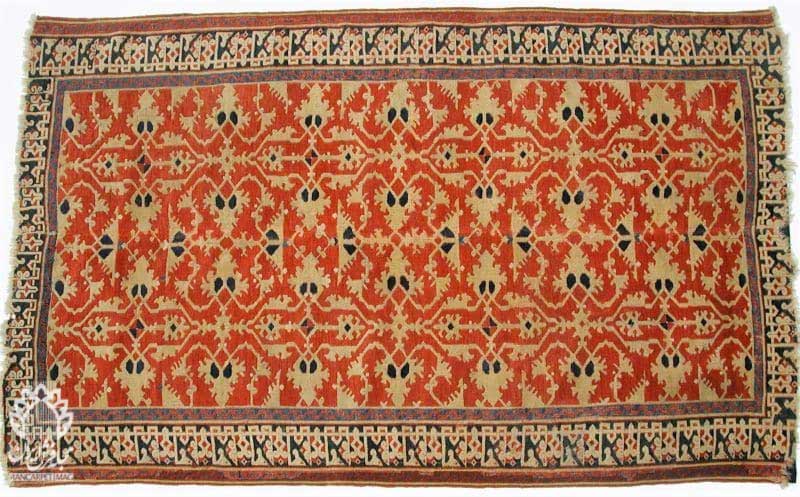 A “Lotto” carpet at the Metropolitan Museum of Art, with ornament resembling Kufic script
Lotto Carpets and Lotto’s Paintings
The first Lotto carpets appeared in paintings around 1516, although their design is thought to be much older. This group of carpets seems to have disappeared from paintings almost as quickly as it appeared, in the late 17th century. Thanks to the efforts of private collectors, a small number of these carpets survive. In most cases, however, the only record we have of their beautiful designs is in paintings.
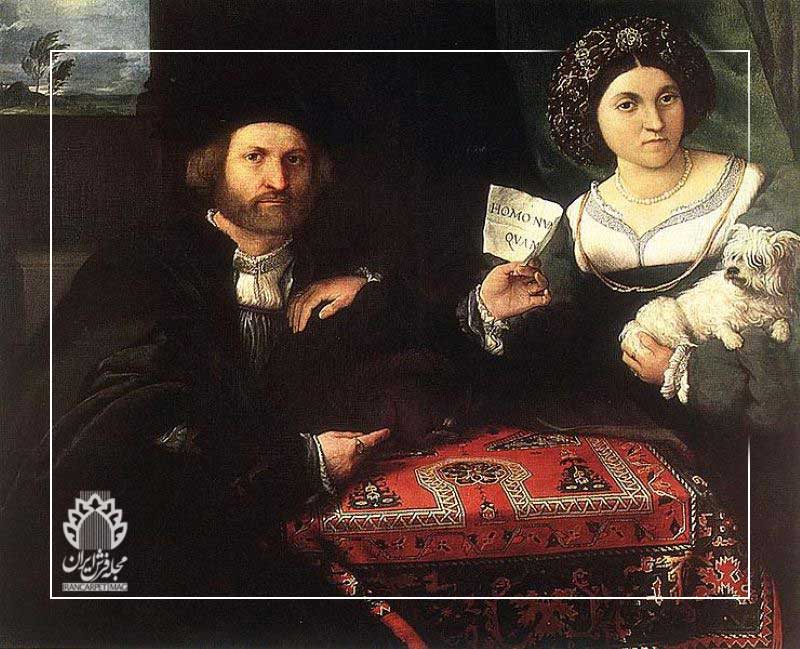 Lorenzo Lotto’s painting "Husband and Wife"
The Metropolitan Museum of Art has two Lotto carpets in its collection. One bears the coats of arms of the Centurione and Doria families, suggesting that it may have been commissioned. London’s Victoria and Albert Museum also holds a well-preserved Lotto carpet. The Museum of Turkish and Islamic Arts in Istanbul has a unique 17th-century Lotto carpet with rose motifs and cloud bands, characteristic of Ushak carpets. Apart from these, only two or three other examples exist in the world.
Among the finest examples are Lotto carpets depicted in the altarpiece he created for the Church of Santi Giovanni e Paolo in Venice. They can be seen in Lotto’s paintings Husband and Wife (1523), Portrait of Giovanni della Volta with His Wife and Children (1547), and The Alms of Saint Anthony (1542).
Lotto was not the first artist to depict these carpets in his paintings. Records indicate that he owned more than one of them during his lifetime. However, we do not know whether any of the carpets shown in his paintings belonged to him or whether he saw them elsewhere during his travels. Judging by the number of records of these carpet types depicted by Renaissance painters, the pattern was once common among carpets traded at the time.
Scholars classify the carpets found in Renaissance paintings according to their design and style. Many artists depicted a particular pattern or style of carpet, probably because it was a type they commonly encountered.
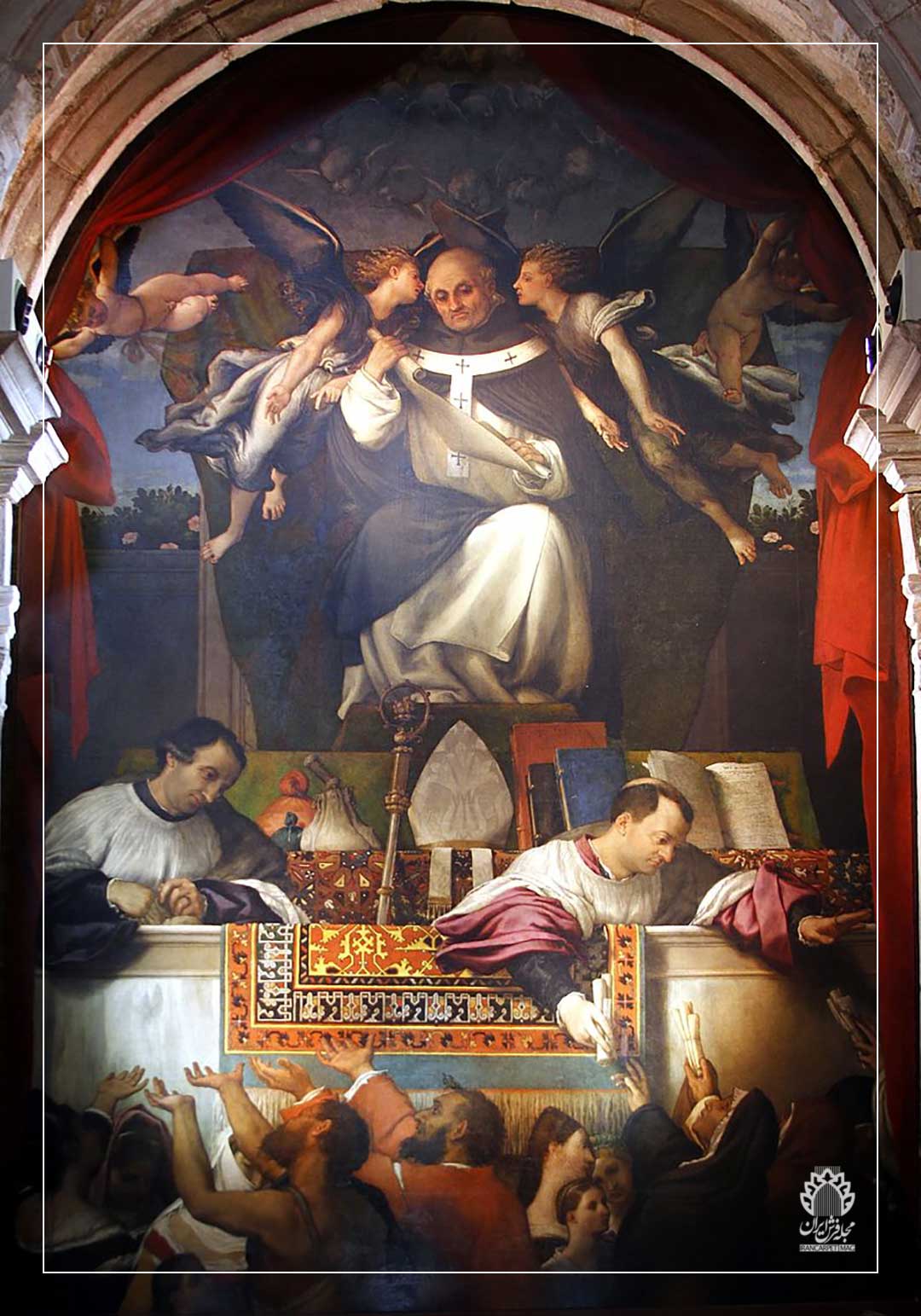 “Saint Antoninus Giving Alms,” Metropolitan Museum of Art
The Enduring Legacy of Lotto Carpets
We know more about Lotto carpets through paintings than from the examples that have survived to our time. They are an important group from a historical perspective: the carpet motif seems to have appeared suddenly and then disappeared just as quickly, and we still have no explanation for why.
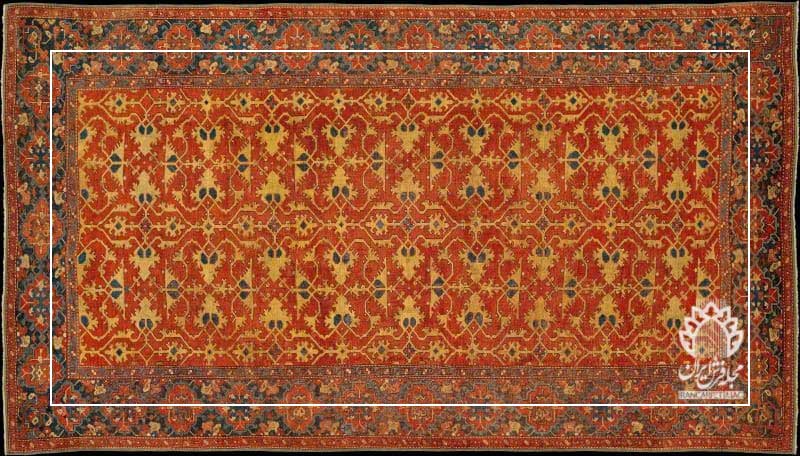 Late 16th-century “Lotto” carpet, Metropolitan Museum of Art
What we do know is that these carpets feature some of the most magnificent color combinations and beautiful motifs in the history of carpet weaving. Finding an authentic Lotto carpet is almost impossible, but they were woven in different periods over the years. Some exquisite reproductions were made in the late 19th century. In many cases, it is difficult to distinguish a copy from an original, since dyeing and weaving techniques have not changed significantly. Even reproductions dating from the late 19th century are considered valuable antiques.
Author: Omri Schwartz Translation: Faezeh Ghaderi