
Patterns & Symbolism
Immortality and Freedom: The Latent Meaning of Iran-shahr’s Rugs
Mar 5, 20222 min readIran Carpet Company
The tree in its general form—as a sign of plant life—is frequently depicted in Iranian rugs. Yet in its more particular form, the tree seems to embody a singular, primordial and eternal motif: at times called Sidrat al-Muntaha, at times Hezār-Tokhmeh (the Thousand-Seeded Tree), Tuba, or Haoma.
The principal design of tree carpets generally consists of one or more trees with abundant branches and foliage. In unidirectional carpets, the motif appears either as a tree or as one set in a vase.
In its general form, the tree motif expresses the longing for verdure and for favourable conditions for cultivation in Iranian carpets. Birds, animals, flowers, leaves, pools and fish spread across the carpet’s surface, creating a joyful garden. It is the age-old wish of Iranians: the Garden of Paradise!
In its particular form, however, the tree conceals other meanings: immortality, freedom, uniqueness, benefit for all, ascent to the heavens and the world beyond. These meanings sometimes intertwine with mythic motifs and symbols, such as the Simurgh, the dragon and winged creatures.
The Iranian understanding of the tree—rooted in the idea of Iran-shahr—has not changed over the ages. The earliest teachings of the Iranians were among the noblest, and that meaning has endured to this day.
There was only one reason to weave designs into rugs: Iranians saw their homes and shelters as one with their homeland. Thus, they wove all their longings and aspirations into rugs, extending them to everyone. In this way, they depicted on their rugs their wish for immortality, ascent to the heavens, and more, so that all might share in it.
The tree has put forth buds, and the nightingales are drunk;
The world is young again, and friends sit down to revel.
 Kashan carpet / circa 1305 Solar Hijri (1926–27)
An excerpt from a poem by Saadi of Shiraz, woven into a Kashan carpet
Circa 1305 Solar Hijri (1926–27)
According to the inscription at the top, this carpet was woven “at the request of Esma'il and Aba Yahudi.”
Abdolhossein Qasemnejad
 Patterns & Symbolism
Inspired by the Borujerdi House in Kashan, a distinguished example of Qajar architecture, this carpet shows how concepts such as plan, spatial organization, and architectural ornament can be reimagined through a carpet’s motifs, composition, and palette.
 Patterns & Symbolism2
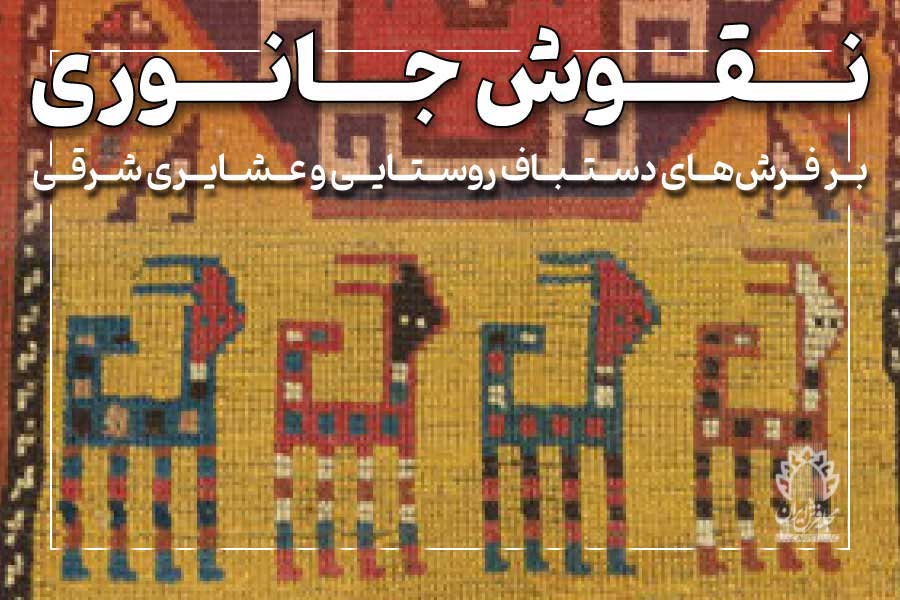
The lives of nomads and villagers have always been closely connected with nature and the animal world. They regarded certain animals as totems and embodiments of hidden qualities, and recorded their images in works of art such as carpets.
 Patterns & Symbolism9
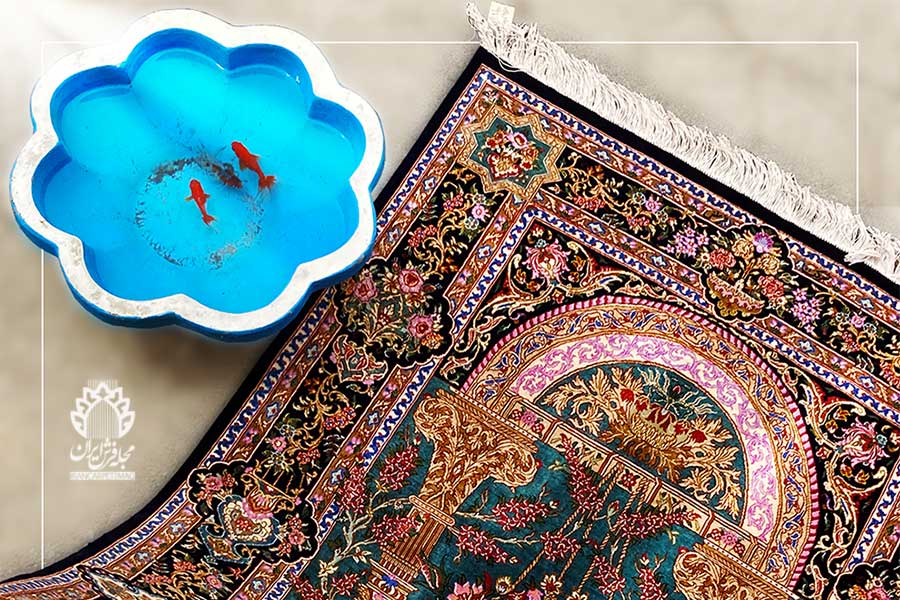
One of the most compelling features of Iranian handwoven carpets is the diversity of their designs and motifs. Beautifully balanced and carefully composed, these designs also carry a range of meanings. The Mehrabi design is one such example, and the subject of this article.