From Mehrab to Mihrab in Iranian Carpets
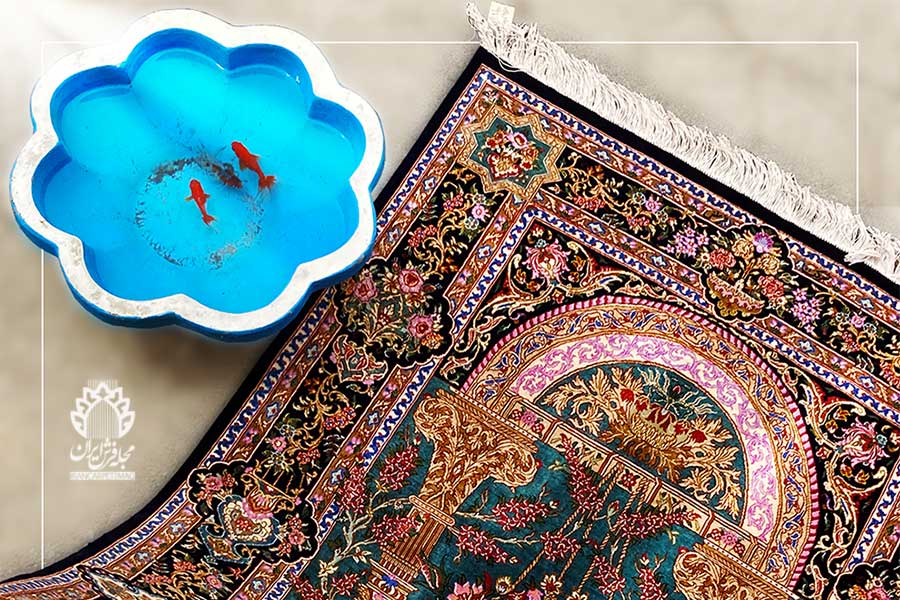
Mehrabi designs, woven in smaller formats for worshippers to use in prayer and therefore also known as prayer rugs, carry symbolic meanings like other customary floor coverings in Iran. As the name suggests—Mehrab–Mihrab—the design is inspired by the mihrab found in religious buildings such as mosques and churches. Accordingly, its defining feature in carpet patterns is often a pair of columns on either side of the field, with a rounded arch above it; these are also common features of mihrabs in religious settings.
In this design, the mihrab arch is placed at one end, with borders arranged around it. There are two interpretations of the word *mehrab*. Sometimes it is written with the letter «ح» and understood to mean a place of battle. From this perspective, a Muslim standing toward the qibla to pray is, in effect, waging war against the ill-intentioned impulses within. The spelling «مهراب», however, is linked to the worship of Mithra, whose followers prayed to him in a dedicated sanctuary.
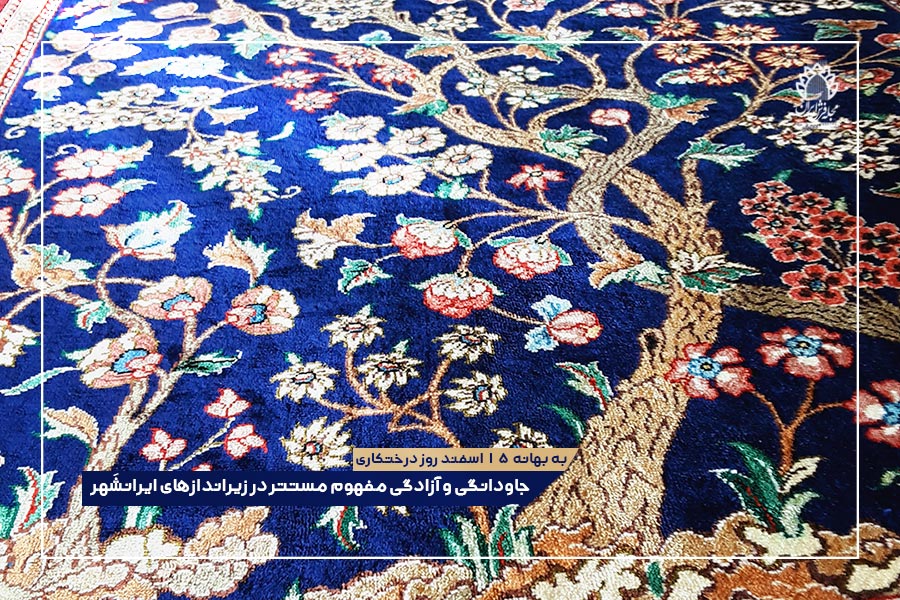
This type of Iranian carpet also features other designs and motifs. Lamps and lanterns: Lamps and lanterns woven into the centre of a carpet signify light, since in the Qur’an God describes Himself as light. In this setting, it is as though a person stands before God and worships Him. Columns: A column motif may suggest a gateway or a place from which to look out, such as a veranda opening toward paradise. Trees and flowers: Trees with dense branches and flowers winding along them evoke a delightful place such as paradise. A flower vase or a solitary tree: If the tree depicted is a cypress, it symbolizes freedom and dignity. The idea is that the worshipper is free, bound by nothing; here alone, they speak with God. If instead a plant is shown growing from a vase at the centre, it represents the Tuba tree, which, according to Islamic tradition, stands in the midst of paradise, each of its branches casting shade over one person. Gate, pavilion, and portal: A gate woven on either side of the carpet’s field represents a portal or an entrance to paradise. Inscriptions: Inscriptions—whether poems on the theme of a blessed destiny, Qur’anic verses, or divine attributes—serve to evoke the hereafter. Animals: Birds and four-legged animals are depicted in mihrab carpets to create a pleasing setting. The use of the «struggle» motif in this group of carpets suggests a conflict between virtuous and ill-intentioned conduct. Its beginning and end may be unknown, as a person is caught between these opposing ways; the focus is on the struggle itself, not its outcome. The speaking or Waqwaq tree: This tree comes from ancient Iranian legends, which tell of trees whose fruit takes the form of human or animal heads, male and female, each speaking in its own language. When such a tree appears at the centre of a mihrab, sometimes with branches growing from the body of a demon or Satan, it alludes to the aspect of Iblis that seeks to ensnare Adam and his descendants and lead them astray. The worshipper must step over and struggle against Iblis and the self.
Some researchers, however, argue that the mihrab or Mehrabi carpet—also known by names such as vase, single-ended, and tree designs—does not necessarily represent an idealized setting shaped by Islamic teachings. Rather, like other Iranian arts, it acquired new meanings aligned with Islamic beliefs after the advent of Islam. From this perspective, the Mehrabi (Mihrab) is an authentic Iranian design whose history predates Islam. In recent decades, designers and weavers have rarely turned to it; in most cases, it has been overshadowed by vase and tree designs or blended with them.
The carpet researcher Toraj Zholeh observes: “The principal reason the Mehrabi design fell out of favour or was eclipsed by vase and tree designs is unclear. In modern times, carpets bearing the design’s defining features have been woven only rarely. The beginnings of this shift may, judging by the oldest surviving examples, date to the Safavid era. Among the design’s defining features, the columns on either side of the field have often been removed or obscured, leaving only the arch above the field—which, in many cases, resembles a broad curtain more than a mihrab arch. In most carpets attributed to this design, a window or portal opening onto nature, or a veranda, appears in front of the mihrab. Some seek to connect this feature with the idea of the mehrab or mihrab, interpreting it as a window opening onto paradise.”
Abdolhossein Qasemnejad Senior Specialist in Handwoven Carpets
Photo Album (9)
Related Reading
All Journal & Blog Patterns & Symbolism
Re-reading an Architectural Narrative in the Warp and Weft of a Carpet
Inspired by the Borujerdi House in Kashan, a distinguished example of Qajar architecture, this carpet shows how concepts such as plan, spatial organization, and architectural ornament can be reimagined through a carpet’s motifs, composition, and palette.