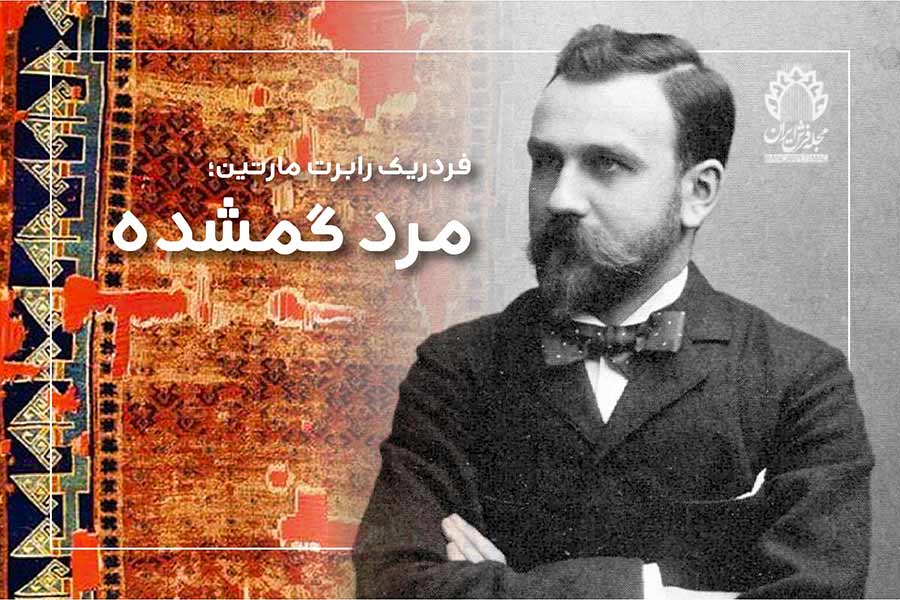
Frederick Robert Martin: The Lost Man
When the great exhibition of masterpieces of Muhammadan art (before the term “Islamic art” was coined, Europeans used this expression for the art of Islamic lands) opened in Munich in 1910, Frederick Robert Martin was perhaps the most distinguished historian of Islamic art in the West. He had written the highly influential book A History of Oriental Carpets before 1800, which was published more than a century ago and remains one of the foremost reference works on Oriental carpets.
 Frederick Robert Martin
In the decade following the exhibition of masterpieces of Muhammadan art, Martin’s star gradually faded. His popularity ebbed, and he became “a lost man.” Professor Farenheim delivered a comprehensive lecture on Martin in 2017, and it was he who applied the term “lost man” to him. Farenheim emphasizes that, given Martin’s particular qualities, the decline in his popularity may have been as predictable as his rise and sudden fame were unforeseeable.
But how did Martin shine so brightly, only to be so short-lived?
Frederick Robert Martin, a diplomat, researcher, collector, and art dealer, was born on May 8, 1868, in Stockholm, Sweden. At sixteen, he became an assistant at the Stockholm Museum of Ethnography, and at twenty, an assistant at the city’s Museum of Archaeology. At twenty-four, he turned his attention to Islamic art, embarking on extensive journeys to Russia, Iran, the Caucasus, Central Asia, Egypt, and Turkey to collect works of art. But his destiny was shaped in Anatolia, as he approached the age of forty.
In 1905, Martin, then translator at the Swedish Embassy in Constantinople, accompanied Prince Wilhelm, Duke of Södermanland, on a visit to the Ottoman Empire. They had travelled to Konya with the German adviser Julius Lloyd-Hardegg when they came upon the Seljuk Alaeddin Keykubad Mosque. Martin’s attention was suddenly drawn to fragments of carpets lying in a dark corner near the mosque’s famous pulpit. He moved several carpets aside and found among them carpets dating from the 7th century AH. Thus the Seljuk carpets were discovered. Their historical importance lies in the fact that they were the oldest relatively intact carpets to be found before the discovery of the Pazyryk carpet in 1949; experts date them to the period of the Sultanate of Rum. The worshippers and custodians of the Alaeddin Mosque were probably aware of the carpets’ presence and may even have prayed upon them, but perhaps did not know their historical significance. In any case, the record is somewhat unclear. Some say that the carpets were hidden beneath others, or even that Martin had found them earlier but chose to announce the discovery when Prince Wilhelm visited the mosque. For years, Lloyd-Hardegg was even thought to have discovered the carpets; later, however, documentary evidence established that it was Martin who had found them.
Mehmed Ferid Pasha, Grand Vizier of the Ottoman Empire, assigned Lloyd-Hardegg to photograph the carpets, then prepare hand-drawn designs and color them in watercolor. Two years after the carpets were found, in 1907, the German Orientalist and carpet scholar Friedrich Sarre published three of Lloyd-Hardegg’s photographs in an article without permission. Their publication immediately caused a stir in scholarly circles—particularly because Martin was working on A History of Oriental Carpets before 1800, whose most notable section concerned the newly discovered Seljuk carpets. The photographs’ publication threatened the originality of the book’s subject.
 A History of Oriental Carpets before 1800, by Frederick R. Martin
The question is how the photographs came into Sarre’s possession. Evidence suggests that Lloyd-Hardegg sent several photographs to the Berlin Museum without permission from either the Ottoman Empire or Martin. The photographs reached Wilhelm von Bode, director of the Berlin Museum, and passed through him to Sarre, who published them in his article. Thus, although Martin discovered the carpets, Sarre was the first to discuss them in a scholarly publication. In footnote 247 of A History of Oriental Carpets before 1800, Martin responded sharply—and understandably—to the matter, attacking Lloyd-Hardegg and Sarre and calling their conduct unprofessional. In 1909, alongside the republication of Martin’s book, Sarre expressed regret for his actions in a note and apologized to Martin. Apart from this exchange, Sarre had speculated about the carpets’ age and date, based only on photographs and without having seen them in person. Remarkably, his conjectures were entirely in keeping with Martin’s conclusions. This convergence of views led Martin and Sarre to meet at the Munich exhibition of masterpieces of Muhammadan art, despite the strain in their earlier relationship. What passed between them, however, is unknown.
There was probably some rivalry and animosity between Lloyd-Hardegg and Martin. When Martin began excavations in Konya, Lloyd-Hardegg’s studies came to a halt, and the suspension of the excavations also caused him financial difficulties. But the discovery of the carpets turned matters to Lloyd-Hardegg’s advantage. He sent his photographs to von Bode and Sarre, hoping to open the way to a profitable commercial offer. Von Bode sent Lloyd-Hardegg 150 lira to purchase carpets and other objects. In 1907, he himself travelled to Constantinople, ostensibly to consult Ottoman officials about exporting antiquities, though his principal purpose may have been to meet Lloyd-Hardegg. In any event, the hurried publication of the photographs in an article Sarre wrote that same year made the Ottoman government wary of the carpets. Officials intervened, and the sale and purchase of the Seljuk carpets were prohibited. The carpets were later transferred to the Istanbul Museum in 1911 and put on display on March 31, 1930.
All these events led von Bode, who was more than twenty years older than Martin and more experienced in scholarly circles, to attack Martin in a review of A History of Oriental Carpets before 1800, published in October 1908, accusing him of literary and scholarly plagiarism. Although von Bode’s review was not wholly negative and acknowledged the value of Martin’s research, it nonetheless cost Martin some standing among scholars of Islamic art. In 1912, he wrote Persian, Indian and Turkish Miniature Painting and Miniature Painters, from the 8th to the 18th Century; before that, he had also written several important books on Islamic art. His best-known book, however, remains A History of Oriental Carpets before 1800, which has been cited repeatedly and has only grown in value with the passage of time.
 Seljuk carpet, 13th century, Museum of Turkish and Islamic Arts, Turkey
From 1920 until his death, Martin, in Farenheim’s words, suddenly disappears. Perhaps he withdrew into solitude; perhaps he devoted himself to new research; perhaps he was depressed; perhaps… In any case, he died in Cairo on an unspecified day in 1933. His last published book, Seen, Heard and Known: Sketches from Turkey, Russia, Italy and Other Countries, also appeared that year, but is little known. A collection of more than 900 works of art that Martin gathered from around the world is now held at Konstfack, the University of Arts, Crafts and Design in Sweden.
Compiled by Dr. Davoud Shadloo Faculty member, Department of Carpet, Shiraz University of Art
Photo Album (3)
Related Reading
All Journal & Blog Research Articles
Symbolism of the Neyriz Tree Carpet
Among researchers, Neyriz tree carpets are known as “three-trunk” carpets, since the tree’s trunk is formed from three sections, sometimes aligned uniformly and sometimes arranged unevenly. Read more about this carpet in this article.