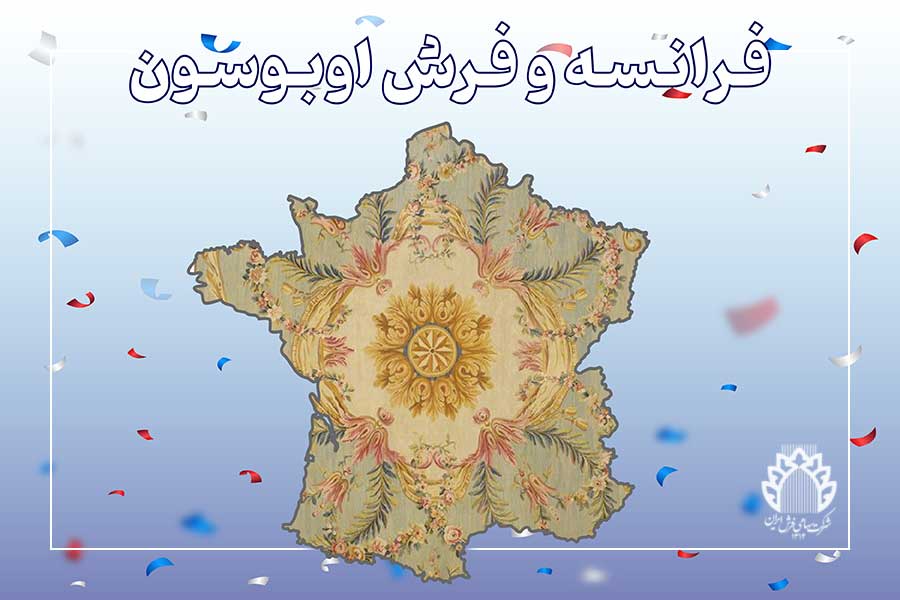
France and Aubusson Carpets
Aubusson is a town on the banks of the Creuse River in central France. It has been renowned for its carpets and tapestries since the fifteenth century. Antique Aubusson carpets, woven using tapestry techniques, are among the most beautiful and luxurious antique floor coverings. The precise beginnings of flat-woven Aubusson carpet production in France are unknown. However, examples featuring Rococo designs have led to the supposition that production began around the mid-eighteenth century, when European tastes shifted away from Oriental carpets in favor of European design. We know that Louis XV, Louis XVI, and Napoleon I all commissioned flat-woven Aubusson carpets—with the latter two ordering them far more frequently than the first.
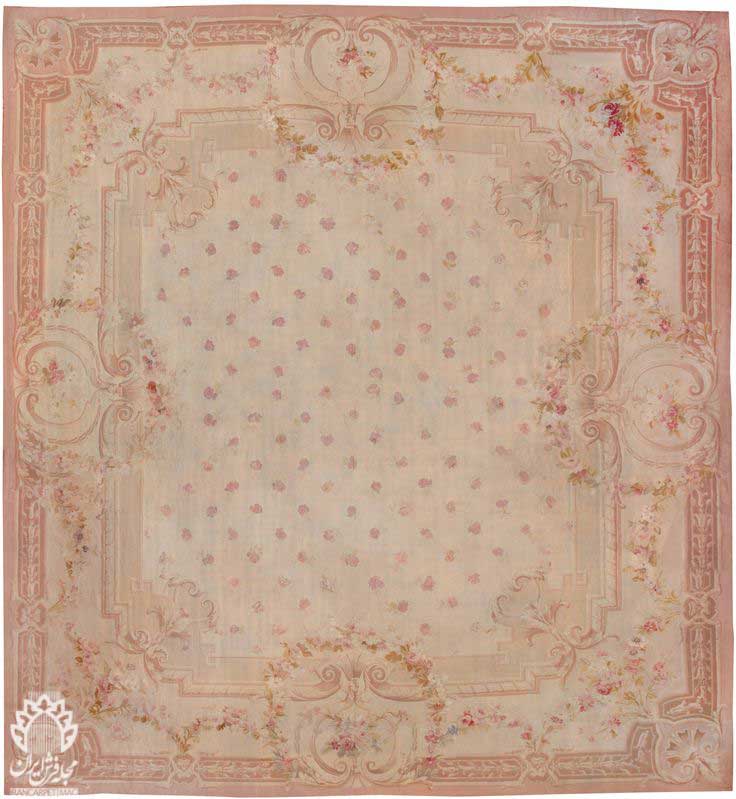
French Aubusson carpets evoke Greco-Roman decorative arts
An inventory from 1786 lists more than one hundred Aubusson carpets at the Palace of Versailles, while an inventory from 1789 describes a great many carpets in all the royal palaces. Many carpets from the region were commissioned by the nobility for their palaces and châteaux. Because Aubusson carpets were simpler to produce, weavers could make carpets for unusually large spaces in less time, while maintaining the quality, refinement, appeal, and aesthetic beauty sought by the ruling class of the time. With their large-scale designs of frames and cartouches suspended from garlands, almost Neoclassical architecture, and gentle palette, Aubusson carpets evoke Greco-Roman decorative arts.
The aristocratic style of Aubusson carpets
Aubusson carpets are rich in history and possess timeless appeal. For decades, antique Aubusson carpets have been prized by leading interior designers as well as consumers. They were often commissioned by the nobility, who could admire them not only as decorative floor coverings but also as magnificent works of art—objects of beauty for all who entered their palaces and châteaux. The ruling class always sought to convey a sense of grandeur; rather than divide a room with several smaller pieces, they preferred to cover the entire floor. For this reason, Aubusson carpets are rarely found in small sizes, and large examples are more abundant than those of almost any other type.
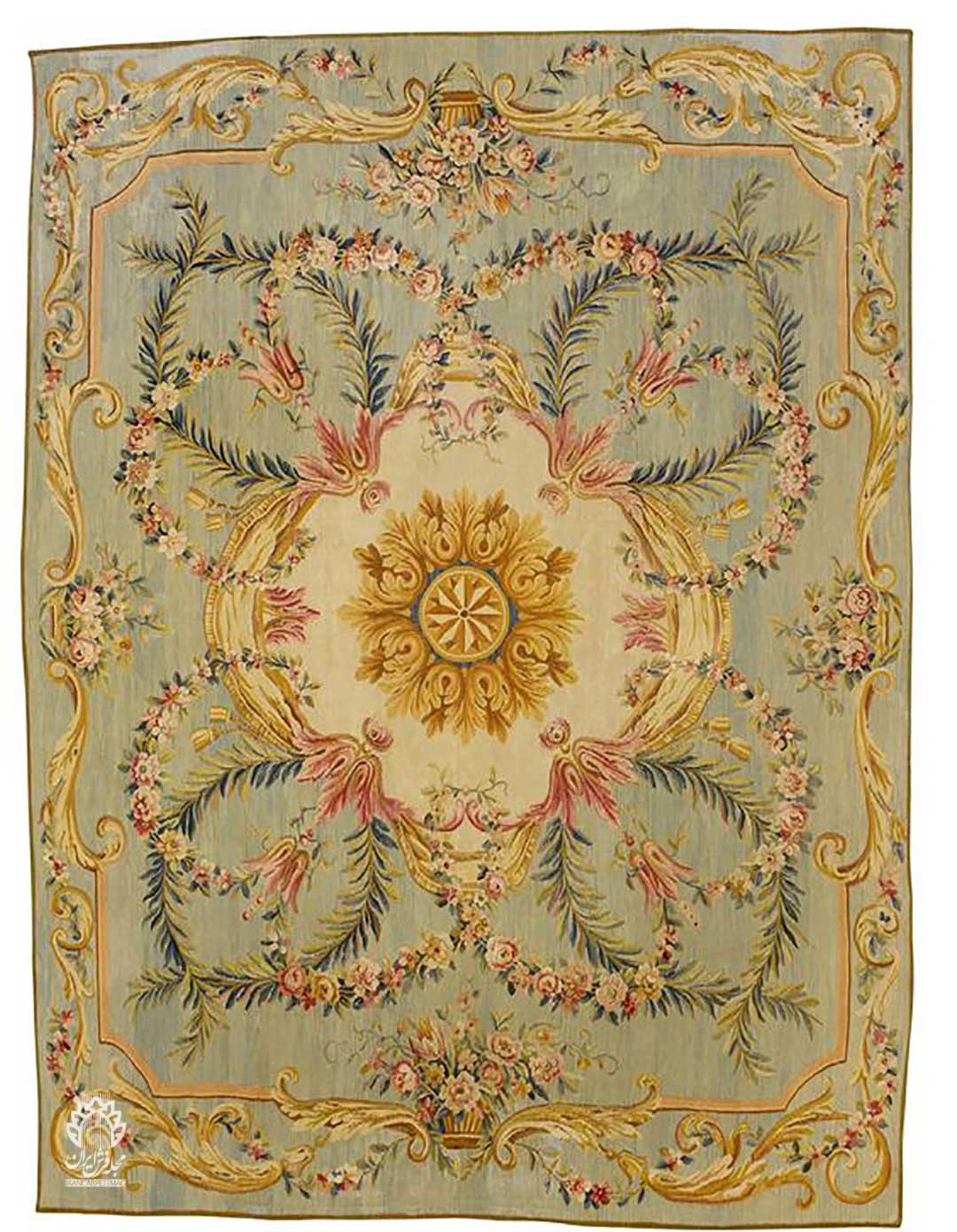
The aristocratic style of Aubusson carpets is unlike that of any other country. Like the most successful carpet-making systems, France’s large weaving workshops were established to serve the country’s leaders and nobility. In keeping with royal tastes, designers painstakingly created fine, flat-woven tapestry carpets that rivalled the sumptuous architecture of Versailles. Drawing on acanthus leaves and bouquets of roses, skilled designers in Aubusson created elegant French carpets that perfectly complemented the Baroque style of the period. The romantic pastel colors, architectural designs, and floral style of Aubusson carpets have continued to appeal to designers and prominent figures in later eras. Coco Chanel, Tory Burch, and the Kennedys have all admired the luxurious Neoclassical style of Aubusson carpets.
Aubusson carpets in postmodern interiors
Although woven decorative floor coverings are often associated with Oriental carpets, they have also been produced in Europe and the Americas for centuries. The most important European examples of this kind were Aubusson carpets and the pile carpets made at the Savonnerie manufactory in the eighteenth century. Until the 1880s, these carpets eclipsed European demand for Oriental carpets. In the twentieth century, however, the balance shifted once again. Though they retained a niche market, Aubusson and Savonnerie carpets, along with their English cousins, Axminster carpets, lived in the shadow of Oriental carpets. Aubusson thus became a defining symbol of traditional European interiors.
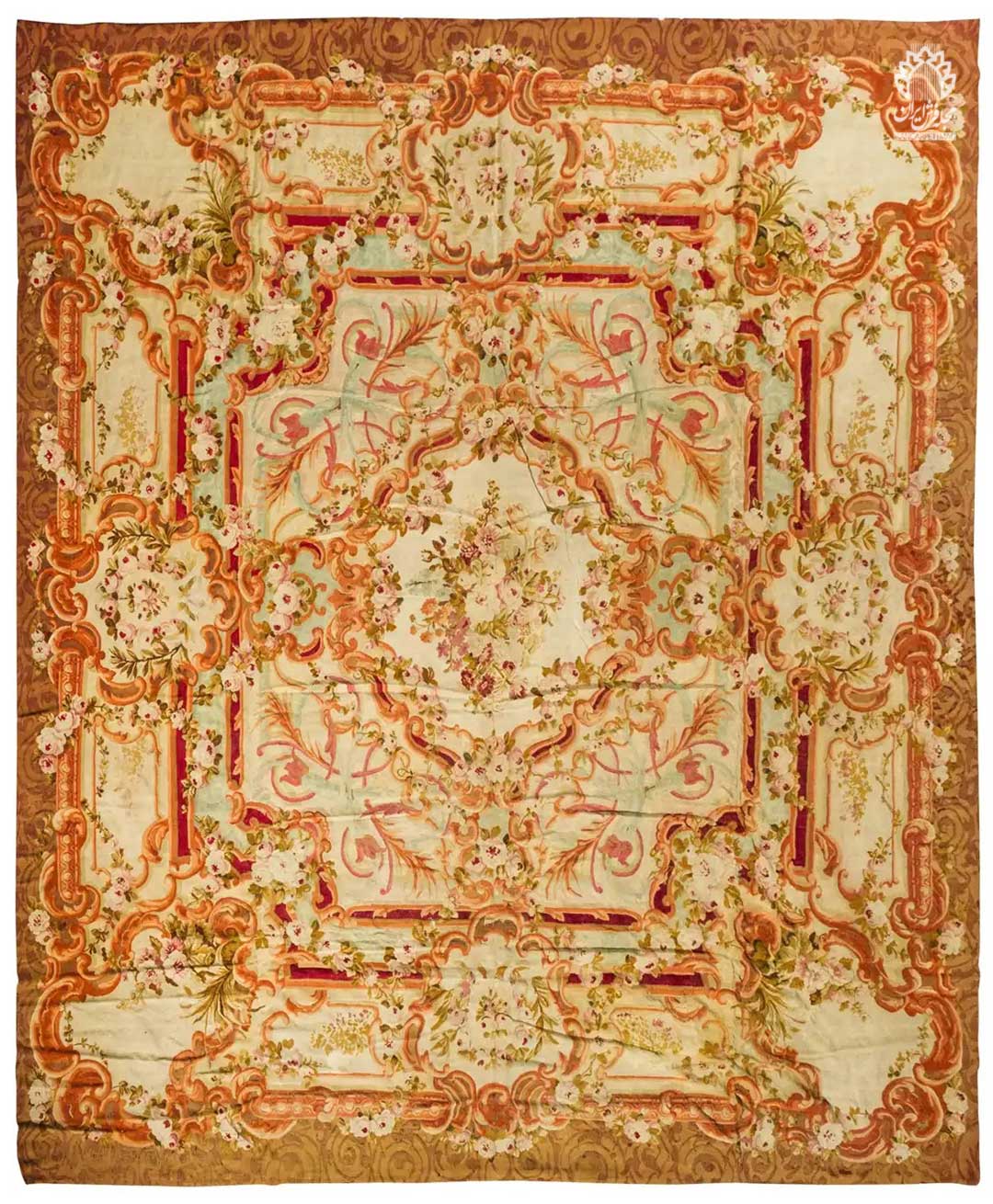
For those who still enjoy the styles of the Louis XV or Louis XVI periods, their Neoclassical successors, the First and Second Empires, or English styles, nothing could define a room more effectively than an Aubusson or Savonnerie carpet. As a result, Aubusson, Savonnerie, and Axminster carpets tend to be associated with conservative, old-fashioned taste.
Yet truly great carpets, like all great works of art, transcend the circumstances that gave rise to them. Although Oriental carpets are products of the thought and way of life of the peoples of the East, they have long been valued as essential elements of Western European interiors. Western owners of Oriental carpets freely pair their antique carpets with Western furniture of every kind, period, and style.
Although we may habitually regard Aubusson and other European carpets as inseparable from certain latent notions of Neoclassical conservatism, Aubusson carpets are in fact remarkably adaptable to a wide range of modern and contemporary settings. This is clear from their colors alone. Aubusson carpets tend toward dominant shades of cream, ivory, or light tan, with darker accents such as deep brown and purple.
Much of their effect comes from the tonal approach cherished by contemporary interior designers. Some Aubusson carpets feature historic, almost architectural designs, with large mouldings, frames, and Baroque cartouches. Yet these features are always softened by a restrained, neutral palette and the use of open, quiet, undecorated spaces.
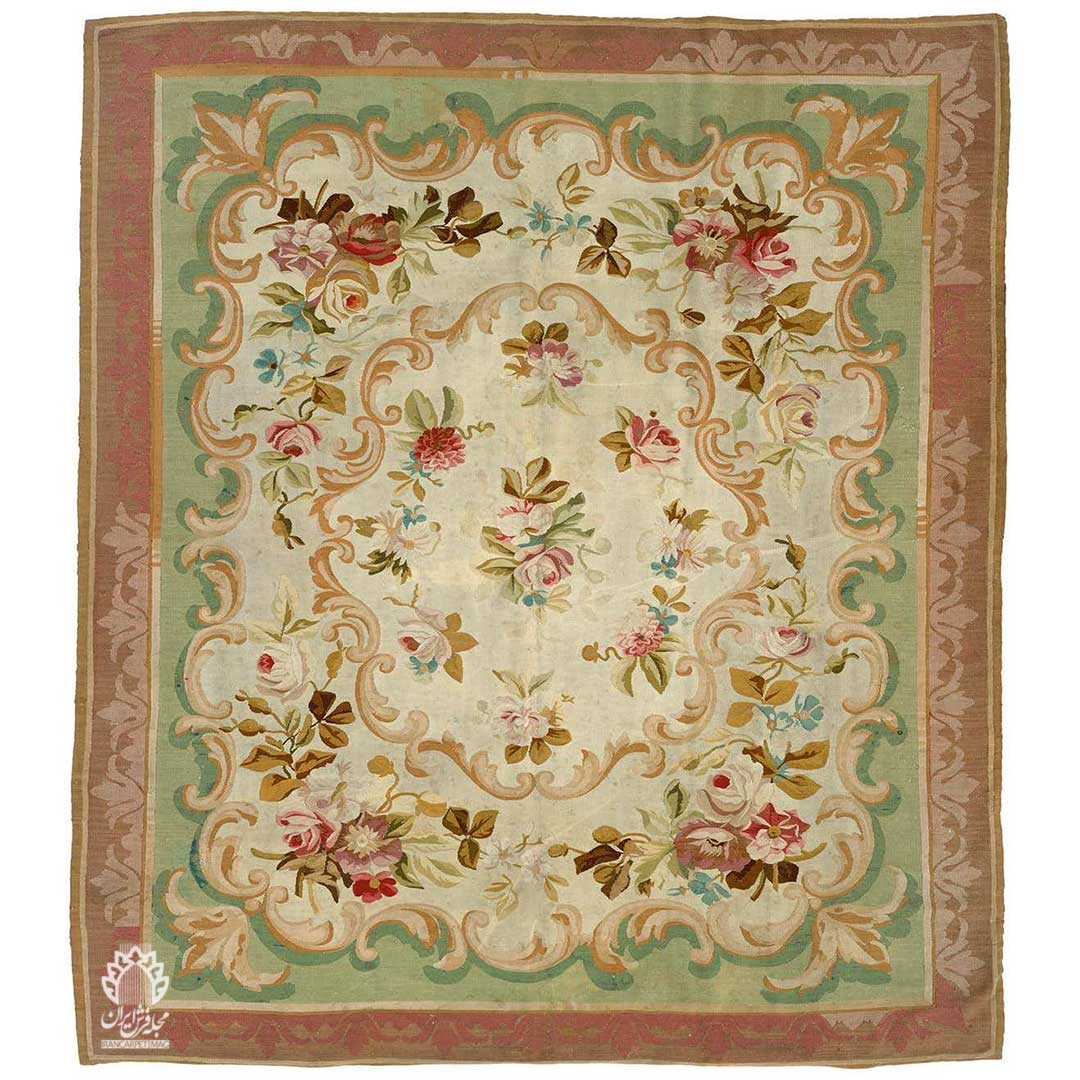
Perhaps it is the graphic flourish of the scrolls and vines in Aubusson carpets that seems old-fashioned by today’s standards. Or perhaps the naturalistic flowers and foliage appear too lifelike for a modern eye focused on geometric abstraction. Yet modern architecture and interior design have arrived at a postmodern aesthetic that reaches beyond such restrictive categories. Classicism has been deconstructed and reconsidered to reveal new potential and possibilities.
Classical works or elements can be reintroduced into modern spaces. Aubusson carpets no longer need Louis XVI or Empire furniture as companions. Instead, it is exciting to discover how effectively these carpets can complement a range of modern and contemporary styles from the twentieth century, particularly those that use curvilinear design elements. The results are fresh and surprising, once again showing what is possible when we simply let go of the burden of familiar opinions and preconceptions.
Faezeh Ghaderi Senior Handwoven Carpet Specialist
Related Reading
All Journal & Blog Research Articles
Symbolism of the Neyriz Tree Carpet
Among researchers, Neyriz tree carpets are known as “three-trunk” carpets, since the tree’s trunk is formed from three sections, sometimes aligned uniformly and sometimes arranged unevenly. Read more about this carpet in this article.