Eastern Carpets in the Renaissance
Eastern carpets were used in Western Europe in ways and contexts quite different from those of the Islamic world, and their original cultural context was never fully understood. The Renaissance understanding of Eastern carpets can be described in three principal ways:
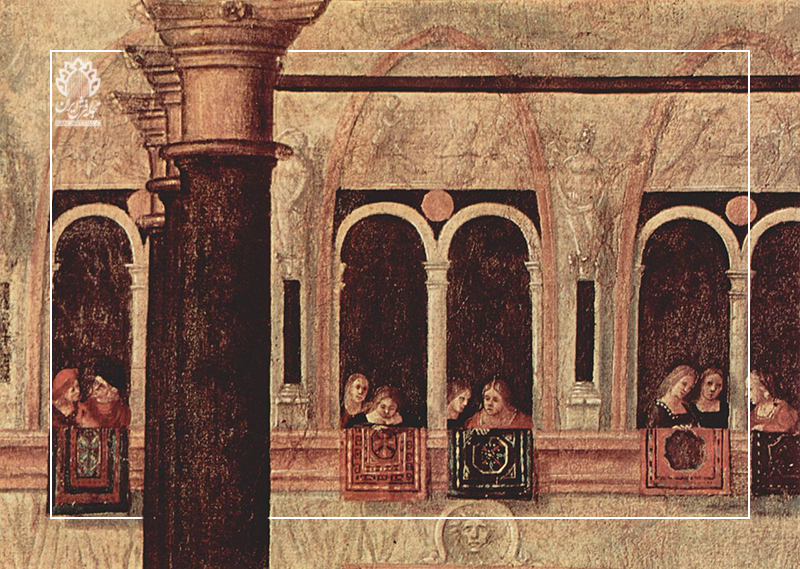 Carpets displayed from windows during processions in Venice. Vittore Carpaccio, 1507
1. Because they were rare, precious, and exotic, Eastern carpets were depicted as settings for saints and religious scenes. Later, powerful political figures appropriated religious iconography to affirm their status and authority.
2. Eastern carpets were generally regarded as rare commodities and luxurious decorative objects. From the mid-sixteenth century onward, their iconographic context sometimes expanded to include themes of extravagance or vanity.
3. As relations between the Islamic world and Europe took on an increasingly violent character, Eastern carpets were sometimes used as symbols of Christian self-assertion.
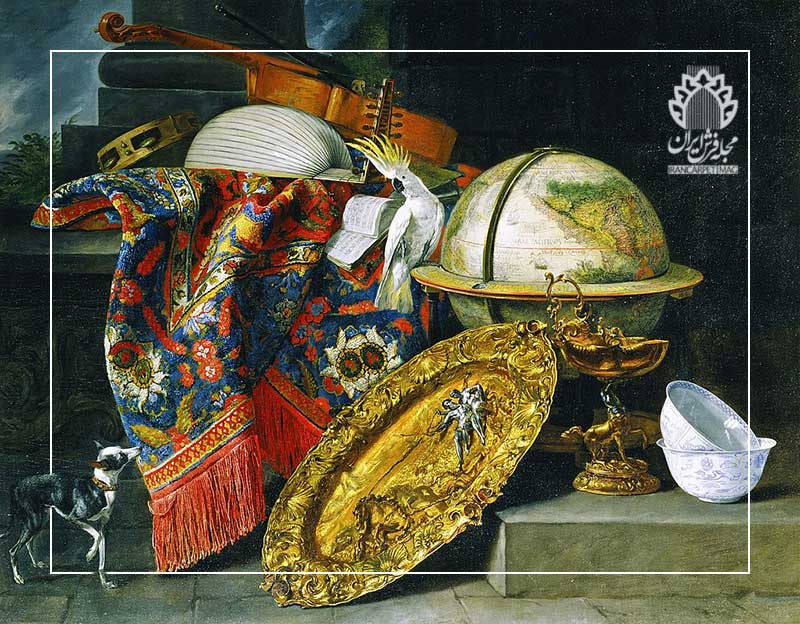 Pieter Boel, circa 1658
We do not know exactly what Renaissance artists thought about the Eastern carpets they depicted. We do know, however, that on special occasions Venice’s Piazza San Marco was adorned with carpets hung from the windows of the surrounding palaces and houses. The carpets served as decorative frames, lending greater prominence to the important event taking place. Like the fictitious pseudo-Kufic inscriptions in contemporary paintings, European artists borrowed something from another culture that they fundamentally did not understand.
A very common genre in the Dutch Golden Age and Flemish Baroque[1] was the group portrait, depicting people enjoying themselves—usually drinking, seated, and often playing music. In these scenes, Eastern carpets frequently cover and decorate tables or are spread over furniture. In this way, they either emphasize the wealth and prestige of those portrayed or add a sense of extravagance and excess to certain scenes.
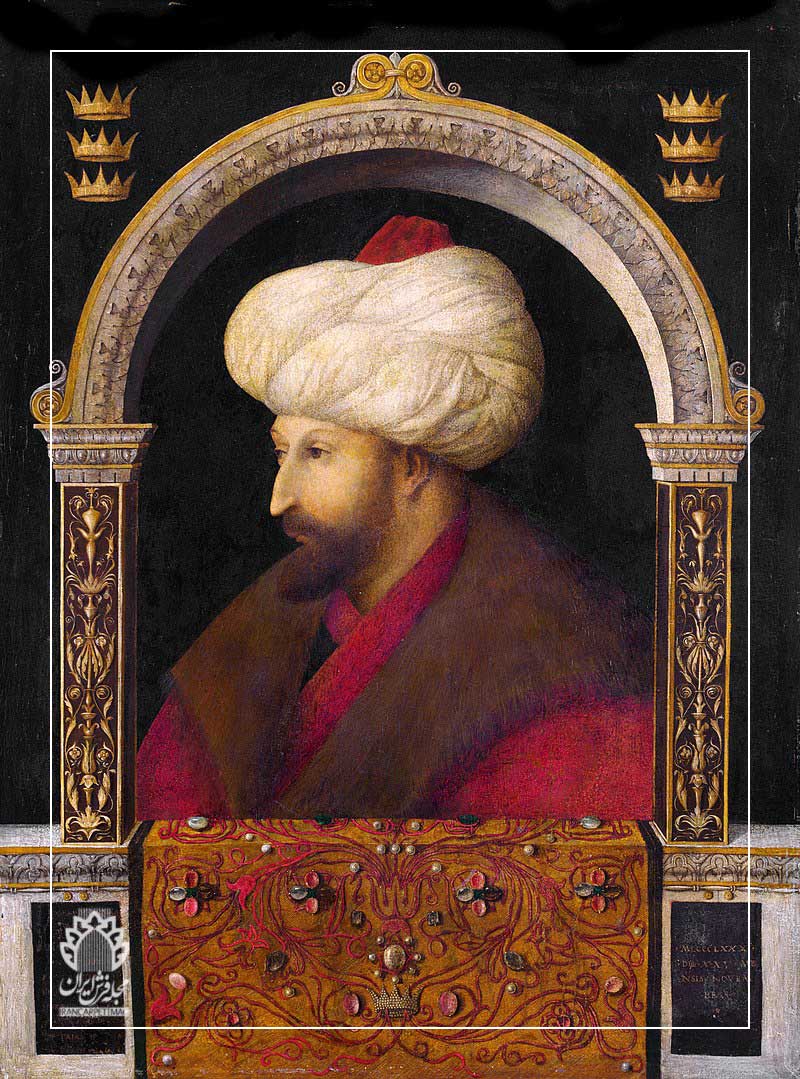 Portrait of Sultan Mehmed II by Gentile Bellini. Victoria and Albert Museum, London
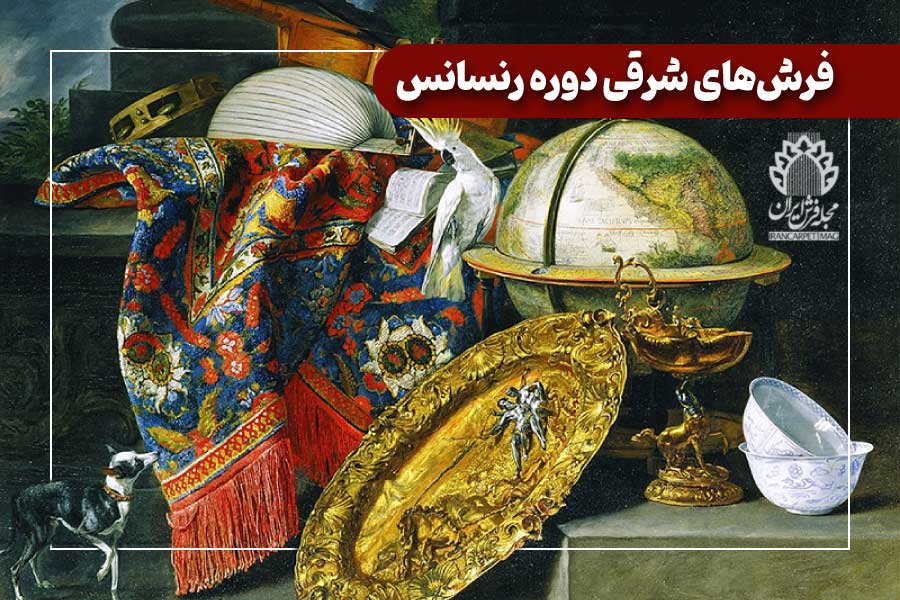
By the sixteenth century, Eastern carpets were often depicted in still-life paintings. Various precious and exotic objects, such as porcelain bowls and animals including parrots, were often intended allegorically or as symbols of “vanitas”[2]—the vanity of human life. This allusion to life’s transience was made explicit through symbols such as human skulls or inscriptions quoting the Bible. As early as 1533, Hans Holbein’s painting The Ambassadors prominently features an anamorphic[3] design. Human skulls and objects in still-life paintings, whatever their allegorical meaning, were often placed on precious velvet tables, marble slabs, or Eastern carpets. In this way, Eastern carpets were treated like other precious objects, with emphasis on their material value and decorative effect.
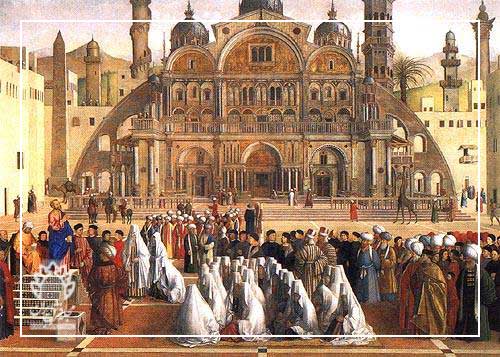 Gentile Bellini: Saint Mark Preaching in Alexandria, 1507
In September 1479, the Venetian painter Gentile Bellini was sent to Constantinople—the new capital of the Ottoman Sultan Mehmed the Conqueror—by the Venetian Senate as a cultural envoy, as part of a peace agreement between Venice and the Turks. Vasari[4] wrote that Bellini “painted the portrait of Sultan Mehmed so well that it was considered a miracle.” The date and attribution of this portrait to Bellini have been questioned. Nevertheless, Bellini was the first great Renaissance painter actually to visit the court of an Islamic sultan.
The impact of Bellini’s encounter with the Islamic world is reflected in the Eastern motifs found in several of his paintings. His 1507 painting of Saint Mark preaching in Alexandria shows Venice’s patron saint preaching to Muslims. The architecture in the background is an incongruous assemblage of buildings that does not correspond to contemporary Islamic architecture. The setting of Saint Mark’s sermon is adorned with exotic animals, including camels and a giraffe, as well as architectural elements such as an ancient Egyptian obelisk in the background. Bellini’s use of these decorative elements resembles the way Eastern carpets were depicted in fourteenth- and fifteenth-century Renaissance paintings: they evoke things that are exotic and precious, framing a person or an important action, while their cultural context is still fundamentally overlooked.
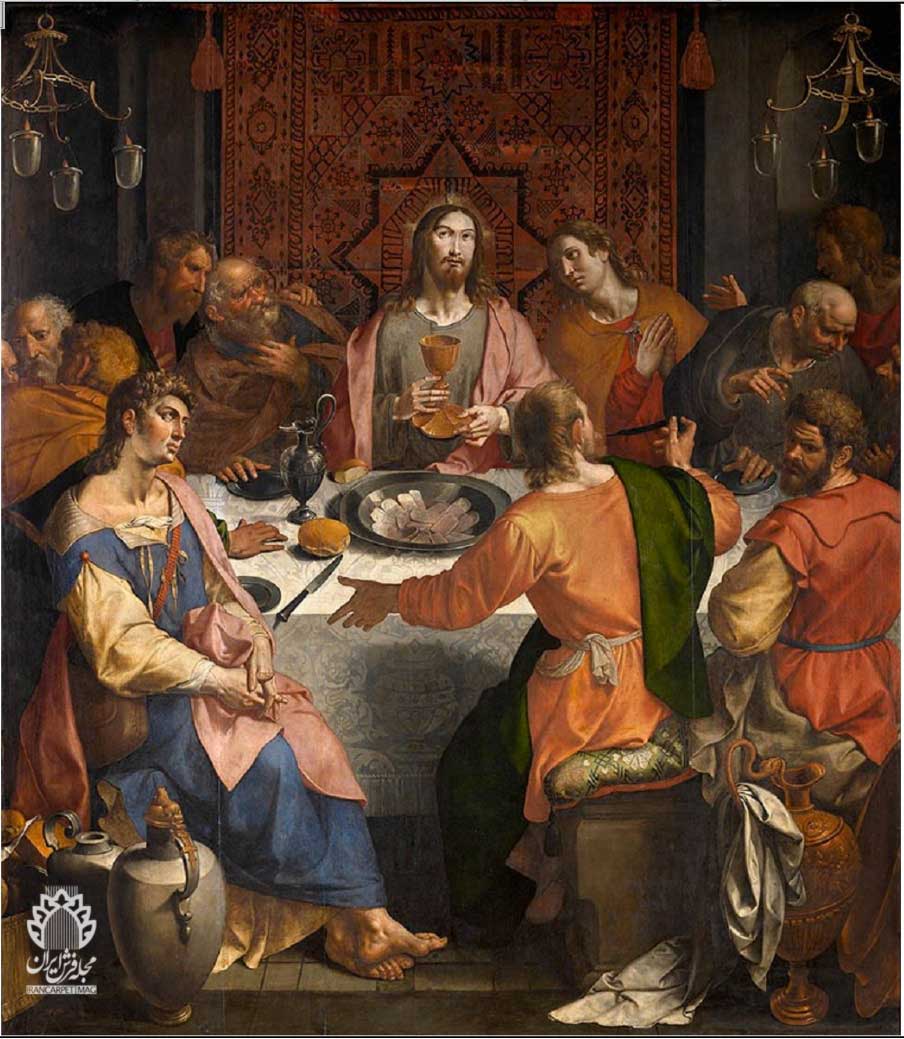 Ambrosius Francken: The Last Supper, sixteenth century, Royal Museum of Fine Arts Antwerp, with an Egyptian Mamluk carpet
The authentic cultural context of the 1547 portrait of King Edward VI of England, standing on an Eastern carpet before his throne, is echoed deliberately in the pose of Holbein’s famous portrait of his father, Henry VIII. The carpet affirms the authority of the young king.
We know nothing for certain about how much Ambrosius Francken knew of the cultural background of the Mamluk carpet he used as a decorative element in his Last Supper. The painting dates only to the sixteenth century. Nevertheless, the use of the central medallion of an Eastern carpet to highlight Christ’s halo is a distinctive case. This motif may have been used simply because the two visual patterns resemble one another, but it can also be understood as a claim of Christian superiority during the Renaissance. Europeans had reason to fear the Islamic world: in 1529, Suleiman the Magnificent besieged Vienna, and the Ottoman Empire remained a persistent threat to Western Europe until the late seventeenth century.
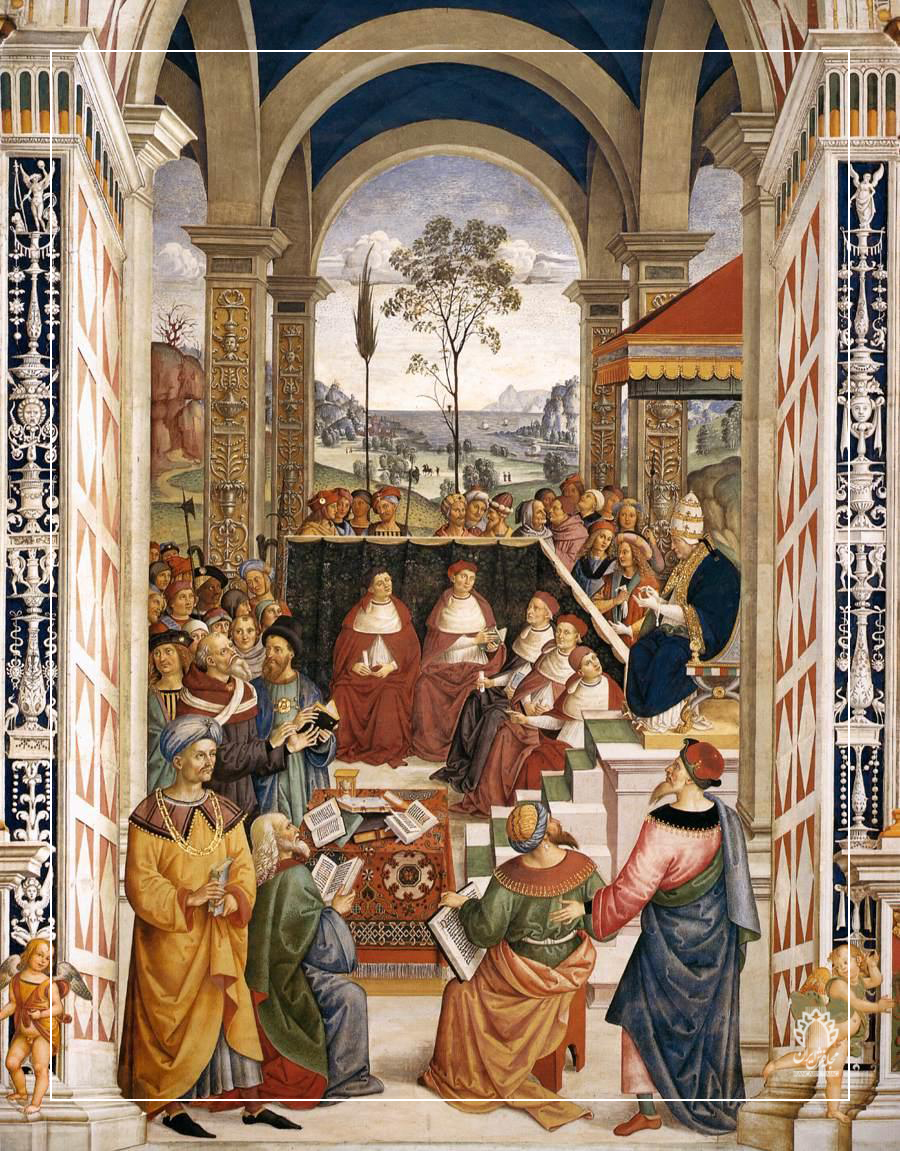 Fresco in the Piccolomini Library in Siena Cathedral, 1502–1509
In his fresco cycle for the Piccolomini Library in Siena Cathedral, painted between 1502 and 1509, Pinturicchio depicts Pope Pius II summoning the princes to Mantua in 1459 to proclaim a new crusade. In the eighth fresco, an Eastern carpet covers a table placed before the pope’s throne. It has been suggested that the carpet may have been spoils from earlier campaigns.
Precious Eastern carpets formed part of the so-called Turkish spoils taken during the siege of Vienna, which ended on September 12, 1683. Their new Christian owners proudly reported their plunder. Some carpets bear inscriptions naming their new owners and the dates they were acquired. Most Eastern carpets, however, continued to be depicted as visually appealing objects without political associations, while their original cultural context was overlooked. Efforts to understand carpets more fully within their Islamic cultural context came in the following century. While Islamic carpets initially served to adorn Renaissance paintings, those paintings later helped foster a better understanding of the carpets. Comparative art-historical research into Eastern carpets in Renaissance painting adds another dimension and contributes to a fuller understanding of the complex and sometimes ambivalent image of the Ottomans in Renaissance Western Europe.
Faizeh Ghaderi Handwoven Carpet Specialist
[1] Flemish Baroque painting refers to art produced in the Southern Netherlands under Spanish rule during the sixteenth and seventeenth centuries. [2] A seventeenth-century Dutch still-life genre containing symbols of death or change as a reminder of their inevitability. [3] Anamorphic art is a form of painting in which an image appears correctly proportioned from one viewing angle but distorted from others. Creating such works requires a deep understanding of how different mirrors work and of the laws of reflection. [4] An Italian painter, writer, historian, and architect. He is best known today for writing Lives of the Most Excellent Painters, Sculptors, and Architects, a collection of Renaissance artist biographies in Italian that is considered a foundational work in the writing of art history.