
Research Articles
With Cochineal Insects: From the Gol-e Ghermezi Carpet to the Mystery of Redemption
Aug 4, 202212 min readIran Carpet Company
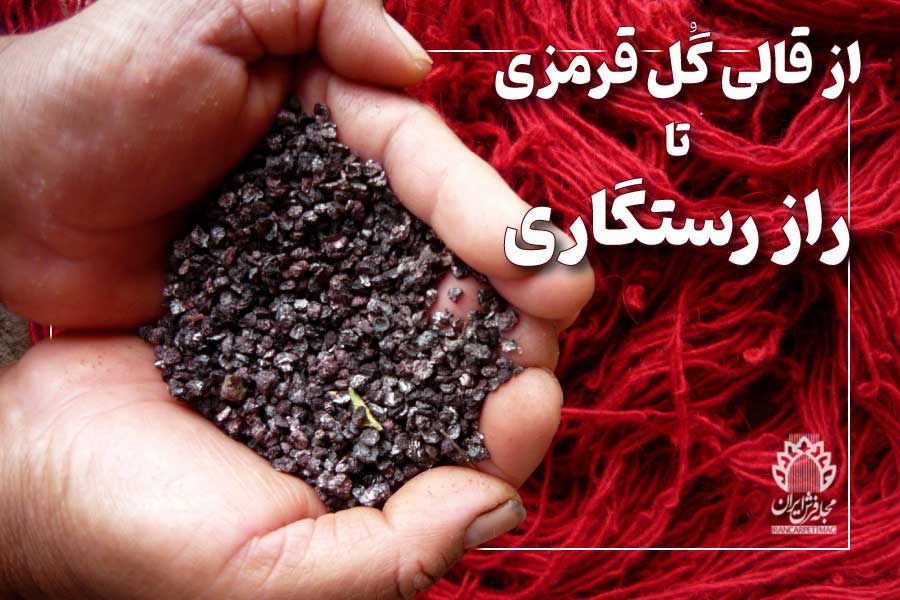
Natural dyes fall into three main groups:
The first comprises dyes obtained from the roots, leaves, flowers, and fruits of plants:
 Plants whose roots provide the dye, such as madder and turmeric
Plants whose stems provide the dye, such as weld
Plants whose leaves provide the dye, such as grapevine, mulberry, and woad
Plants whose flowers provide the dye, such as gundelia, saffron, safflower, and others
Plants whose fruits provide the dye, such as myrobalan
Plants whose skins provide the dye, such as walnut husks, pomegranate peel, onion skins, and oak bark
And some plants have dye-bearing compounds in most of their parts, such as sumac
The second group comprises natural dyes obtained from animals, such as cochineal and the shell of marine snails in the Muricidae family (spiny murex snails, known as Murex).
The third group consists of mineral colorants, or pigments, such as ochre pigment (red earth) and lapis lazuli pigment. These are not used to dye fibers and are employed mainly in restoration work.
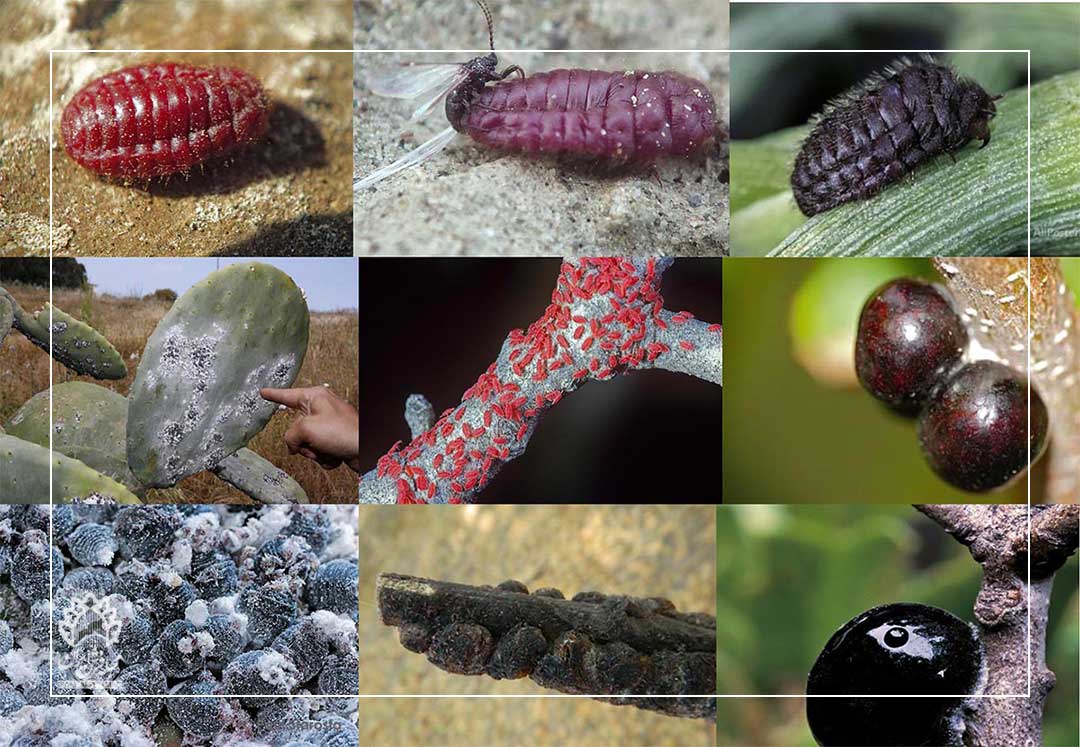
Cochineal can unquestionably be considered the most important dye of animal origin. Archaeological finds trace its use back to the Pazyryk Valley, and specifically to the Pazyryk Carpet. Cochineal-producing insects live on roots, leaves, and tree fruits, and sometimes on cacti; different species are found in different parts of the world. As its name suggests, cochineal has long been used to produce shades of red. Today, in addition to dyeing fibers, it is used in the food industry as an approved food coloring and in cosmetics.
A History of Cochineal
Cortés was the first to note that the Aztecs used it. When the Spanish arrived in Mexico in 1518, they saw Indigenous people dyeing with cochineal. The Spanish mistook this red dye for tiny plant seeds, although it was in fact the dried body of the insect Dactylopius coccus. They sent the dye to Spain for export to various parts of Europe. Guatemala and Mexico were initially its two main sources, since the insects’ food plant, the Indian fig Opuntia cochenillifera (sometimes called nopal or Opuntia cactus), grew in these countries as well as in Georgia and South Carolina.
By 1525, the insect was known in Europe. When Mexico was a Spanish colony, the cochineal trade was one of the country’s major sources of revenue. A law stipulated that anyone who took the female insect out of Spain would be sentenced to death. In the early 19th century, cochineal reached Europe. Its cultivation there made little headway, but in 1810 a living specimen from Cádiz was placed on an Indian fig tree in the agricultural garden of Orotava, on the Canary Island of Tenerife. In the mid-19th century, when vineyards were devastated by phylloxera, the cochineal trade came to their rescue and flourished so dramatically that it astonished local residents. Then the wheel of fortune turned once more: aniline dyes were discovered, and cochineal lost its commercial value, falling into such decline that it was used only for the insignificant task of decorating confectionery.
 Cochineal in Iran
This dye was first brought overland from India to Khorasan and Kerman, where it was well received. Its use became common in eastern Iran, and later a finer variety—Mexican and Canary Islands cochineal—was imported into Iran. Indian lac and cochineal were not used in the western and northwestern cities, where madder grew wild and was the principal dye used for wool. Cochineal dye is used in regions such as Kerman, Yazd, Isfahan, Kashan, and Khorasan, and more rarely in Ardabil and Tabriz.
In Kerman, the color obtained from cochineal is called laki or gol-khovari. Cochineal dye has been used in many carpets, including Safavid-period carpets such as the V&A’s Chelsea Carpet, the Metropolitan Museum’s Animal Carpet, the Clark Kerman Sickle-Leaf Carpet, carpets by Amuoghli, Armenian-woven carpets, and Turkmen carpets. In the past, cochineal was cultivated in Balochistan and along the Persian Gulf and Gulf of Oman coasts. Since cochineal is not produced domestically, its high price has greatly reduced the use of this valuable dye, even in traditional dyeing workshops.
Obtaining Cochineal Dye
When the insects mature, the wingless females, which contain the dye, are removed from the leaves to which they are attached and killed in hot water. They are then dried in the sun, or placed in a bag and dried in an oven. Because of their silvery-gray color, they are called silver cochineal or jaspeada. In the second method, the insects become darker and drier and are called negra.
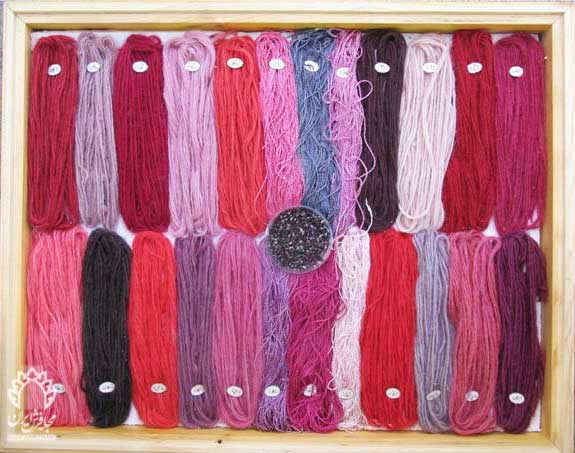
Dyeing with Cochineal
Because cochineal has an anthraquinone chemical base, which is symmetrical, it has relatively high lightfastness. Cochineal is mordanted with potassium bicarbonate, alum, tin chloride, copper sulfate, nickel nitrate, iron sulfate, and dichromate. Since the colorants in cochineal are polygeneric, different mordants can produce a wide range of shades, including pink, red, orange, magenta, wine red, crimson, purple, and even green, gray, and black. Cochineal with alum produces red, and with chrome, purple. Cochineal is not a suitable dye for cotton, since cellulosic fibers have few dye-receptive functional groups. Some wool dyed with cochineal turns slightly bluer when washed, although the dye is fast and does not run.
Types of Cochineal
Indian Cochineal
Indian cochineal insects live in tropical regions of India and settle on fleshy, sweet fruits. Their bodies are used mainly to produce lac; during lac processing, a quantity of deep red dye is also obtained, known in Iran as laki. The word for red, ghermez, also derives from this source. The species found in Iran and India is known scientifically as Coccus lacca and lives on fig trees. The word “lacca,” which means “hundreds of thousands” in Hindi, refers to the vast numbers of these insects found on the plant. After piercing the bark of the Indian fig tree and sucking its sap, the insect secretes a resinous coating in which the females remain enclosed. This resin contains 2 to 10 percent dye, a compound of carminic acid.
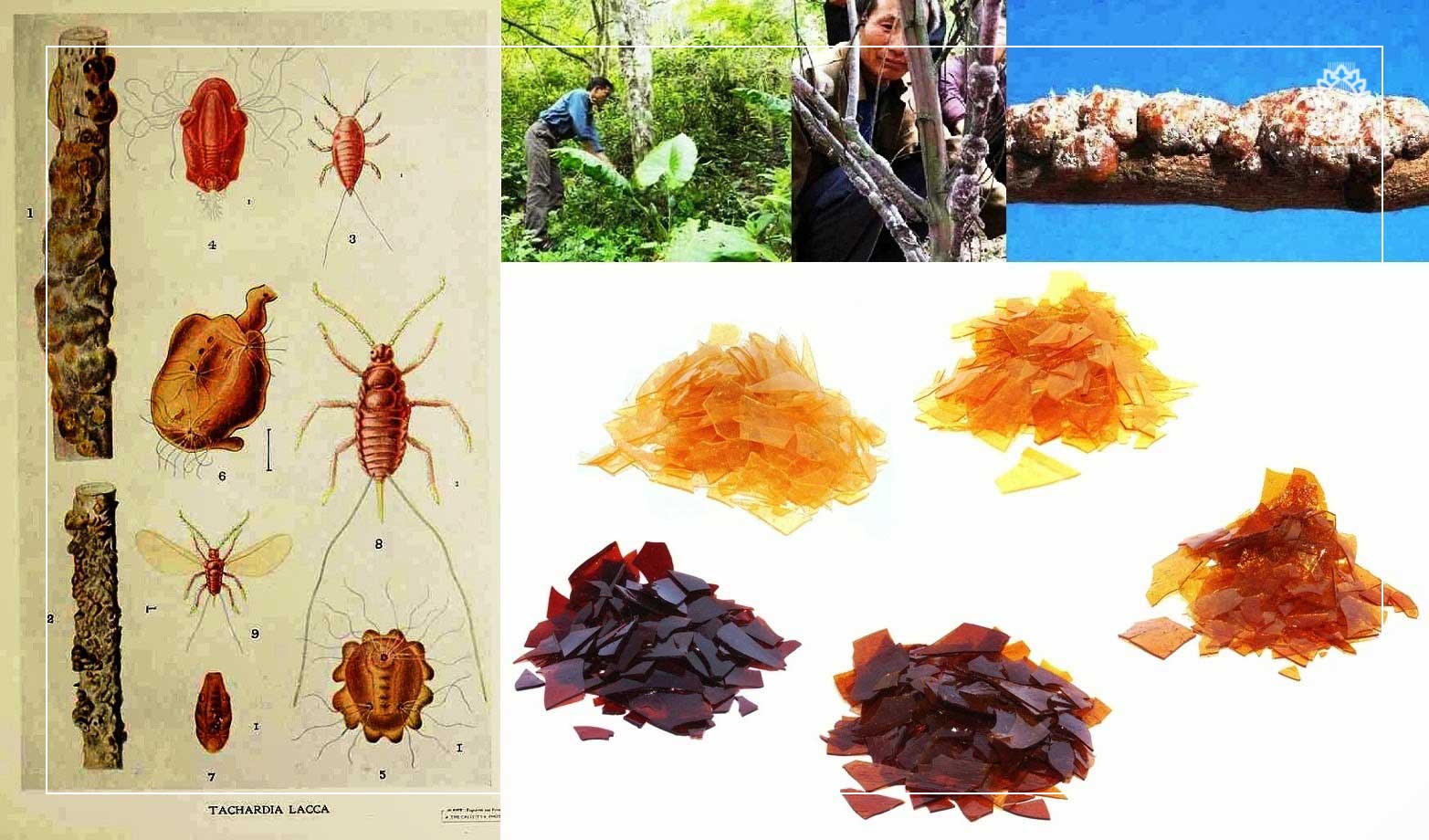
This dye had been known in India for centuries before it was finally exported to England in 1796. A few years later it reached the United States, where it found a ready market that remained strong through the end of the 19th century. Its popularity was due to its affordable price—half the cost of cochineal, which it replaced—and its dark and very light red shades. The red, crimson, and orange shades dyed with lac were not as good as those produced by cochineal. Brilliant cochineal was therefore often blended with fast-dyeing lac to produce an attractive, colorfast shade, with the added advantage of being considerably less expensive than cochineal alone.
Armenian Cochineal
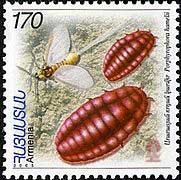
Armenian cochineal (Porphyrophora hamelii), also known as Ararat cochineal or Ararat scale, is native to the Ararat Plain and the Aras River valley in the Armenian Highlands. It was formerly used to produce the eponymous crimson carmine dye, known in Armenia as vordan karmir and in Iran as cochineal. The Armenian cochineal belongs to a different family from the cochineal insect of the Americas. Since both insects produce red dyes, they are commonly called cochineal.
The life cycle of Porphyrophora hamelii takes place mostly underground. Newly hatched nymphs emerge in spring and crawl until they find the roots of herbaceous plants growing in saline soil, such as Aeluropus littoralis and common reed. The nymphs continue feeding on these roots through spring and summer, forming protective, pearl-like cysts in the process. From mid-September to mid-October, mature insects emerge from the ground between 5 a.m. and 10 a.m. to mate. Adult males live for only a few days, while adult females may live longer and burrow into the ground to lay their eggs.
Polish Cochineal
Polish cochineal (Porphyrophora polonica), also known as Polish carmine scale, is a scale insect formerly used to produce the crimson dye of the same name, popularly known as “Saint John’s blood.”
The larvae of P. polonica live on the roots of various plants, especially perennials growing in sandy soils in Central Europe and other parts of Eurasia. Before the spread of aniline, alizarin, and other synthetic dyes, this insect was of considerable economic importance, although its use declined after Mexican cochineal was introduced to Europe in the 16th century.
Mexican Cochineal
One type of cochineal lives on a species of cactus and is known scientifically as Coccus cacti. For this reason, cactus plantations are established in places where the insect is cultivated. Mexican cochineal is an insect from whose body a dye of the same name is extracted. It feeds on plant sap, especially that of certain cacti, notably Opuntia cochenillifera, native to the tropical regions of Central and South America and Mexico. The insect’s body contains a substance called carminic acid, which serves as a defense against other insects. Cochineal insects are collected from plants at egg-laying time, killed by boiling, and then dried. Around 17 to 24 percent of the dry weight of the insect and its eggs consists of carminic acid. When extracted and combined with aluminum and calcium salts, it yields the scarlet pigment carmine, or cochineal, used in food coloring, dyeing, and cosmetics. Madder and cochineal were the most important red dyes used in 18th- and 19th-century America.
In California, D. opuntiae grows on the common cactus, on the edible fruit that is eaten in parts of the southern United States.
Kermes
Kermes (genus Kermes) is a red dye of very ancient origin, obtained, like cochineal, from the dried bodies of insects related to Dactylopius coccus, the cochineal-producing insect. Its color is fast, though not as brilliant as cochineal. Kermes vermilio insects (kermes berries) feed on a particular oak species (Quercus coccifera) and are cultivated in southern France, Spain, and other parts of the Mediterranean coast.
Mediterranean Cochineal
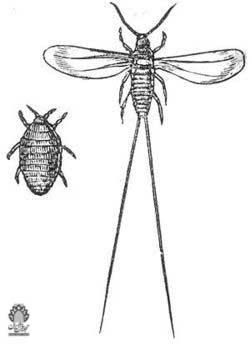
This insect lives on a type of oak that grows in the Mediterranean climate. At times, its numbers become so great that clusters of insects conceal the tree’s branches. This may be why, for many years, some people thought cochineal was a plant-based dye. The word “worm” suggests an earthworm, easily crushed underfoot, but the crimson worm, Coccus ilicis, is in fact an insect rather than a worm. The male is winged and flies about, while the female cannot fly. The insect lives on oak leaves. Scarlet and crimson worms belong to a family of insects that live on oak trees. Their lifespan is about 4 to 14 weeks. During roughly the last four weeks of her life, the female is ready to mate and lay eggs.
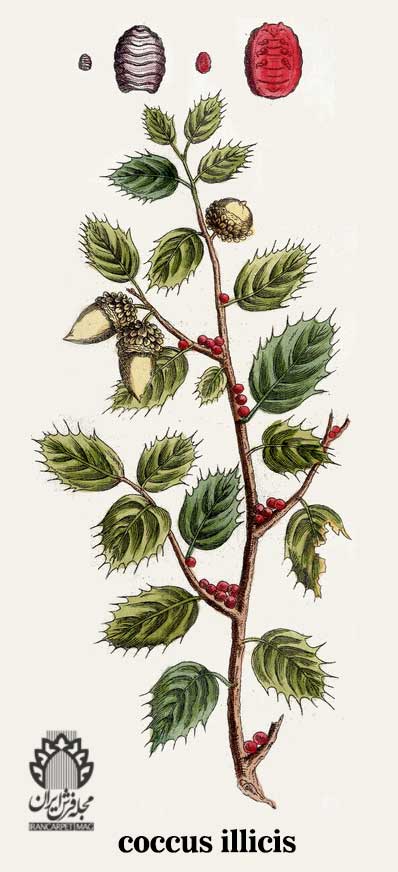 The “Coccus ilicis” worm is a very unusual insect. When it is time for Coccus ilicis to lay eggs, the female attaches herself to a tree or branch, holding on so firmly that she cannot detach herself. As she does so, she builds a hard shield to protect the tiny eggs beneath her. When the larvae hatch, they live under her body and feed on their living mother. After a few days, when the young insects can fend for themselves, the mother dies. At that moment, a scarlet liquid seeps out, staining not only the wood to which she is attached but also the young insects, for the rest of their lives. Three days after the mother dies, her body loses its scarlet color and becomes a fluffy white mass, like snow falling on the ground.
Literature on Coccus ilicis relates that on the morning of the fourth day after its death, the worm’s body becomes a snow-white jelly, like soft white wool falling to the ground. The worm’s death is a manifestation of the death of Jesus Christ on the Cross of Calvary. Its transformation after several days points, in light of Isaiah’s prophecy, to the promise of redemption:
The Lord says: “Though your sins are like scarlet, they shall be as white as snow; though they are crimson, they shall be like wool.”
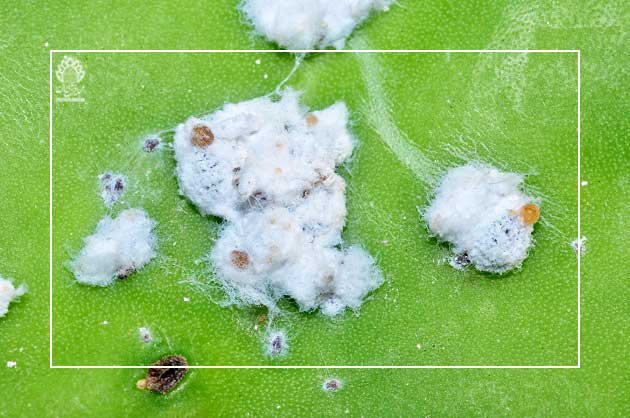
Snow and pure wool are white and bright. White represents purity and cleanliness. When Isaiah says that the Lord can turn our sins from scarlet or crimson to snow or wool, it means that God can do what we cannot do on our own. A piece of cloth dyed red remains red, but through repentance, God can make us pure and white again.
Shaheen Nemati Dehkordi Master’s degree in Handwoven Carpets
*Coloring materials are divided into two groups: dyes and pigments. Pigments are solid; they color only the surface of objects and do not dissolve in water. They can be used to color fabric and yarn or to print on fabric. *The young of insects with incomplete metamorphosis are called nymphs. In their morphological features, they closely resemble the adult insect. *Calvary is the name of the hill where the Romans crucified Jesus Christ.
 Research Articles
Among researchers, Neyriz tree carpets are known as “three-trunk” carpets, since the tree’s trunk is formed from three sections, sometimes aligned uniformly and sometimes arranged unevenly. Read more about this carpet in this article.
 Research Articles6
Magnificent Persian carpets, with their captivating creativity, have the power to transform an interior into something almost magical. Yet few names of master weavers whose work is of exceptional quality have endured. What makes a carpet weaver a true master?
 Research Articles23
Bessarabia is a region in southeastern Europe, north of the Caucasus Mountains in southwestern Russia. It borders Romania to the south and the Black Sea to the east, and lies between the Prut and Dniester rivers.