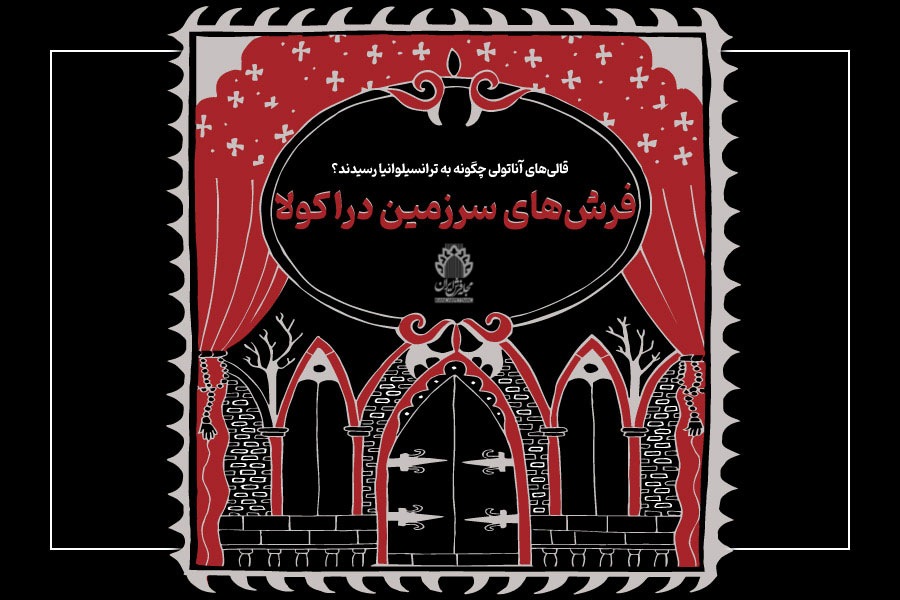
Carpets of Dracula’s Land
 Map of Romania and Transylvania in Europe
A great collection of carpets from the Ottoman period is kept in Europe, in a place unknown to most people: Transylvania, a region of Romania that, since Bram Stoker wrote his novel Dracula in 1897, has been associated with the refuge and forbidding castle of Count Vlad Dracula. Until the First World War, Transylvania was part of the Austro-Hungarian Empire; after its dissolution, it became part of Romania. Several churches with Germanic Gothic architecture in Transylvania house collections of carpets from the Ottoman period. These carpets have hung on church walls for centuries and are now on view to visitors as a national treasure of Romania. The question is how these carpets, all woven between the mid-15th and mid-18th centuries, came to the churches of Transylvania. It is one of the most remarkable stories in the history of carpets.
There are nearly 400 carpets in the churches and museums of the region, featuring celebrated Ottoman carpet designs such as the Holbein, Lotto, and Çintamani. Prayer-rug designs, however, are the most numerous. Transylvania also has carpets from the Ottoman period whose designs do not fit into the established categories of classical Ottoman carpets. Since no other system of classification has yet been proposed, these designs are generally grouped under the name “Transylvanian carpets.”
A great collection of carpets from the Ottoman period is kept in Europe, in a place unknown to most people: Transylvania, a region of Romania that, since Bram Stoker wrote his novel Dracula in 1897, has been associated with the refuge and forbidding castle of Count Vlad Dracula. To answer the question of how these carpets reached Transylvania, we must consider a cast of characters and a series of events that came together in a remote corner of Europe, where their presence might hardly be expected, each playing a part in the unfolding story. The first were the German settlers, who arrived in Transylvania at the invitation of the Hungarian rulers of the region. Their migration was intended to revive the local economy and strengthen its defenses, particularly after the Mongol invasion of the 13th century. The Germans, known locally as Saxons, built towns whose centers were dominated by Gothic churches, their high walls resembling those of military fortresses. The area settled by the Saxons is now known as the Seven Castles.
The Saxons’ arrival in Transylvania may not have had a direct connection to the carpets, but three centuries later another event changed everything: the rise of Protestantism. Most Transylvanian Saxons abandoned Catholicism and joined the Lutheran movement. After their conversion, they no longer needed the traditional furnishings of Catholic churches; their change in outlook called for new furnishings that would give their churches a different appearance. They therefore removed the furnishings from the Catholic churches. The churches were now bare, opening their interiors to new decorative ideas. The time had come for another group of players, arriving at more or less the same moment: the Ottomans.
The question is how these carpets, all woven between the mid-15th and mid-18th centuries, came to the churches of Transylvania. It is one of the most remarkable stories in the history of carpets. The Ottomans entered Europe suddenly after the conquest of Constantinople in 1453. At the time, no army in the world made greater use of artillery and firearms. Yet most of the Ottomans’ enemies in Eastern Europe relied on heavily armoured knights, who suffered a crushing defeat. The Hungarian nobility, led by Lajos (Louis) II, was defeated at the Battle of Mohács in 1526, and Transylvania slipped from its control.
Immediately after the battle, Sultan Suleiman I supported János II, a Transylvanian prince, in taking the throne and ruling Hungary. George Szerémi, a priest at the Hungarian court who was present when Suleiman summoned János, writes: “After the coronation, Sultan Suleiman summoned János to his royal tent. Along the short route János took to meet the sultan, Turkish carpets and many kinds of rugs and floor coverings had been spread on the ground all the way to the sultan’s tent.”
Transylvania has carpets from the Ottoman period whose designs do not fit into the established categories of classical Ottoman carpets. Since no other system of classification has yet been proposed, these designs are generally grouped under the name “Transylvanian carpets.” The Ottomans occupied Buda, but allowed Transylvania to remain under the rule of János II as a self-governing principality on the outskirts of the Ottoman Empire—autonomous, but tributary. From the 16th to the 18th centuries, the Ottomans sought each year to expand their territory in both the east and the west. The army assembled in Istanbul might march towards Europe one year, and towards Iran, North Africa, or Arabia another. In the end, they marched in every direction. Expansion through warfare was essential to the Ottoman economy, since much of the state’s expenditure was covered by tribute paid by conquered territories. At the same time, Ottoman imperial propaganda insisted that these wars were holy campaigns to extend the borders of Islam. In the west, the Sunni Ottomans’ enemies were Christians; in the east, they were the Shiite Iranians. Given all this, it is easy to imagine the Transylvanian Saxons living in fear under the shadow of the warlike Ottoman Empire and doing their best to give it no pretext for intervention.
We do not know where the idea of hanging carpets on walls originated, but perhaps the tradition began when wealthy Transylvanians bequeathed their carpets to churches after their deaths. The expansion of Ottoman territory fostered extensive trade between the Ottoman Empire and Europe, a subject and its wider implications that we discussed earlier in the article “Why Did Oriental Carpets Fall Out of Favor with Europeans?.” Ottoman carpets suddenly found many admirers in Europe, among them wealthy Saxons, who commissioned carpets for their homes and churches. The Saxons hung Ottoman rugs on the walls of their Gothic churches as decoration. We do not know where the idea of hanging carpets on walls originated, but perhaps the tradition began when wealthy Transylvanians bequeathed their carpets to churches after their deaths. Over time, many rugs accumulated in the churches; at church ceremonies, even the descendants of the deceased would sit beneath a rug their ancestor had donated. When townspeople came to church and sat beneath their own rugs, they were also making a subtle display of their wealth and standing.
In 1898, these carpets were catalogued and dated. Carpet scholars refer to the collection as “the Transylvanians” and debate whether some of the carpets might have been woven in Transylvania itself or elsewhere in Eastern Europe, rather than in Anatolia. Interestingly, the Saxon practice of donating carpets to churches bears a striking resemblance to the Muslim custom of donating carpets to mosques. Such gifts have led, over the centuries, to the accumulation of many historic and valuable carpets in Islamic mosques. In Transylvania, too, these endowments gave rise to a large collection of carpets—far more than could be displayed. Today, the Black Church and several museums in Transylvania house many Ottoman carpets, some of which may have no counterparts even in the museums of Turkey. In 1898, these carpets were catalogued and dated. Carpet scholars refer to the collection as “the Transylvanians” and debate whether some of the carpets might have been woven in Transylvania itself or elsewhere in Eastern Europe, rather than in Anatolia. For example, carpet historian Charles Grant Ellis believed that some may have been woven in the Balkans under Ottoman rule.
 Era Nosbacher, head of the Transylvanian Carpet Restoration Team, 1999
Compiled by Dr. Davoud Shadlou Faculty member, Department of Carpet, Shiraz University of the Arts
Photo Album (8)
Related Reading
All Journal & Blog Research Articles
Symbolism of the Neyriz Tree Carpet
Among researchers, Neyriz tree carpets are known as “three-trunk” carpets, since the tree’s trunk is formed from three sections, sometimes aligned uniformly and sometimes arranged unevenly. Read more about this carpet in this article.