Carpets in the Works of Johannes Vermeer
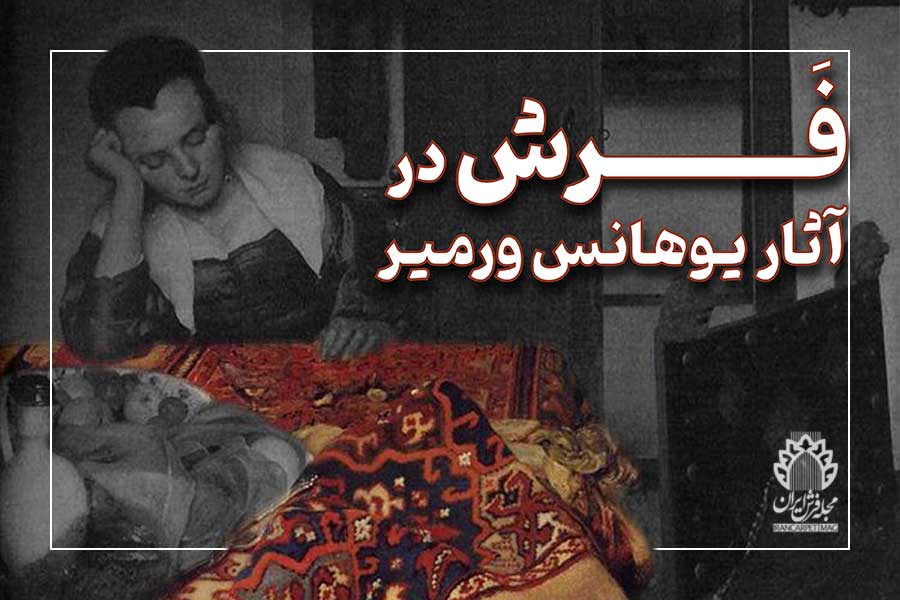
Many depictions of seventeenth-century Persian carpets—exported to countries such as Spain, the Netherlands, Portugal, and India, and often featuring lacquer red, navy blue, and green—appear in the works of celebrated painters of the Baroque period, including Johannes Vermeer (1632–1675), one of the most renowned Dutch painters.
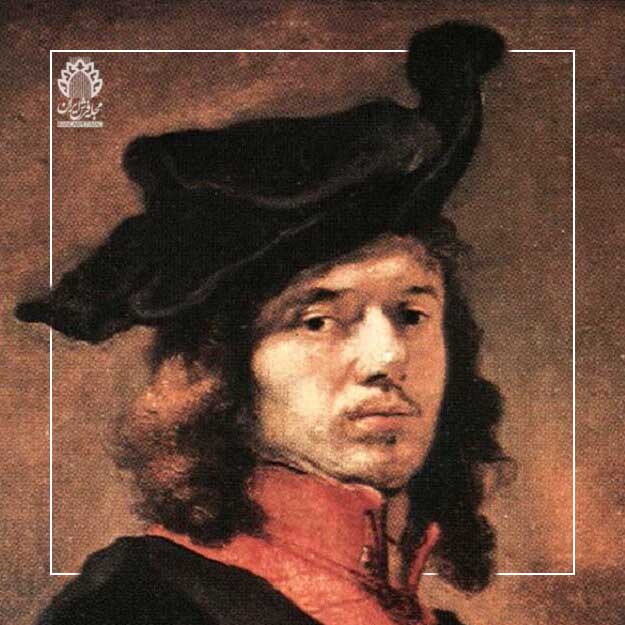 Johannes Vermeer
Vermeer played an important role in shaping Dutch Renaissance art, and his works offer a glimpse into the world of the seventeenth century. Little is known about the artist’s personal life. Shortly before his birth, around 1630, his father entered the art trade as a dealer. His father’s death in 1652 and the debts he left behind may have prevented Vermeer from receiving training under an eminent master. On the other hand, his father’s business may have helped Vermeer develop his considerable ability to secure commissions. After his father’s death, at just 20 years of age, he took over the family business—a position that would have brought him contacts and connections of importance to his career.
In 1653, Vermeer married the daughter of a wealthy Catholic and converted to her faith. He spent his entire life in the Netherlands, most of it in the city of Delft, where the great majority of his paintings were made. For much of his relatively brief career, Vermeer’s paintings commanded high prices, enabling him to support his large family. But the Netherlands’ severe economic downturn in the early 1670s affected his life. He died at the age of 43, leaving his wife with 11 children and a considerable burden of debt. Although Vermeer never travelled far from home, his fame eventually spread around the world.
A Seventeenth-Century Artist, Discovered in the Nineteenth
Vermeer lived and worked in Delft, yet remained relatively unknown until the end of the nineteenth century. Perhaps this was because, although his work was familiar to other connoisseurs in Delft and in the neighbouring court city of The Hague, and some of his paintings were sold in more distant cities such as Antwerp and Amsterdam, he painted for only a small circle of patrons in Delft. In fact, half of Vermeer’s output was purchased by his patron, the local collector Pieter van Ruijven. This limited wider demand and the rise in the value of his work. Van Ruijven appears to have owned 21 works by Vermeer at the time of his death in 1674. Moreover, the fact that Vermeer’s teacher is unknown has contributed to his image as an isolated figure. Nevertheless, his paintings ultimately had a profound impact on our understanding of seventeenth-century art, and he is now regarded as one of the great Dutch artists.
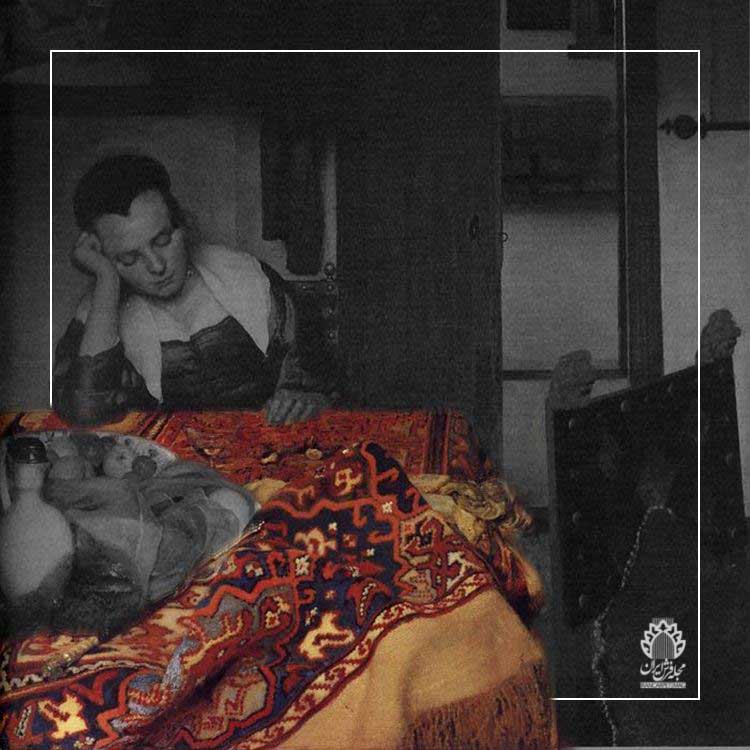 A Maid Asleep, 1656–1657, The Metropolitan Museum of Art, New York
Vermeer’s Aim Was to Reproduce Reality in His Works
In his painting, Vermeer drew inspiration from the contemporary Dutch movement known as the Fijnschilders*, a term that literally means “fine painters.” These artists sought to reproduce reality in precise, naturalistic paintings, often on a small scale. At the time, works by the Fijnschilders sold for enormous sums.
By the late seventeenth century, Persian carpets were highly valued as luxury goods. The Netherlands was then experiencing not only a Golden Age of art but also an age of exploration: Dutch sailors ventured to distant lands, often sailing under the flag of the powerful Dutch East India Company. At this time, Persian carpets were traded extensively by English, Dutch, and Portuguese companies. Ports and port cities generally played a greater role than other cities in harnessing the full capabilities of the English and Dutch East India companies. Persian handwoven carpets brought considerable added value to the court through exports to India, the Ottoman Empire, and Europe. Between 1062 and 1077 AH, exports by the Dutch East India Company included a shipment of 522 wool carpets and 32 silk carpets to Europe. Hundreds of examples of this type of carpet appear in European paintings dating from around 1615 through the eighteenth century.
The tradition of depicting carpets on tables in domestic interiors continued into the eighteenth century. In Vermeer’s paintings, carpets often cover the tables. During this century, trade became central to Dutch life. This meant that people not born into wealth and status could attain them, giving rise to the middle class. As a result, interest in the home grew; the home had shifted from a private space into a public stage for display. This change was reflected in painting, too. Before then, paintings and portraits generally belonged to the world of the wealthy and elite, but Vermeer’s paintings offer a rare glimpse into middle-class life. His portraits and scenes strive to depict reality and everyday life rather than invent them.
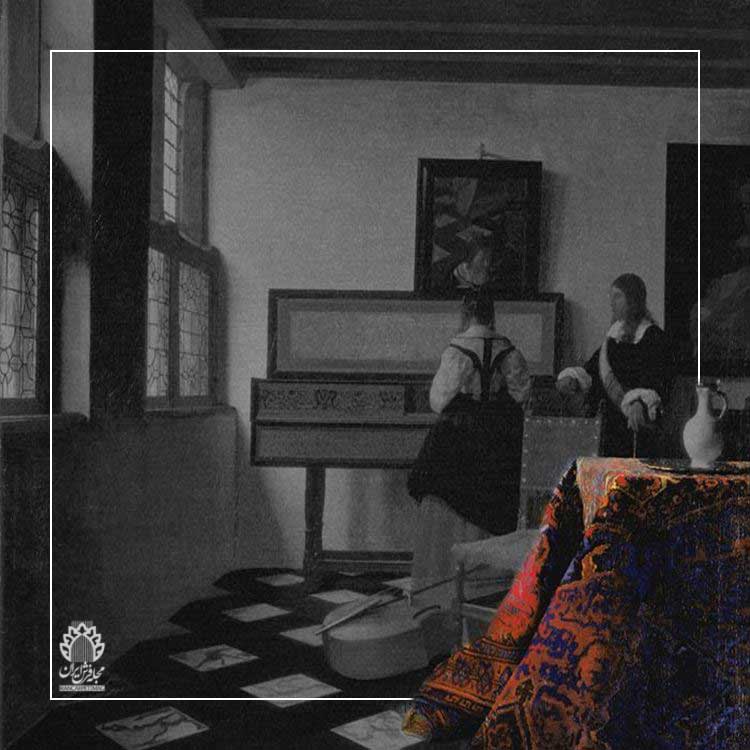 The Music Lesson, 1660, Royal Collection Trust, London, United Kingdom
Most of his paintings depict two aspects of life that were generally overlooked by seventeenth-century artists: women and the home. Vermeer’s women reflect a renewed interest in domestic life. His depictions of women and homes mirror important social changes and the living conditions of the time. In his surviving works, female figures appear around 40 times, while men appear only 14 times. Many of Vermeer’s scenes centre on domestic life: the interiors are even thought to be based on rooms in his own house, and the subjects modelled on his family and servants. Many of Vermeer’s subjects have original, expressive faces. This was one of the first times in Dutch art that women were the focus for their own sake. Rather than conventional beauties, Vermeer’s women are real, domestic figures whose appeal derives from the warm, inviting, and secure surroundings in which they are portrayed.
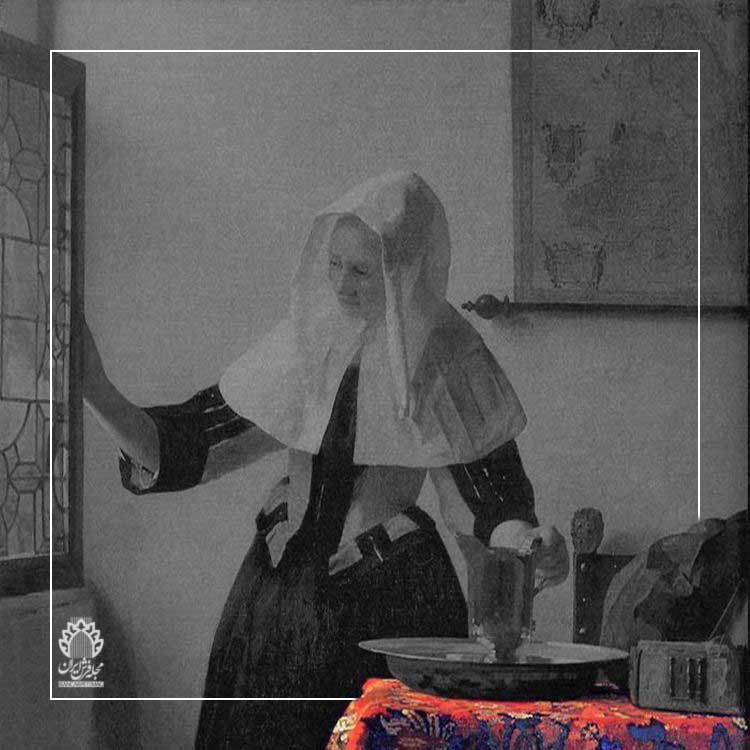 Young Woman with a Water Pitcher, 1662, The Metropolitan Museum of Art, New York
Vermeer’s Interiors Are Often as Intriguing as the People in Them
Johannes Vermeer is best known for his quiet, introspective interior scenes, his unprecedented use of bright, vivid colour, and his persuasive illusionism. In Vermeer’s time, depicting private rooms in art was unusual. His portrayals of domestic interiors therefore offer a glimpse into the largely unseen world of kitchens and private rooms.
Although Vermeer produced relatively few paintings during his lifetime, many of the striking details in his works are depictions of seventeenth-century Oriental carpets. One example is the painting of a young woman with a water pitcher, in which a Persian carpet is shown on a table. The tradition of depicting carpets on tables in domestic interiors continued into the eighteenth century. In Vermeer’s paintings, carpets often cover the tables.
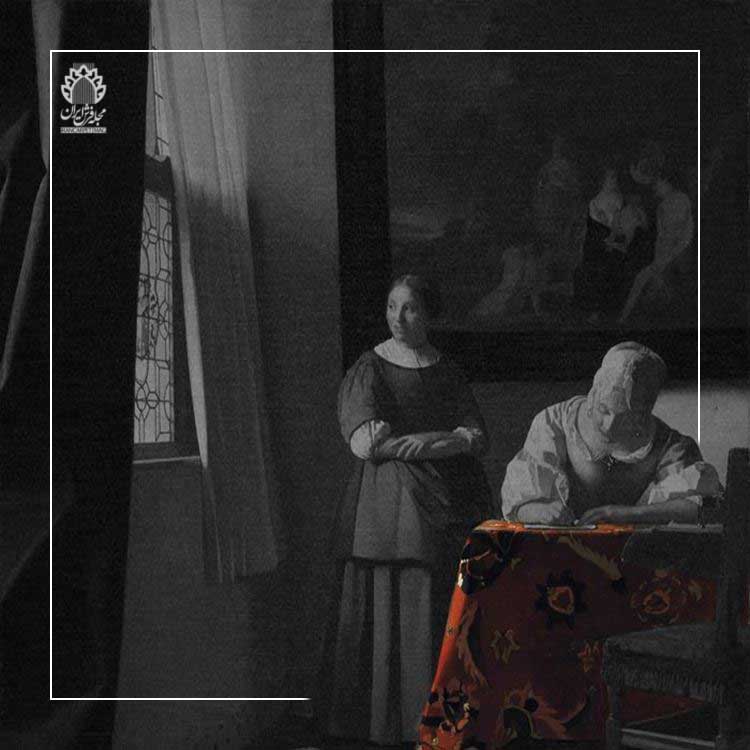 A Woman Writing a Letter with Her Maid, c. 1670, National Gallery of Ireland, Dublin, Ireland
Another striking feature of Vermeer’s interiors is the maps that frequently appear on the walls. The Netherlands was a centre of seventeenth-century cartography, with leading mapmakers working in its major cities and the East and West India companies expanding and demanding new, up-to-date navigational materials. Maps and charts consequently became more common possessions. Their presence in Vermeer’s paintings helps illuminate how cartography flourished across all levels of society. A map of Europe in the background of a Dutch home reflected the pride of the time in the country’s superiority in navigation and mapmaking.
Vermeer’s Paintings Are Dynamic Narratives
Despite drawing inspiration from the Fijnschilders, whose style could be described as static, Vermeer managed to imbue his paintings with a sense of dynamism and create the illusion of movement. He often did this by slightly blurring his subjects and depicting them in the midst of an activity rather than in a rigid pose, thereby bringing them to life. Vermeer used the full spectrum of colour in his works, making particular use of colour to create vivid paintings. His preference for rich—and therefore expensive—colours probably did little to improve his financial situation. His use of light, especially sunlight, also helped convey a vibrant energy. In Vermeer’s paintings, the window was the source of light, which always came from the left. The light entering through the window fully illuminated some objects or forms. Because the curves created in the carpets in his works could reflect light and cast shadows, and because the use of light was one of the most important features of Vermeer’s work, these carpets cover much of the surface in his paintings.
Edited and translated by: Faezeh Ghaderi Handwoven Carpet Specialist
* Johannes Vermeer * The Fijnschilders