Carpet Markets in the Works of Painters
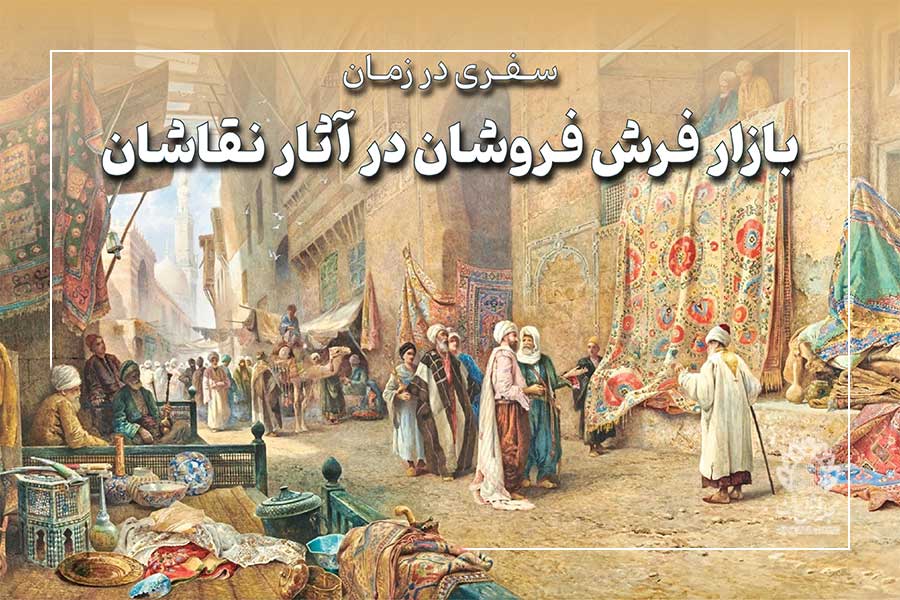
Through the medium of painting, fine art offers some of the best clues to the masterpieces of carpet weaving. Some of the best-known paintings depict carpets in the lives and societies around them. Join us as we travel through these canvases into the mysterious world of Oriental carpets.
The East is the birthplace of many ancient tales and epics, woven into human memory through legends of mystery, wonder, and fascination. Oriental carpets, too, are equally enchanting and compelling, rich with symbolism. For centuries, they have been part of the lives of people from every station in society, adorning the domains of the mighty and the kings, and bearing witness to their stories.
 Many of these carpets, including the Bahar-e Khosrow carpet, have themselves vanished from history. Fortunately, surviving accounts have kept their stories alive. Oriental carpets also captured the attention of fine artists, and several renowned painters included them in their works or drew inspiration from them. In this way, painting offers one of the best sources of insight into these masterpieces. Some of the most famous works depict not only carpets, but also the lives and societies around them.
A journey through time to the Oriental carpet markets in paintings
The popularity in Europe of what we call Oriental carpets is reflected in European paintings from the fourteenth century onward. Renaissance artists’ works are therefore a valuable source for the designs of early Persian and Ottoman carpets. Yet some of the best information available to us comes from later artists. The late Middle Ages and the Renaissance are considered a golden age of carpet production and design. Many traditional designs and motifs emerged during this period. In the eighteenth century, however, many carpet-weaving centers were affected by war and conquest.
In the late nineteenth century, interest in Oriental carpets and Persian rugs revived, and many traditional weaving centers began producing again and creating new designs. This also caught the attention of Orientalist painters. The work of scholars and collectors, which began in the late nineteenth century, considerably expanded the surviving collections of Oriental carpets and made it possible to compare existing carpets more closely with their painted counterparts. Western comparative research led to a more precise cultural history of the Oriental art of carpet weaving. In turn, this renewed and stimulated scholarly interest in the countries where these carpets originated. Comparative research based on Renaissance paintings and carpets held in museums and collections continues to expand our historical and cultural knowledge of the art.
Painters who considered Persian and Oriental carpets worthy of their canvases often travelled through the mysterious East, recording what they saw in astonishing detail and adhering to rigorous standards of accuracy in their subjects. They placed carpets in a variety of settings. One of the most frequently depicted settings is the carpet market. Looking at these works takes us on a journey into the heart of history, transporting us to bustling markets of another age—places where we might wish to lose ourselves among the carpets’ captivating patterns and the fragrant aroma of spices.
With Jean-Léon Gérôme in a nineteenth-century carpet market
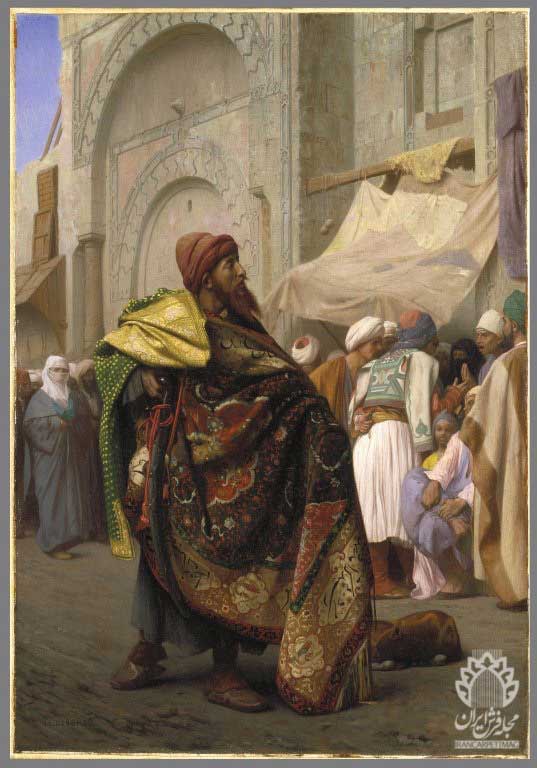
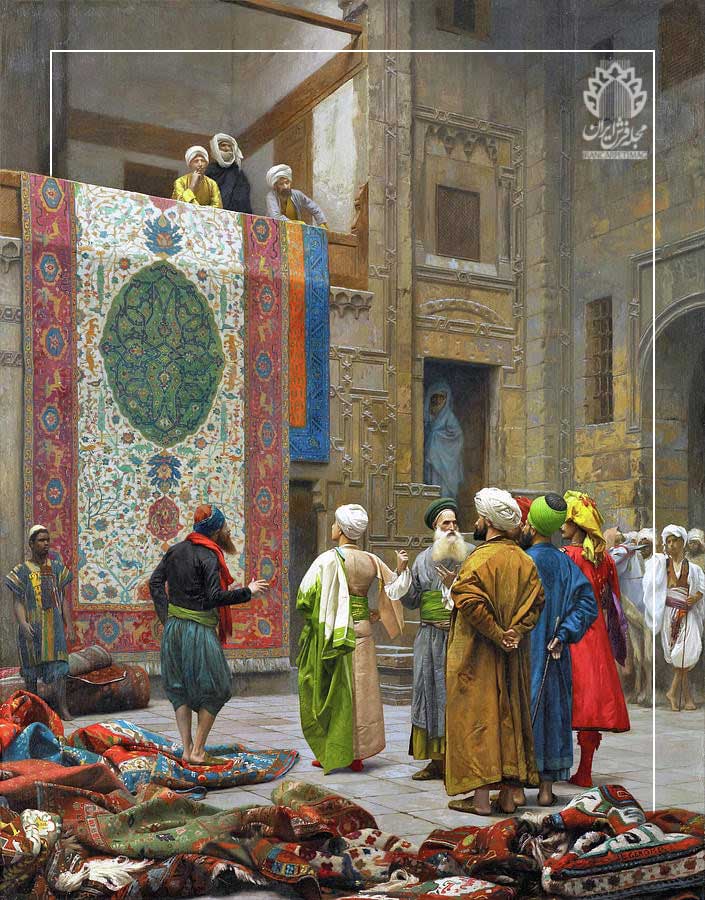 The Carpet Merchant by Jean-Léon Gérôme
One of the most famous Orientalist paintings of a carpet market was created by Jean-Léon Gérôme in 1887 and is titled The Carpet Merchant. Gérôme, who studied at the École des Beaux-Arts, was a prolific and popular artist. Like Delacroix and many of his artist and writer friends, he travelled extensively in North Africa and the Middle East. With The Carpet Merchant, Gérôme opens a window onto the carpet market in Cairo, resembling the scene he experienced during his travels in the East in 1885. He gives us a clear sense of the scale and remarkable detail of this work. The viewer looks upon the finely rendered scene from behind. Several men, whose clothing suggests wealth, inspect a large carpet hanging from a balcony. Decorated with floral and animal motifs, it almost obscures a smaller carpet, which may already have been sold or may not have interested the buyers. More carpets lie on the ground, apparently either rejected or already sold, since no one pays them any attention; all eyes are on the large carpet. The men regard it with different body language. The white-bearded man points to the carpet with his fingers. Two men have their hands clasped behind their backs, seeming to show little interest in buying. The youngest member of the group stands closer to the carpet to get a better look. A little farther away, a dark-bearded man points at something. Others surround the scene, their appearance suggesting a lower social standing. They are spectators or personal guards, with no significant role in the carpet transaction, watching in amazement—much like the viewer of the painting.
In the Cairo carpet market with Charles Robertson
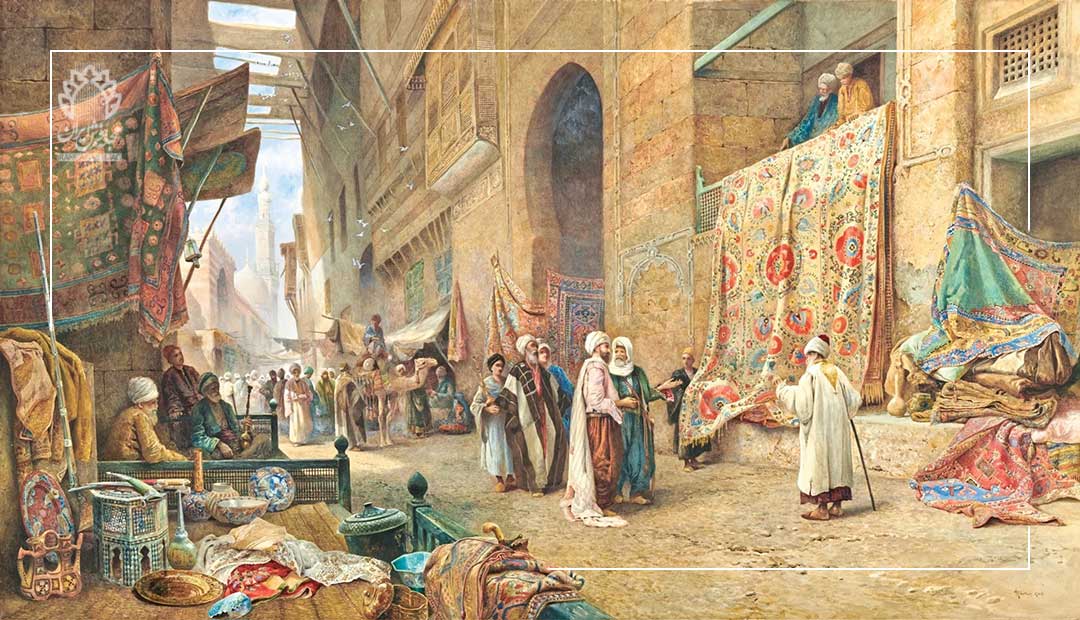 Carpet Seller, Cairo, by Charles Robertson
Charles Robertson was another Orientalist painter fascinated by carpets and carpet merchants. Many of his paintings recreated the markets of Cairo. One of his finest works is The Carpet Seller, Cairo, painted in 1887. This magnificent painting shows us pieces of several fine carpets and draws our attention to an extraordinary masterpiece with an all-over design. As in his other work, the artist also gives us a sense of the carpet’s scale in relation to the human figures, while depicting it in a way that reveals its exceptionally fine weave. Another striking feature is the vivid green and purple of the carpets on the right side of the painting.
These colors remain rare even today, and producing them calls for extraordinary skill in natural vegetable dyeing.
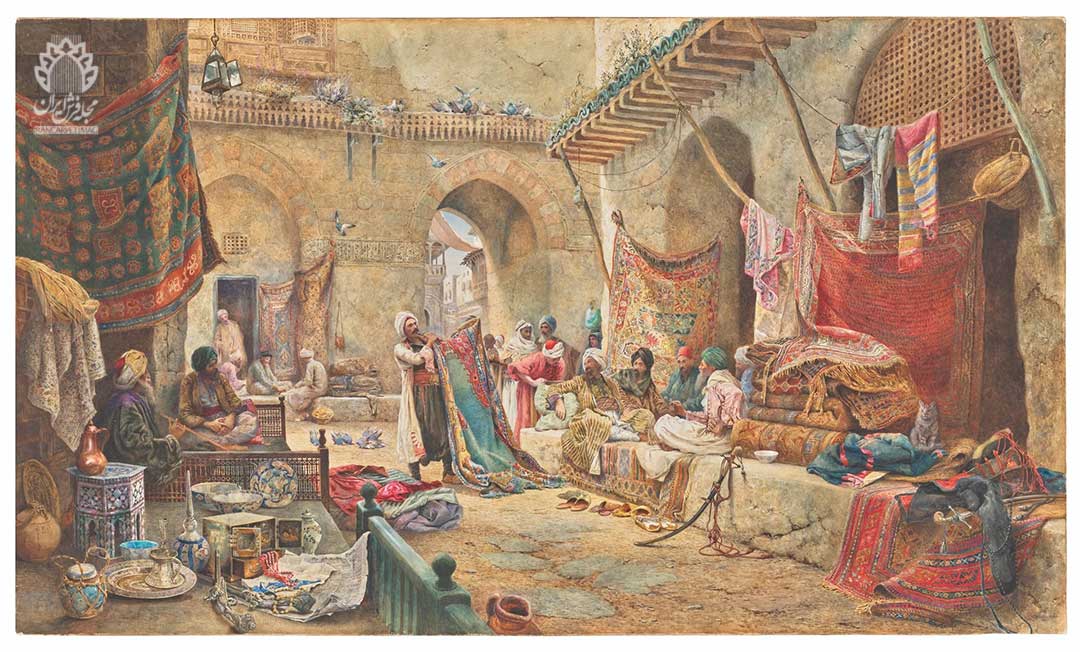 The Carpet Market, Cairo, by Charles Robertson
Here we see another of Charles Robertson’s famous paintings of The Carpet Market, Cairo. This work is significant because it shows the merchant with what appears to be a typical example of a village carpet. Smaller than the carpets in the other paintings, it represents a nomadic-village rug of the period. In The Carpet Market, Cairo, Robertson conveys the reach and international importance of carpet weaving at the end of the nineteenth century. He records examples of carpets from various parts of the world dating to the late nineteenth century, including the distinctive Kazak carpet hanging on the left side of the painting. A large Ottoman carpet can also be seen hanging in the farthest arch on the right. Alongside these, examples of nomadic and village carpets that appear to have been woven in Iran can be seen throughout the work.
Faizeh Ghaderi Handwoven Carpet Specialist
Related Reading
All Journal & Blog Research Articles
Symbolism of the Neyriz Tree Carpet
Among researchers, Neyriz tree carpets are known as “three-trunk” carpets, since the tree’s trunk is formed from three sections, sometimes aligned uniformly and sometimes arranged unevenly. Read more about this carpet in this article.