A Thousand Rows Woven from Answered Prayers
In the first centuries after Islam came to Iran, many carpet designs popular in the Sasanian period continued to be used and retained their place in the Islamic era. Although it is generally thought that some designs disappeared altogether, the evidence available to us through the fifth century AH shows that the designs and motifs of pre-Islamic carpets—especially those of the Sasanian period—also persisted in the Islamic era, at least in some regions of Iran.
 Saf carpet, Tabriz, 1890 CE
 Saf carpet, Deccan, India, 19th century CE
The Arabs, who had once torn the carpet of the Palace of Ctesiphon to pieces, became the most important patrons of carpets in the Islamic era. Persian carpets—or carpets modeled on Persian designs and motifs—were spread throughout the Islamic world, from palaces to mosques. This patronage has continued to the present day: the world’s largest carpet, covering more than 6,000 square meters, was woven by Iran Carpet Company for a mosque in Abu Dhabi.
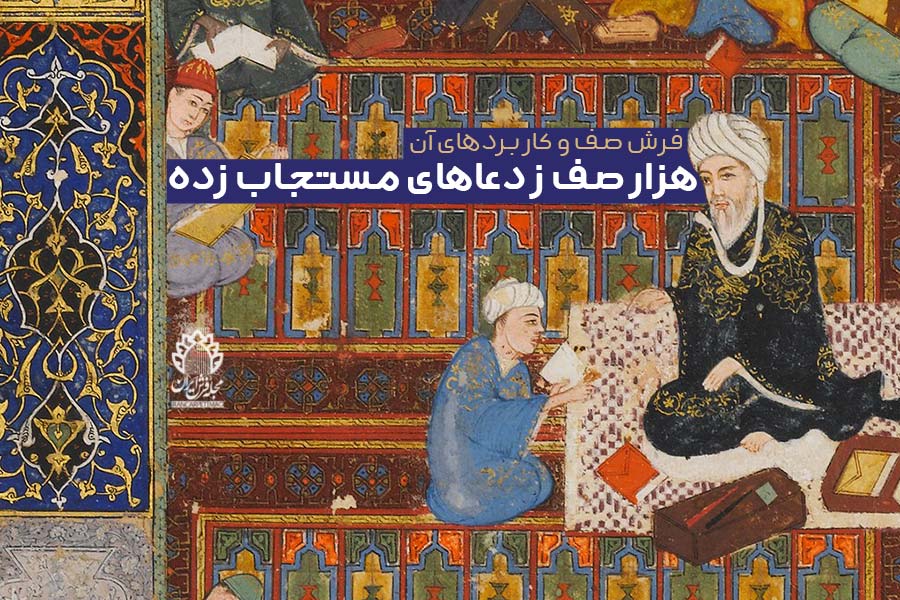
Among these, however, there was one group of carpets designed and woven entirely in response to the needs and conditions of the new Islamic era: carpets known as saf (row) carpets, made specifically for mosques. Their purpose was to align the rows of worshippers and keep them continuous, so that the lines of congregational prayer remained unbroken and the followers stayed connected to the imam. This type of carpet also appears in a number of Persian miniatures, especially those depicting stories set in a mosque or madrasa, such as “Layla and Majnun at School” in a Timurid-period copy of Nizami’s Khamsa, dated 835 AH (c. 1431 CE), or a manuscript of the Maqamat of al-Hariri.
There are also rare examples that can overturn our assumptions and open new avenues for research in this field. One is the carpet below, woven in the 19th century CE in Xinjiang, in western China. It is a small-format carpet, too small to have served as a prayer rug for several adults to stand on. It may therefore have been made to encourage children to pray, or perhaps as a wall hanging.
 Saf prayer rug, probably from Xinjiang, western China, 19th century CE, 330 × 101 cm
Compiled by Dr. Davoud Shadlou Faculty member, Carpet Department, Shiraz University of Art
Photo Album (2)
Related Reading
All Journal & Blog Research Articles
Symbolism of the Neyriz Tree Carpet
Among researchers, Neyriz tree carpets are known as “three-trunk” carpets, since the tree’s trunk is formed from three sections, sometimes aligned uniformly and sometimes arranged unevenly. Read more about this carpet in this article.