A Story Beyond Life
Before the Taliban returned to power in Afghanistan, colorful Central Asian carpets were a common sight in Kabul’s carpet market. The most frequently traded, however, were portrait carpets, their vivid colors reminiscent of film posters. Portraits of Ahmad Shah Massoud were especially common, appearing in abundance on both handwoven and machine-made carpets.

It is hardly surprising that Afghan carpets should bear Massoud’s portrait. Portrait carpets generally bring art and politics together, and follow a visual language of their own. Massoud, too, is a national hero of Afghanistan.
Few people are fortunate enough to have their likeness woven into a carpet and embraced by the public. The first requirement is to have a story that reaches beyond one’s lifetime. The Lion of Panjshir has such a story. He fought both the Soviets and the Taliban, and became a symbol of resistance. His sudden martyrdom, like an untimely absence, further strengthened his popularity. In Hollywood, America’s deceased leaders are immortalized on film; in lands where carpet weaving is a tradition, national heroes live on in carpets.
 Turkmen carpet depicting Lenin
Massoud carpets are plainly more political than artistic. Both handwoven and machine-made examples are inexpensive, which has helped them circulate widely. This is not true, however, of every portrait carpet, which is woven in various forms from the Caucasus to Iran and China. In the Soviet Union, the state spent heavily on portrait carpets, which served the Soviet propaganda machine. For more on Soviet propaganda carpets, see the article “Sickle, Hammer, and Loom Beater.”
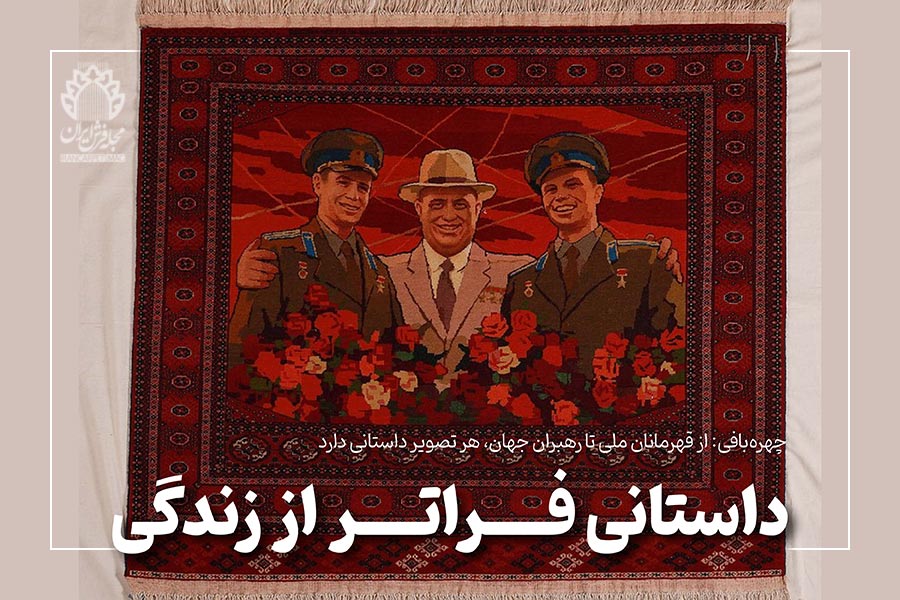
One of the most unusual figures to have his likeness woven into carpets was probably Yuri Gagarin, the Russian cosmonaut and the first person to travel into space. On 12 April 1961, he flew into space aboard Vostok 1 and completed one full orbit of Earth in 108 minutes. Carpets depicting him were particularly popular in the 1960s and 1970s.
Portrait weaving also has a long history in Iran. Before the Revolution, carpets were woven with portraits of the Shah and the Pahlavi family, as well as of some American presidents, including Nixon and Kennedy. After the Revolution, portraits of leaders of the Islamic Republic were also woven into carpets in great numbers.
 Turkmen carpet, 1962: Nikita Khrushchev (First Secretary of the Central Committee of the Communist Party of the Soviet Union) with Yuri Gagarin and Gherman Titov (the world’s first cosmonauts)
 Portrait of U.S. President Nixon; this carpet was presented by the Shah to the U.S. government in 1971
Perhaps one of the most unexpected figures to appear on Iranian carpets is the young American Howard Baskerville, who was 24 and teaching at the Memorial School in Tabriz. He gave his life in the Constitutional Revolution, while trying to break the siege of the city. He is often remembered as “Iran’s American Lafayette” and “the American martyr of Iran’s Constitutional Revolution.” During a battle at Shanb-e Ghazan in Tabriz between the Rescue Force, led by Baskerville, and the besiegers, a bullet struck him in the chest and killed him. Sattar Khan took the rifle Baskerville had been holding when he was killed, inscribed it with his name and the date of his death, wrapped it in the Iranian flag, and sent it to his family in America. Tabriz carpet weavers also wove his portrait into a carpet to send as a gift to his mother in America.

Compiled by Dr. Davood Shadloo Faculty member, Department of Carpet, Shiraz University of Art
Photo Album (2)
Related Reading
All Journal & Blog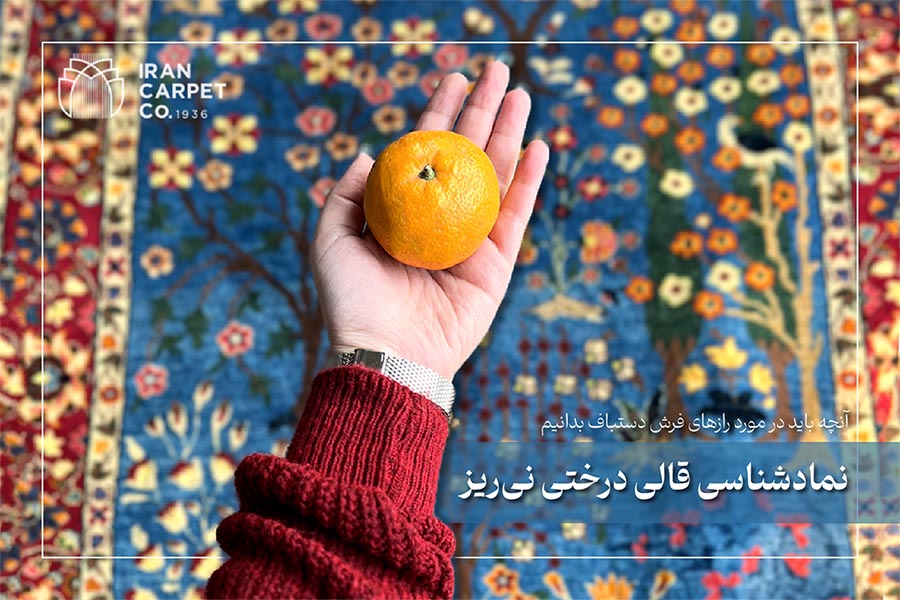 Research Articles
Symbolism of the Neyriz Tree Carpet
Among researchers, Neyriz tree carpets are known as “three-trunk” carpets, since the tree’s trunk is formed from three sections, sometimes aligned uniformly and sometimes arranged unevenly. Read more about this carpet in this article.