Wool: The Most Important Raw Material in Handwoven Carpets
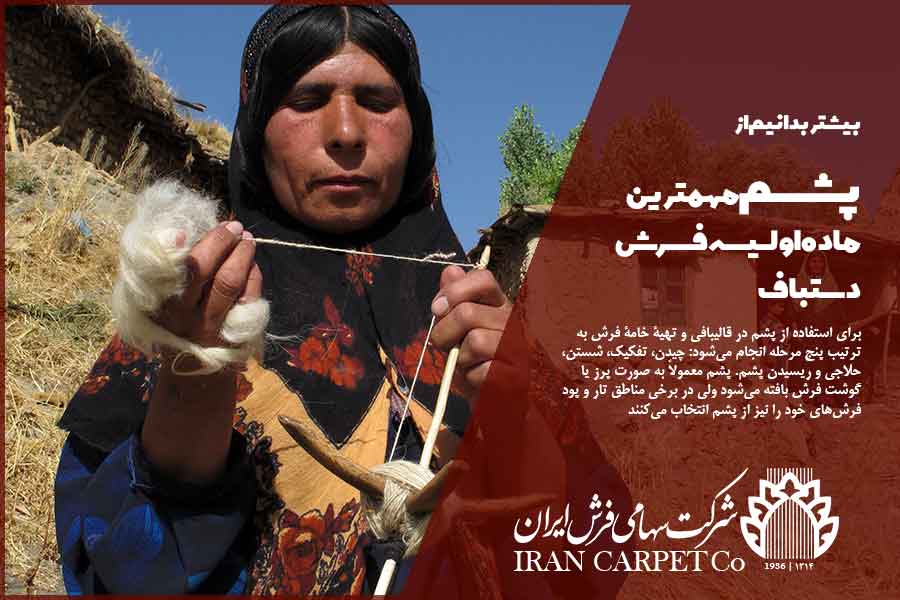
Despite its relatively dry climate, the vast Iranian plateau has green pastures suitable for raising livestock. Sheep are bred on the slopes of the Alborz and Zagros mountain ranges—particularly around Sanandaj and Kermanshah—as well as in northern Khorasan, Baluchistan, and central Iran. Their fine wool is used to make durable carpets that stand up well to wear. Well-known Iranian sheep breeds include Qaragol, Makui, Sanjabi, Kurdish, Afshari, Baluchi, Qezel, Kal Koohi, Moghan, Bakhtiari, Naeini, and Sangsari; all are suited to the production of handwoven carpets. Sheep raised in mountainous regions and temperate climates produce finer wool than those in low-lying, humid areas. Sheep are generally shorn twice a year. The spring fleece is longer and heavier, while the autumn fleece is finer and lighter. In general, spring wool is better suited to carpet making. There is an inferior type of wool known as pulled wool, which is entirely unsuitable for carpet weaving. Pulled wool is removed from the hide of a dead sheep by chemical treatment; it is less strong and not suitable for carpet making. One way to identify it is to grip a woven piece of wool: the pile fibers break easily and come away in the hand. Preparing wool for carpet weaving and making pile yarn involves five stages: shearing, sorting, washing, carding, and spinning. Wool is generally used for a carpet’s pile, but nomadic weavers such as the Qashqai, Baluch, and Lur tribes also use wool for the warp and weft of their carpets. These are known as all-wool carpets. In almost all Iranian weaving centers, wool is used for the selvages, with the exception of silk carpets. Lur and Baluch carpets sometimes use goat hair for this purpose as well. There are several ways to distinguish wool from other fibers, including: The burn test: A small amount of fiber is brought close to a flame. Natural wool behaves as follows: near the flame, it moves away and contracts as it loses moisture; in the flame, it burns slowly and partially melts; once removed from the flame, it continues to burn slowly. Its smoke smells of sulfur and, more distinctly, of singed hair. It leaves a dark, softenable ash. Visual examination under a microscope: Under magnification, wool fibers have scales resembling those on a pine twig. The scales are free at one end; the older and more damaged the wool, the shorter and less raised they are.
Down Down is one of the materials used in fine, relatively expensive carpets. The term refers to the soft wool that grows on sheep, goats, and camels and catches between the teeth of a comb when their coats are combed. Given the large number of small rugs on the market inaccurately described as down rugs, it is clear that so many could not be made from fibers that are so difficult to obtain. Rather, fine foreign wools such as Merino are used to form the pile of these rugs.
Related Reading
All Journal & Blog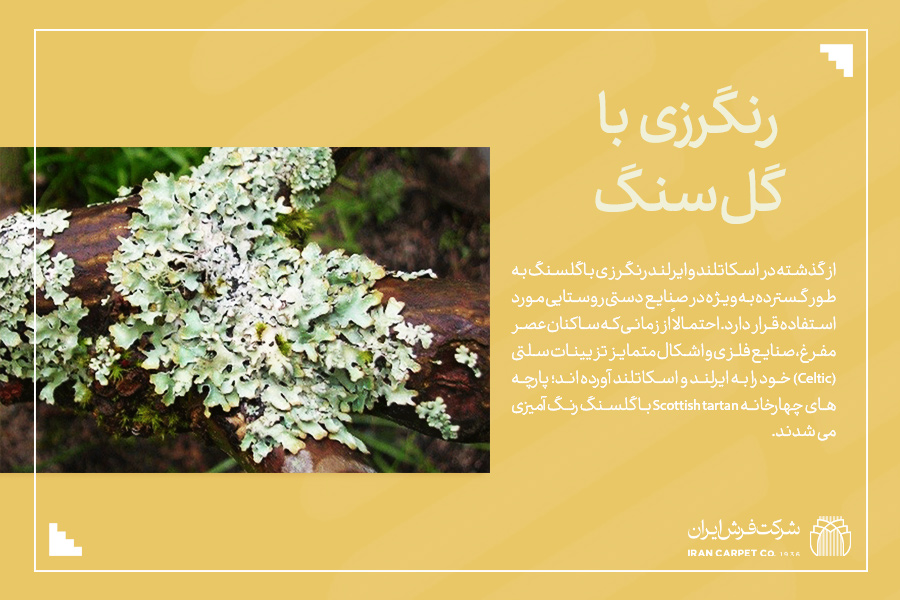 Weaving & Dyeing
Dyeing with Lichens
A lichen is a living partnership between two organisms—an alga and a fungus—sharing a single body. Lichens usually grow on rocks, walls, and tree trunks, forming patches of yellow, whitish gray, or greenish gray.