
Interviews
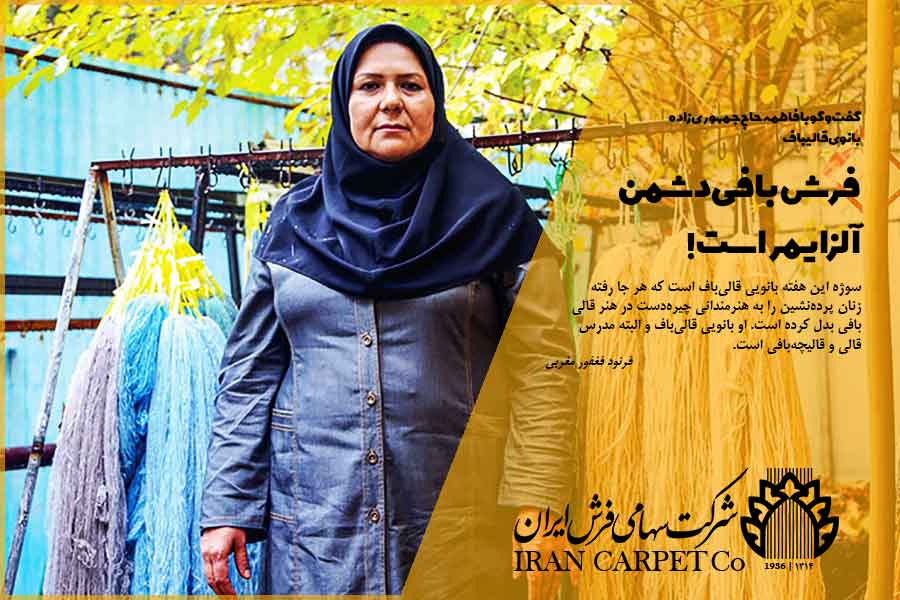
Weaving Carpets Is the Enemy of Alzheimer’s!
Nov 22, 201918 min readIran Carpet Company
Farnoud Faghfour Maghrebi
A carpet holds within it the thoughts, dreams and four-season landscapes of this land. Before a carpet is finished, its weaver endures many hardships and sleepless nights. She creates a work of art that does not fade with time; indeed, the more it is walked upon, the greater its value becomes. The story of a carpet, with its countless rows of knots and stitches, is like the tale of the “One Thousand and One Nights,” and can be approached from many angles. The first night of this tale is the setting up of the looms; next comes warping. It takes strong hands and a particular knack, and is considered men’s work. One must think about the design while also sourcing yarn and weaving tools. In the end, patience and perseverance must be brought together to keep the work moving forward. When the carpet is cut from the loom and its ends are released, a new life begins for it. But the story continues: the carpet must be finished, and then comes the final “trial”—the hardest night of all: finding a buyer. This is when middlemen appear, buying the carpet for “a paltry price” and “a few dirhams,” while the exhaustion of months of weaving remains with the weaver... This week’s subject is a woman who, wherever she has gone, has turned women who rarely ventured beyond their homes into accomplished carpet-weaving artists. She is both a carpet weaver and an instructor in carpet and rug weaving. She has introduced several women in the North Resalat Street area, Mehrgan Township and elsewhere to the art of carpet weaving, and has countless stories and memories to share.
I carry the carpet loom on my shoulders “I was born in Kashmar and have been living in Mashhad for these past few years. My husband is in the military, so we have settled in different places every few years. But wherever I went, I set up to weave carpets and rugs, continuing my own work and inviting neighbours, friends and acquaintances to join me. I have three sons, and all three have taken part in carpet weaving with their mother to some extent. My middle son came first in a carpet-weaving competition held in the province’s schools, and my youngest earned one million tomans from weaving over the three-month summer break. Of course, he does this alongside football and his other pastimes. I was born into a family in which everyone wove carpets. Weaving is a legacy passed down to all of us by our elders, and I learned the art at my family’s side from the age of seven. Although I still weave, this craft is becoming less common and less vibrant in our hometown every day. I may be one of the few remaining custodians of Kashmar’s carpet-weaving tradition who continues the work in Mashhad. Kashmar’s carpet weavers generally complain that the income is meagre.”
The aches of carpet weavers are a sweet kind of pain It is clear that sitting for long hours at work can cause problems for a person’s bones and muscles. Weight gain due to limited movement is one such problem; bone and joint pain is another. The carpet weaver agrees: “Contrary to what people might think, our eyesight does not usually become very weak, but there is no escaping backaches and pain in the legs. Of course, after a while the body ‘gets used to it.’ But remember that rural women have many other responsibilities alongside carpet weaving, most of them involving physical labour, which more than makes up for the lack of movement!” She also speaks of the benefits of weaving: “Alongside the ailments that may result from weaving for long periods, it is beneficial for the mind. It is impossible for a carpet weaver to develop Alzheimer’s. We do not really suffer from hand or foot pain either, because weavers who use handwoven carpets in their own homes do not develop the illnesses associated with factory-made carpets, thanks to the natural wool in the carpet. I wish academics and researchers would explain the harms of factory-made carpets to the public. For example, my aunts are ninety years old and have woven carpets for years. They are living with all their wits about them, yet in our own family we sometimes see men and women in their sixties already facing the problems of old age.”
I bring the art of carpet weaving into people’s homes She continues: “I have no hesitation about teaching my work and art to others for free. I do not think that more weavers will flood the market and make business slow. Carpets have found a place both inside and outside the country, and even if the number of weavers doubled or multiplied several times over, the carpet market would not become saturated. A few years ago, I tried to set up carpet-weaving workshops in District 3, but I encountered difficulties. Perhaps families were not comfortable with their daughters going to a house that had been turned into a workshop and working there for hours. At first, people were enthusiastic, but later their interest waned. There are no longer dedicated homes in this area equipped solely for carpet weaving in the way I had hoped, but many women are weaving rugs and pictorial carpets on their own at home. One of my students and weavers had a university degree. She said she could not find a job, and that weaving could make up for everything she lacked. These days, I provide the basic equipment for several women who are steadily weaving carpets, rugs and pictorial carpets, take it to their homes, and give them the design. We sign a contract and agree on a payment; they finish the work by an agreed date and receive their wages. Three women in the Mehrgan area and another three in Qarqi, after receiving training from me, have become weavers and now earn an income for themselves and their families, even if it is not quite enough. I also have students working in other parts of the city.”
I am an advocate for carpets Before teaching carpet weaving in her classes, the instructor covers a few simple but important points. She constantly says that carpet weaving is the enemy of Alzheimer’s, and says she has a scientific basis for this claim. She also makes an interesting point: “If a woman learns to weave carpets, she can work in her spare time and, in a year or two, create all the carpets and rugs her home needs with her own artistic fingers. A handwoven carpet is a familiar adornment in every Iranian home, and it also serves as a store of wealth.” The instructor says: “Anyone can learn carpet weaving, and people can start at the age of seven, just as I did. Someone can take it up even at ninety. At most, ten to twelve lessons are needed to learn the work.” At this point in our conversation, I look at the carpets in Ms Haj Jomhouri’s home. It seems to be a case of the potter drinking from a broken pot. I ask, “So where are your handwoven carpets?” She smiles and says, entirely contentedly, “They were traded up!” I ask her to explain, and she says: “Ten years ago, I wove several carpets for my own home. On average, each one cost me 500,000 tomans. Last year, I sold each for around 12 million tomans. We used and enjoyed them all those years, and in the end I received a good sum that went towards buying our new home!”
Low wages, high profits! When the discussion turns to economics, the carpet weaver begins to air her grievances. “Do you know why handwoven carpets are scarce—and expensive?” When I fall silent, she explains: “There are various reasons, but perhaps the most important is the low wages paid to carpet weavers. On average, if someone spends five hours a day on this craft, they earn around 700,000 tomans a month. But it may be hard for you to believe that carpet exporters buy the fruits of our work for, say, four million tomans and sell them to the final customer for 12 million! I have often seen a carpet bought for 18 million tomans in our own town and sold in Mashhad shops for 34 million. Some people who know how this works approach the weavers directly and, as the saying goes, buy from the source, avoiding the extra cost of buying from carpet sellers.”
Carpets differ from one another Carpets are valued differently in the market. They are generally known by the name of the city or place where they are woven—for example, Tabriz, Mashhad or Na’in carpets. Their designs also vary. The artist says: “For the weaver, the different designs do not make much difference. What distinguishes carpets is their thickness and what is called density. For example, Kashmar carpets have a lower density, while carpets from Bajestan and Gonabad are denser. Na’in carpets are woven very finely. Where other places might use two-ply yarn, a Na’in carpet is woven with a single strand.”
What about self-employed workers’ insurance? The reality is that women carpet weavers are among the most important examples of women who have created employment for themselves at home. By law, they should receive the necessary support, but the weaver tells a different story: “A few years ago, I looked into getting insured so that I would have an income in my old age. But they told me there was nothing available and that, as they put it, the scheme had been closed! So I let it go.”
Carpet weavers face many different challenges Carpet weavers face a range of difficulties, from the rising cost of yarn and sourcing raw materials to the way carpets are sold in the market. Ms Haj Jomhouri says: “Perhaps the first problem for most weavers is finding a suitable place to weave. I have a small loom at home now, but it cannot accommodate a 12-square-metre carpet or anything larger, so I have to stick to smaller pieces. To weave a carpet with an area of six square metres, you need at least a room with a wall eight square metres in size. Larger carpets likewise require larger walls, which means a larger room or workshop. That is why women who weave at home usually cannot take on large carpets; they settle for rugs and pictorial carpets, and the market is now full of these products.” She points to other difficulties facing weavers: “Raw materials for carpet weaving are hard to find in the city. In villages and small towns, it is easier to obtain them. Sellers will provide the materials without asking for a cheque, a promissory note or cash; everything runs on personal trust. But it is not like that in the city. We have to pay in cash, and if we are allowed to pay at the end of the work, the interest added to the original amount is so high that it effectively wipes out the weaver’s profit from the carpet.”
Middlemen are a source of frustration It has often been said that in different trades and businesses, middlemen take the largest share of the profits while producers receive the smallest. The carpet weaver from our neighbourhood agrees: “Carpet weavers are treated with the greatest injustice. When a middleman approaches a weaver, he calculates the cost of the raw materials and adds a small amount for the time spent weaving the carpet—that is all. He then sells that same carpet for two to three times as much in domestic and international markets, despite having done no work and created no added value. The entire job was done by the weaver.” At this point in our conversation, I hear some disheartening words from Ms Haj Jomhouri. She says: “You cannot recommend that someone take up weaving pictorial carpets or small rugs to earn an income. If we can promote carpets—and without making false promises—the only profitable ones are those larger than six square metres, and even then the profit is modest. Weaving a carpet of that size requires both patience and a great deal of raw material, which means the weaver’s capital is tied up. Weavers generally do not have much financial means and cannot cover the initial costs. That is why conditions for carpets and carpet weaving are not good. If the government or municipality provided support, we could set up many workshops across the city and right here in District 3, and increase employment. Remember, since carpet weaving is generally seen as women’s work, and women weave at home or in workshops, it can also offer reassurance in terms of women’s safety and dignity. We could empower the women of the city and district without creating side issues. But who is there to listen, and who has a heart that aches for those in need?”
I bring new designs to the market Most people think that carpets differ mainly in their designs. Some weavers work with designs that have long been regarded as traditional, while others, particularly in smaller carpets, experiment creatively. Many of the great designs recognised as traditional in the world of carpets—and sometimes registered nationally or internationally—are the result of the creative vision of these very women and men who weave carpets. Our district’s carpet-weaving instructor says: “I can turn any photograph I like into a carpet design and pattern and use it in my work. Pictorial carpets, however, are different. We weave them to order.”
Carpets serve many purposes If you look at a carpet only as a work of art, you might not have the heart to walk on a handwoven one. The striking beauty of carpets made by the hardworking, artistic hands of their weavers can be so extraordinary that, with a discerning eye and a calm, inquiring mind, each viewing reveals a subtle new detail. But the carpet weaver sees things differently. She says: “Carpets are made for the feet. A weaver spends her life at the loom. Don’t you think it’s a shame not to use something we have devoted our lives to making? When you lay a carpet on the floor, the eye enjoys it, and your feet are standing on a fine product.” At this point, the carpet weaver explains the difference between handwoven and machine-made carpets: “The difference between the two is like night and day. Machine-made carpets feel forced! Some skin conditions, backaches and pain in the legs come from these factory-made carpets. But when wool—the main material in a carpet—is used, as it usually is in a handwoven carpet, its balanced moisture makes it suitable for the feet, which are in truth every person’s second heart. Factory-made carpets, on the other hand, are dry. If I have to walk on a machine-made carpet, I would rather wear leather slippers than put my feet directly on it. People ask me why the older generation, especially those from rural areas, suffered less from foot and back pain. The answer is clear: they used products made of wool, not acrylic. Not only their carpets but also the blankets and mattresses they slept on were made of wool.”
Foreign buyers are better She says: “Because of the constraints imposed by my husband’s job, I cannot have much contact with foreign buyers or sell to them, but I have sold pictorial carpets in Turkey once or twice. Foreign customers do not buy our carpets at twice the price, but at three times the price! A gentleman from Turkey bought a pictorial carpet from me and called me one day to say, ‘I hung the pictorial carpet on the wall, and every time I look at it, I discover something new. I salute your artistic hands.’ Compare the way carpet weavers are treated in this country with the way foreign customers treat us. Of course, not everyone can take carpets abroad. Even if it is not exclusively in the hands of a select few, it requires substantial capital and connections—things that are certainly beyond the means of an ordinary carpet weaver in some far-off village. I wish we had carpet-weavers’ cooperatives to do this work. There are so many “if onlys” in the carpet business!” She continues: “Once, several other women carpet weavers and I sat down together and decided to start a company, drawing on family members who could help with domestic and international sales. But the idea never got off the ground, because none of us had or has the capital needed to start. If the government or municipality helped us with consulting, marketing and initial investment, we could become independent after a while, improve our own circumstances and earn foreign currency for our country and city. This is exactly what is meant by a ‘resistance economy,’ but in practice it does not happen.”
In closing: from fishing to carpet weaving! The artist concludes: “You have surely heard the famous saying: ‘If you want to feed someone for a day, give them a fish; if you want to feed them forever, teach them how to fish.’ One day, a woman came to me and asked for help. I told her the most I could give her was 1,000 tomans, but if she wanted to provide for herself forever and never have to hold out her hand to anyone, she should take my business card! She was surprised. I told her I was a carpet weaver and could teach her to weave. She came and learned. Now she is a carpet-weaving artist and gets by without needing help or charity from others. She works seriously all 30 days of the month and earns around two million tomans, supporting a family of three in her hometown. Whenever I see her, I am immensely happy that I have been able to empower a woman. I have one other small memory. Two of my students, who work in this very part of District 3, told me that they used to have to go to the farmland on the outskirts of the city from early morning until evening for 30 tomans a day, doing hard labour. They said they used to pray constantly that it would not rain so they could go out to work in the fields. Now they work at home beside their children, for even lower wages. They can look after their homes and work at the same time.”
 Interviews4
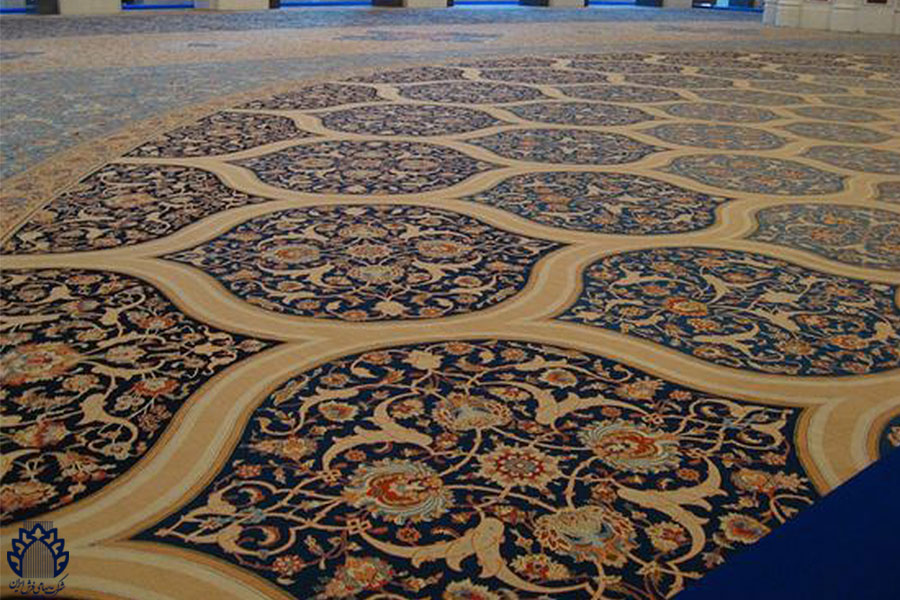
The carpet for the Sultan Qaboos Grand Mosque in Muscat is one of the large-format carpets produced by Iran Carpet Company. It was sent to Oman in 2000. On this occasion, we spoke with Reza Allahdad, who was the company’s Deputy for Production at the time.
 Interviews15
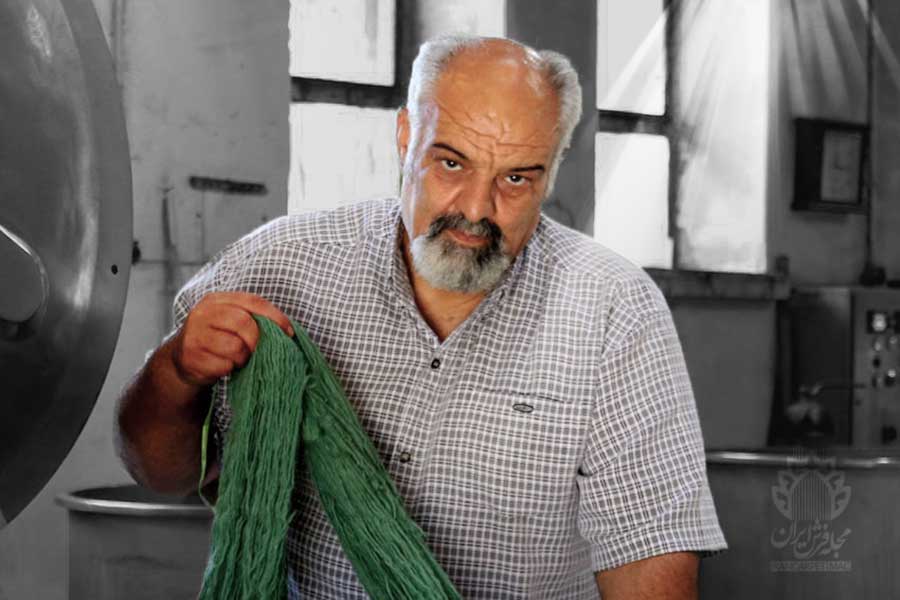
In its 14th issue, Carpet Plus, an online monthly magazine devoted to handwoven carpets, published an interview with Majid Jalali, a veteran dyer at Iran Carpet Company. Read the conversation below.
 Interviews
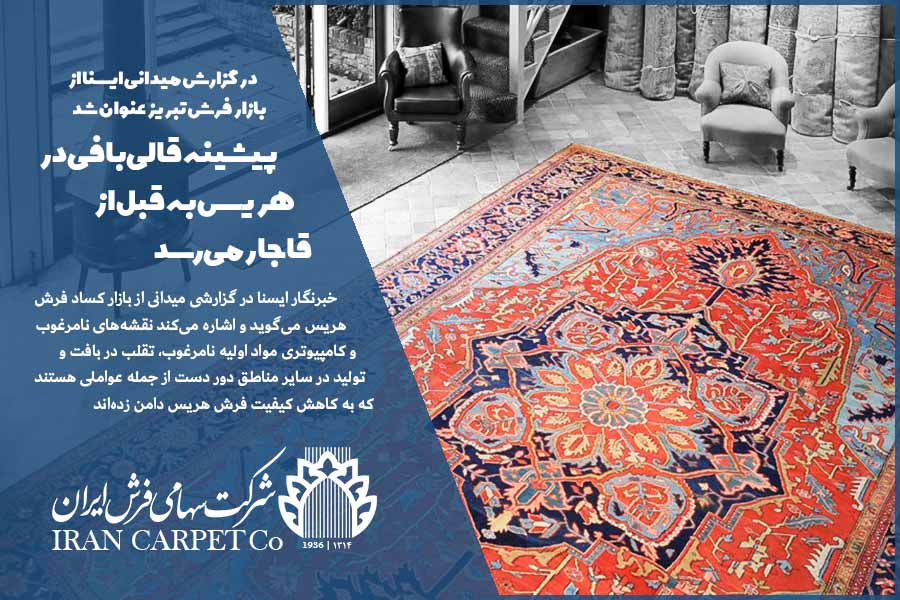
An ISNA field report on the sluggish Heris carpet market notes that inferior, computer-generated designs, poor-quality materials, deceptive weaving practices, and production in other, distant regions are among the factors contributing to the decline in Heris carpet quality.