Carpet-Weaving Masterpieces by Iran Carpet Company
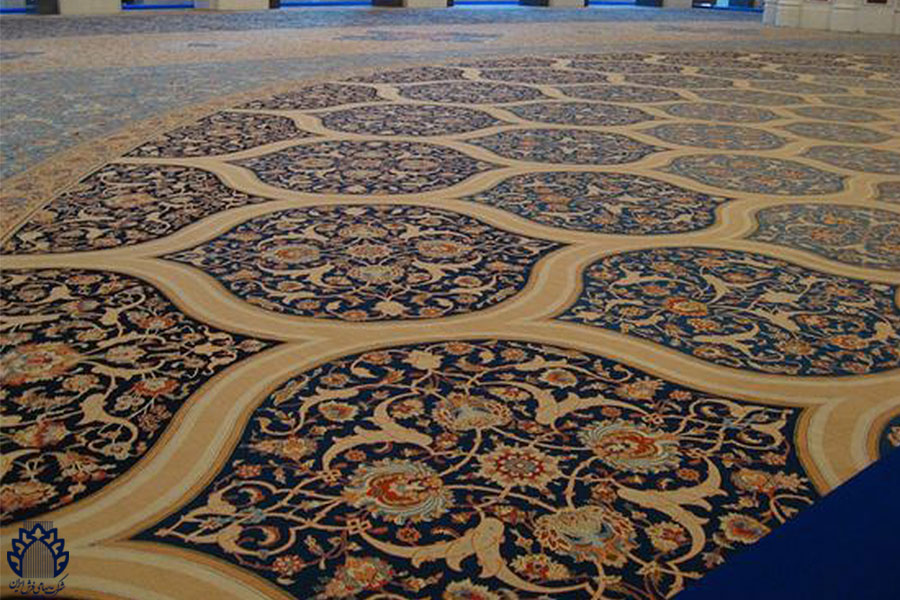
In addition to its regular production, Iran Carpet Company has had the privilege of producing and delivering several exceptional carpets to order for international clients. Among these masterpieces is the vast carpet made for the Sultan Qaboos Grand Mosque in Muscat. On December 31, 2000, the main headlines in the newspapers reported that the carpet had been sent to Oman. The reports read: “The world’s largest handwoven carpet, measuring nearly 5,000 square metres, was loaded and exported to Oman via Mehrabad Airport’s air cargo customs. The carpet contains 1.7 billion knots and was woven over three years by 500 carpet weavers. Experts have valued it at $5.2 million. Weighing 22 tonnes, it was woven using an authentic Iranian design and natural dyes, and is to be laid in the Sultan Qaboos Grand Mosque in Muscat. Designing the patterns took about eight months. The carpet consists of 42 sections, the largest measuring 1,200 square metres. A team of Iranian carpet artisans is to be sent to Oman to join the sections together over a period of three months.” On this occasion, we spoke with Reza Allahdad.
How were the raw materials for the carpet sourced?
The largest section of this carpet measured 30 by 40 metres—that is, 1,200 square metres. We could not use an ordinary warp. It had to be strong enough that, if a forklift lifted one part of the carpet while the rest remained on the floor, the warp would not break. We therefore had to import three tonnes of No. 50 cotton yarn from Korea. We twisted it into 27-ply yarn for the warp. As for the wool, since the carpet was 40 raj, we needed wool that would make it flexible underfoot, rather than stiff like felt. We decided to use foreign wool, combining 50 per cent of our own wool from Torbat with 50 per cent New Zealand wool.
How was the wool dyed?
Under our contract with Oman, all colours except the navy-blue family had to be dyed with natural dyes. Our dye vats held 50 kilograms each. Every expert knows that the shade differs slightly from one vat to another. Since the carpet required three tonnes of madder, we had no choice but to grind it into a fine powder and put it in the vats. We had not anticipated that the tiny particles of madder would penetrate the wool fibres and cause problems during spinning. In the end, we had to dye the three tonnes of wool intended for the red palette in fibre form.
We made an agreement with a spinning mill in Mashhad to spin the fibre. The mill worked on it for a week, then said, “I’m cancelling this contract. No matter how much you pay me, I can’t spin this fibre. The particles come loose, so I have to brush and clean the carding belts again and again just to produce yarn. It simply isn’t worth it for us.” As a result, we had the fibre carded three times to remove the particles. We prepared three tonnes of clean, uniformly plant-dyed fibre, then spun it into an even-coloured yarn.
Was there a workshop at the time capable of weaving a carpet of this size?
After preparing and dyeing the raw materials, we had to build a workshop. No existing workshop could accommodate a carpet of this area. At first, the Omanis had asked us to weave it in Kashan, but that was not possible. We discussed it with them and changed the contract to Mashhad and its surroundings—in other words, Nishapur. We first travelled throughout Khorasan Province, including Nishapur, Kashmar, Gonabad and Birjand.
We chose Nishapur for three reasons. First, it had a large number of weavers. Second, there was land on which we could build workshops. Third, we needed someone with land who was willing to work with us. A man named Baghshani, who was the company’s local agent in Nishapur, said, “I have the land.” We built two workshops: one in Baghshan, near Ghadamgah, and the other in Yousefabad, south of Baghshan.
What kind of looms equipped the two workshops?
We built the workshops to suit our looms. One loom was 50 metres wide and five metres high. A carpet of this size also required specific arrangements; we could not use just any loom. We laid foundations and steel girders in the workshop floors, anchoring the looms to the foundations so they would not lift off the ground when we tensioned the warp threads for warping. We also secured them from above with special cables to the foundations in the workshop roof.
The warping method was important to us. We had to use Persian-style warping. There were warpers in Nain who had warped carpets measuring 800 square metres, so we invited them to come and warp ours. We had to install 16 cranes along the length of the loom to hold the surplus warp threads. It was an enormous undertaking, and it was being done for the first time.
What type of knot did you use, and how were the weavers selected?
In Nishapur, all the weavers were accustomed to jofte weaving. We re-warped one loom in each workshop for carpets measuring 24 square metres, so that more people could work on them. We brought the weavers into these workshops and taught them to tie single knots instead of using the jofte technique. They learned the method by working on the Oman carpet. After a month, we tested them, then moved them to the main carpet.
We calculated that we could seat one weaver every 80 centimetres. The weft also had to run continuously, and not every weaver could manage it in separate sections. Their daily output had to be equal so that they could draw the weft through continuously. We also had to leave weft ends that would allow us to join the sections neatly when the carpet was assembled in the mosque. Every increase or decrease in length was monitored. The design had to be controlled as well. For example, a Shah Abbasi flower might be woven partly in Baghshan and partly in Yousefabad; we had to supervise the work so that when the two sections were laid side by side in Oman, the flower aligned perfectly—not higher on one side or lower on the other. The work was extraordinarily difficult.
The carpet’s design was inspired by the dome of the Sheikh Lotfollah Mosque. How did you choose it?
The story of the design was extraordinary. We had no idea what was happening when one day Mr Abed called to say that an order to weave a carpet had come in from Oman. Three Iranian organisations were to take part in the Omani tender: Iran Carpet Company, Jahad, and a private company. A message came from Oman asking us to send them a coloured carpet design on an A4 sheet within 24 hours.
I said that, to give Oman a glimpse of Iran, we should place the design beneath the dome of the Sheikh Lotfollah Mosque at the centre of the carpet. The rest could feature floral motifs combining elements from Tabriz, Isfahan and Kashan. I called in the designer and said, “Prepare this design on an A4 sheet.” He went away and drew it by hand on a single page.
Then I called in the painter, Mr Rezaeian, who is highly skilled. Before he began colouring the design, I contacted the Iranian Embassy in Oman and asked the ambassador which colours Omanis liked. In colouring the design, we tried to incorporate those preferred colours while preserving the character of our own carpet palette.
In the end, we sent the design to Oman within 24 hours. Later, when I went to Oman, I was told that the Sultan had liked the company’s design. Mr Hasan Vazifeh and Mr Pakdast helped translate the design into a full-scale pattern. Mr Pakdast asked us for a 100-square-metre hall so he could spread out the pattern paper. He was lying face down over the design. His son came to me and said, “My father is getting ill. What are you making him do? Cancel the contract. He can’t do this; he’ll get sick.” In the end, the design of the Sheikh Lotfollah Mosque dome was rendered at one-sixteenth scale. When weaving, we would need to repeat it sixteen times. We also rendered a quarter of the design, with the weavers repeating the remaining three quarters as they worked.
How were the design and colouring supervised?
We established a committee to review every design, one by one. If a Shah Abbasi flower, a scroll or a motif had been drawn incorrectly, it was sent back to the design unit for correction, then returned for review. The committee was responsible for matching the sections. Once it approved them, they went for colouring. Mr Rezaeian, Parsa-Serešt and Farahani handled the colouring. We had three highly skilled, top-level dyers. They coloured the carpet design, marking colours and dots on the quarter-scale pattern.
Since we had two workshops and little time, we thought we could make colour photocopies so weaving could proceed in different locations. That way, one workshop would not have to finish before the next could begin. At the time, however, photocopiers could reproduce only six or seven colours. We realised that this would not give the weavers enough information about which colours to use. So we called in the designer and asked him to draw the remaining three quarters of the pattern. We would then colour and mark those sections as well. In effect, we designed five thousand square metres of pattern by hand, then coloured and marked it. It was extremely difficult. When we asked the designer to draw the remaining three quarters, he said, “I want the same fee as for the first quarter.” I said, “But you’ve already designed it; you can trace the pattern.” He replied, “No. I want the same fee.” I said, “Fine. In that case, you’ll have to revise all the borders in the original design, as well as the remaining three quarters, because the border motifs must not repeat.” We ended up paying him the same fee for the remaining three quarters as for the first quarter. It proved very expensive for us.
Once the pattern was ready, it had to be cut into sections measuring eight centimetres by eight centimetres. Every time a weaver completed ten centimetres, they needed the next section of the pattern. We numbered the sections so we could keep track of which pattern each weaver had received and how much they had woven. We put a system in place to manage the issuing and return of each pattern section.
We seated the weavers at the looms and worked with them. Interestingly, in Nishapur they tied knots by hand. To teach them to make the asymmetrical Persian (Senneh) knot with a hook, we trained them at the looms, too, so they could work faster and more consistently. About 600 weavers were working in the workshops in Nishapur and Baghshan. When the carpet was about three or four metres long, we invited an Omani delegation to visit. They were very pleased with what they saw.
How was the finishing work carried out on a carpet of this size?
As the carpet gradually neared completion, we had to decide where to finish it. The sections needed a special place for finishing. We had built a workshop in Karaj for storing the carpets, so we transported them there rolled up and carried out the finishing work in Karaj.
The largest section, measuring 1,200 square metres, had 30 centimetres of excess at the ends. We invited a weaver from Arak and built hinged frames, attaching them to the carpet so it could be brought into position. Then we applied tragacanth gum to the back of the carpet to keep it from drawing in.
How did you transport the carpets to the airport?
We had to take several things into account when transporting them. First, customs officials had to come to Karaj and seal the carpets so they would not have to be inspected again at the airport. Second, we had to notify the Islamic Revolutionary Guard Corps. The carpets were packaged, covered with tarpaulins and looked like missiles when loaded onto the lorries. The Guard Corps was informed, and the lorries set off for Mehrabad Airport. We had chartered a cargo plane from Ukraine, which was at the airport on the day of dispatch. The carpets were loaded that same day and sent to Muscat.
What challenges did you face in packing the large carpets?
Before we rolled up the large carpet, I learned that the entrance to the mosque where it had to go was three metres and 20 centimetres wide. We had to roll the carpet so that the roll was three metres in diameter and could pass through the doorway. A team of 120 workers unrolled and rerolled it three times before we managed to reduce the diameter to three metres. The first roll was four metres across; the second was three and a half. For an entire day, all 120 workers worked under great strain to roll the carpets.
How did you select the carpet menders?
While the main carpet was being woven, we had woven several small sections, measuring one metre by one and a half metres. We put out a call for carpet menders, and 120 people came forward: a group of 30 from Isfahan and another 30 from Tehran, among others. We selected 60 menders and gave them the test pieces. We told them to mend them weft by weft. We would attach each piece to a forklift and pull. If the carpet came loose, the candidate had failed; if it held, they had passed. I was very pleased that the carpets held.
Tell us about sending the menders to Oman.
We had to arrange the menders’ deployment. The Omanis were responsible for accommodating the people we sent. They called to say they had selected some places for us. I went to see them and found an isolated spot on the outskirts of Muscat, with old buildings. I said, “These people are specialists. They won’t come and live here.” A month later they called again, and I went back to Oman. This time, they had selected some very luxurious apartments. I said, “Well, these apartments aren’t equipped. Where will they wash their clothes? What about refrigerators and the other essentials?” In the end, they bought brand-new equipment for every apartment.
We also chose an Iranian cook, who prepared a rotating menu so that the meals did not repeat for 15 days. He portioned the meals himself for the menders working at the site.
How did you install the carpets in the mosque?
I got a call saying that after laying the carpet, they had found it was out of alignment by 30 centimetres. I went to Oman and said, “Mr Shahidi, you should first have drawn a line with chalk to mark the carpet’s position, then laid it.” I saw that he had done so, but the line was too faint and had not been marked clearly. We gathered 70 people around the carpet, but it would not budge. The centre of the carpet had to be lifted. I called the Omanis and said, “I need 100 workers who speak English and are all dressed alike.” He said, “100 workers by tomorrow?” The next day, 100 workers in matching uniforms were at the mosque. We marked the line properly, then positioned everyone around the carpet. They lifted it so that the middle rose, and we pulled it into place. The problem was solved, and we installed the carpets correctly. I want to make clear that it was extremely difficult work.
Photo Album (4)
Related Reading
All Journal & Blog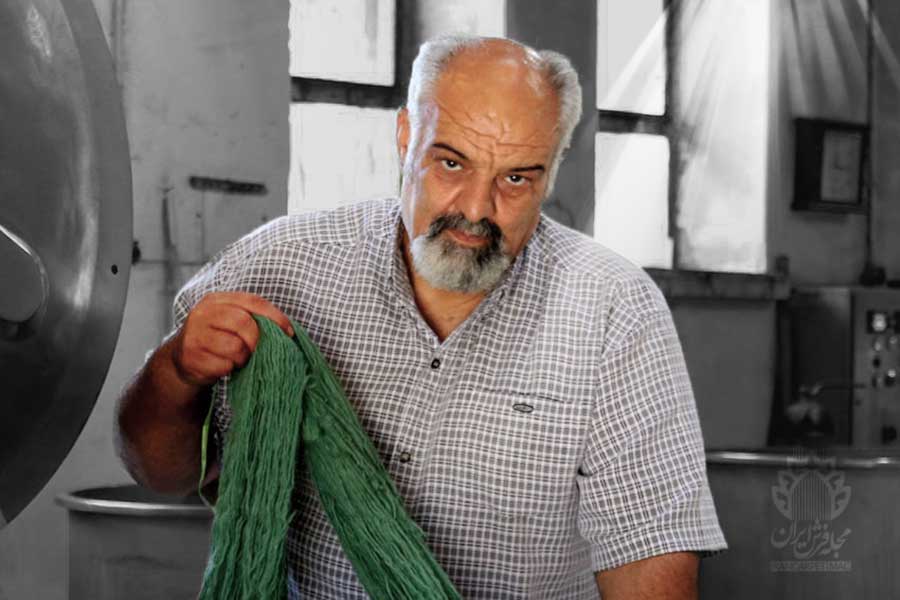 Interviews15
You Won’t Become a Master Dyer Until You’ve Worked at the Dye Vat
In its 14th issue, Carpet Plus, an online monthly magazine devoted to handwoven carpets, published an interview with Majid Jalali, a veteran dyer at Iran Carpet Company. Read the conversation below.