The Sultanabad Carpet: Arak Today
Arak Carpets
The city of Sultanabad in Iraq-e Ajam1, now known as Arak, was founded in 1187 SH (1808 CE) and later became a major center of carpet production in Iran. The first person to call Iraq-e Ajam “Arak” was Mirza Agha Khan Kermani, who introduced the name in a poem:
Its soil is fragrant with musk from end to end Arak is the bride of the world
The people of Arak are Persian-speaking and of Iranian descent. The city is a center for two important activities: agriculture and carpet weaving. Carpet weaving expanded in the region in the mid-19th century, with the presence of several foreign companies in Sultanabad (Arak). Before the arrival of Westerners, Sultanabad carpets followed Iran’s long-standing traditions in design, motifs, colors, and weaving tools. After foreign companies arrived, however, all these elements were influenced by Western art and culture and underwent significant changes. Accordingly, the history of scholarship on Sultanabad carpets can be considered in two broad periods: before the arrival of Western merchants, and after the establishment of foreign companies. The presence of these companies led to the emergence of a new carpet style that retained the structure and methods of traditional Iranian carpets while incorporating features of Western art. Thanks to their high quality and distinctive artistic characteristics, the city’s carpets attracted considerable attention from domestic and international traders in the 18th and 19th centuries.
Carpet Trade in Arak
The production of goods for export in Arak began around 1875, led by merchants from Tabriz. The Anglo-Swiss Ziegler company opened an office in the city in 1883. Ziegler employees were the first to make the practice of supplying weavers with dyed, ready-to-use skeins commonplace. They used both local and European dyes, and most often employed repeating designs. Before the First World War, foreign companies sent large quantities of two less expensive types of Sultanabad carpet to Istanbul, where they were known in trade as Mushkabad and Mahal carpets. Buyers from around the world, particularly from Germany and Austria, traveled to Istanbul to purchase Iranian carpets. The First World War dealt a severe blow to Arak carpets. Unexpected demand from the United States for a finer, newer type of carpet—the Saruq—saved these businesses. With the start of the Second World War, however, they lost their European markets and, temporarily, the American market as well. After its financial crisis, the United States once again placed orders for Saruq carpets, but circumstances had changed: the trade was now entirely in Iranian hands, and Iranian merchants became the intermediaries.
Common Designs and Motifs in Arak Carpets
Arak carpets feature a variety of designs and motifs, some of which are briefly introduced below.
Mostofi motif: Mostofi was a title bestowed by the Qajar rulers on their secretaries and officials. Weaving carpets with this design is common in Arak, Tabriz, and Bijar. The design is built around diamond shapes combined with Farangi flowers and ornamental branches.
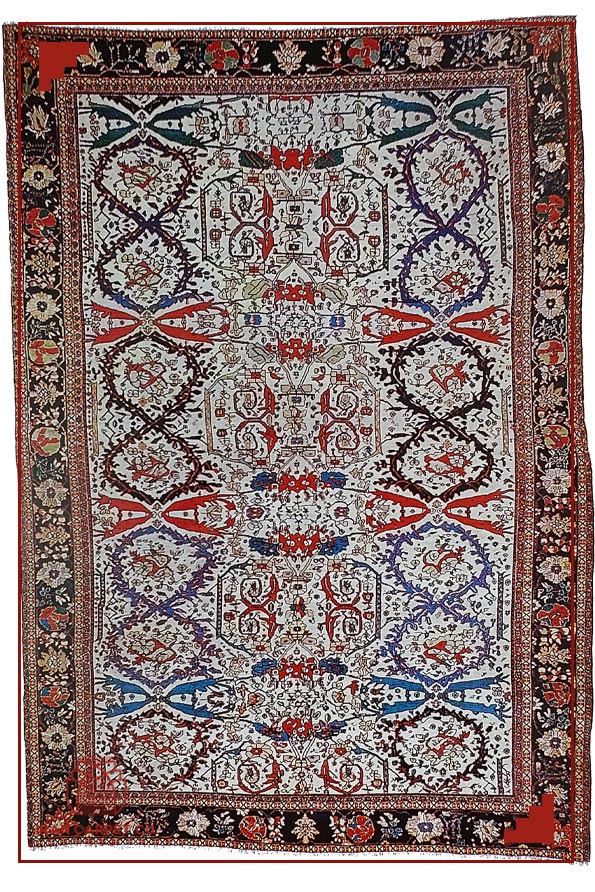 Mostofi design, Farahan (possibly Saruq), asymmetrical Persian (Senneh) knot. Final quarter of the 13th century SH. The carpet features a repeating, interlocking pattern known locally in Arak as Mostofi.
Henna flower motif: In the West, this motif is called “chestnut,” as its flowers and leaves resemble those of the oak. It is especially common in Sultanabad, Arak.
Tabari boteh motif: A single-boteh design featuring one large boteh in the field. In some examples, the upper end of the boteh is broad in shape; its resemblance to an axe gives the motif the name Tabari boteh.
Taremadz design: The henna flower design, known in the West as “chestnut,” is one of old Arak’s distinctive designs. It is also known as Taremadz, after one of its most important weaving centers.
Geography design: Woven in Arak in two similar styles, known as Solar Geography and Flower-and-Plant Geography.
Bird-and-fish motif: Visually, it differs only slightly from the intertwined fish design. Carpets in this design are no longer woven or produced.
Other examples of Arak carpet designs and motifs include the Boteh Miri motif (in its most authentic form, found in the village of Malmir in Sarband); the intertwined fish motif (designed and woven in Arak in styles known as Beehive Fish and Farahan Fish); the Zir-e Khaki design; the vase motif; the bouquet or vase-and-bouquet motif; the Shah Abbasi medallion and corner (Lachak-Toranj) with an all-over Afshan motif and Farangi flowers; and adaptations of the Bakhtiari compartment design.
Carpet-Weaving Areas of Arak
The principal carpet-weaving areas of Arak include Saruq, Arak, Mahallat, Tafresh, Shazand, Saveh, Farahan, Malmir, Mahal, Mushkabad, Khomein, and the villages of Delijan and Lilian. These are among the province’s major carpet-producing areas.
Saruq: Saruq carpets have a firm, dense weave and a short pile of 11–12 mm, with floral and foliate motifs covering the entire field.
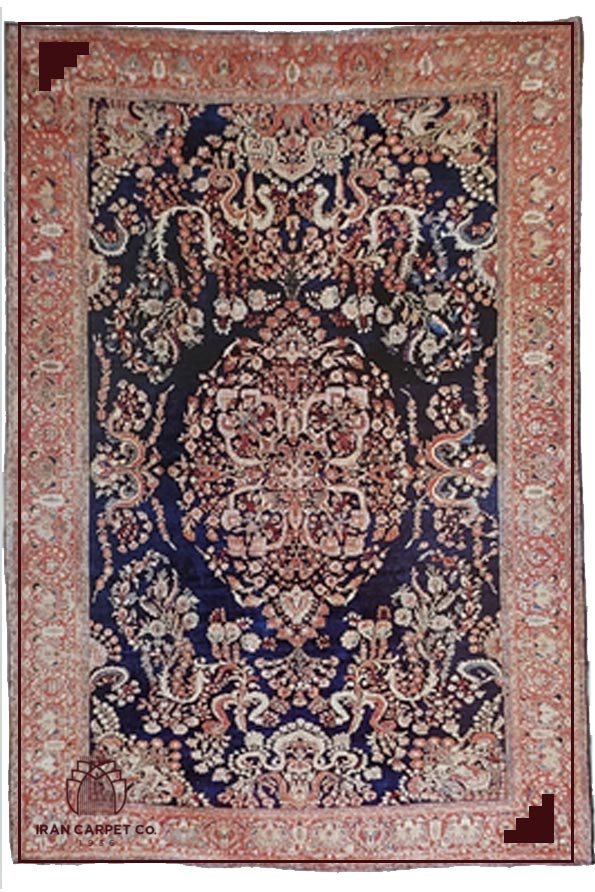 Saruq, circa 1300 SH. Most Saruq carpets have a navy-blue field.
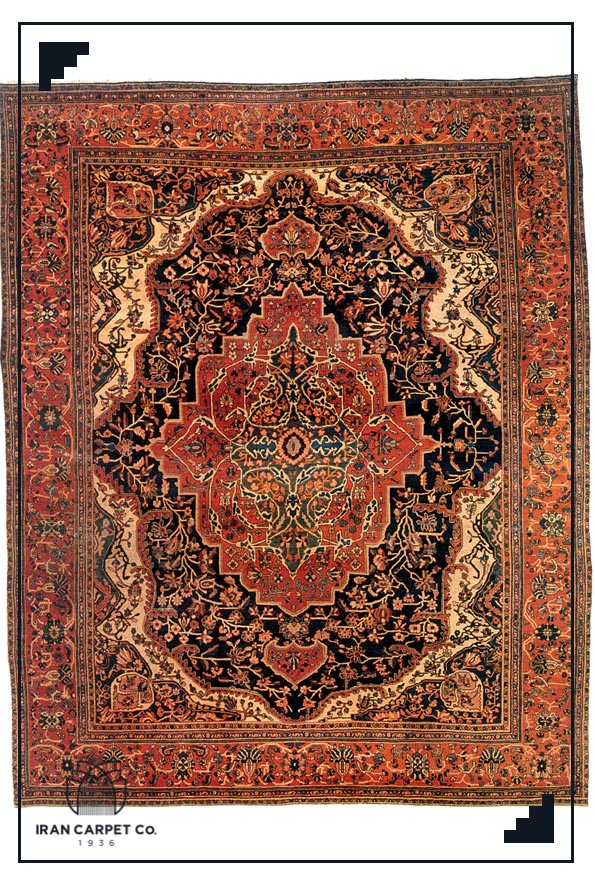 Medallion-and-corner design, woven in Saruq, 1299 SH.
Farahan: Farahan carpets have a compact weave and feature medallion-and-corner designs and fish motifs. Turkish Kaisariyeh carpets imitate those of Farahan.
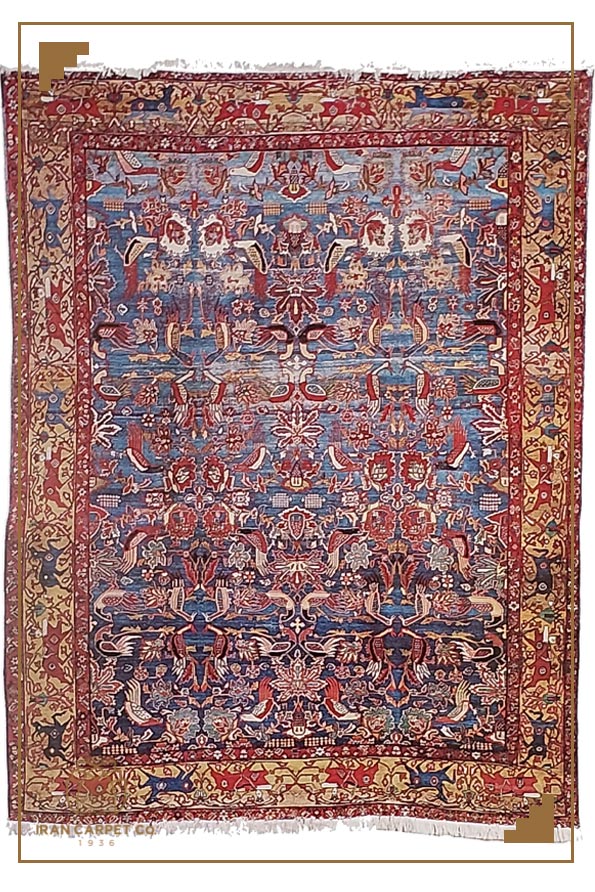 Sultanabad (possibly Farahan), first quarter of the 14th century SH, repeating pattern
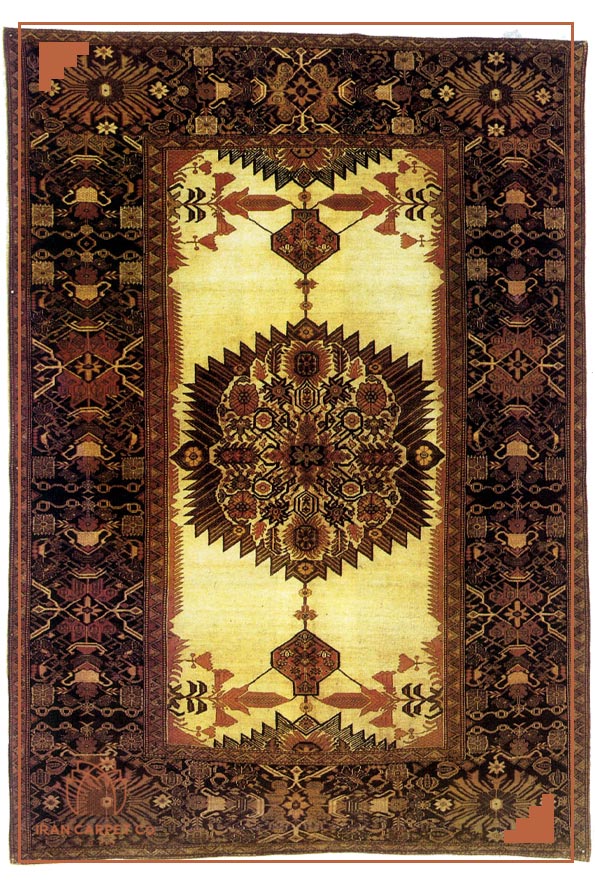 Medallion design, woven in Farahan, 13th century SH.
Mahal (Mahall): Carpets from the Mahallat region, particularly Mushkabad—which was once an important trading center—are known as “Mahal.”
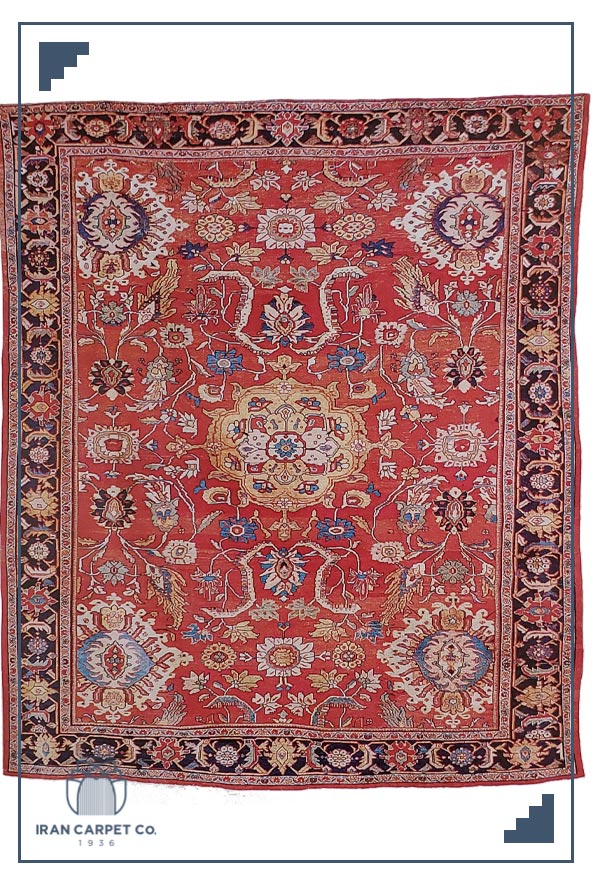 Sultanabad (Mahal), final quarter of the 13th century SH, medallion design
Mushkabad: Mushkabad carpets are quintessential market carpets: villagers make them using their own funds and sell them in the market for whatever price they can obtain. The designs used are generally established, repeating patterns, such as Herati, henna flower, Mina Khani, and crab motifs, as well as simpler Shah Abbasi and Joshaghan motifs.
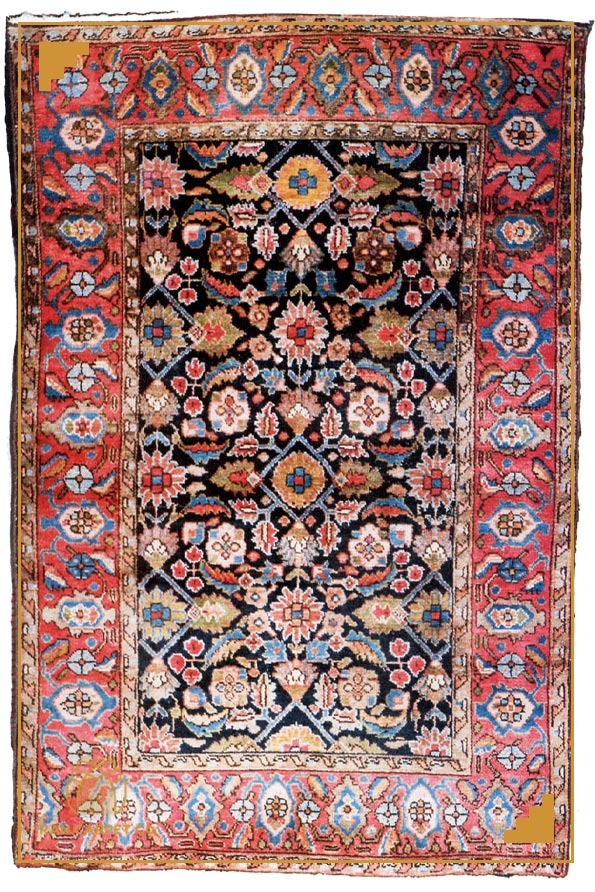 Repeating fish design, Mushkabad
Saveh: Carpet weaving in this area is mostly rural. Medallion-and-corner, tree, and compartment designs are woven on cotton warps and wefts, using the symmetrical Turkish (Ghiordes) knot. Their knot count is around 20 knots per raj. Common designs in Saveh include Gadeli Mazlaqani, Aghcheh Qaliyei, and Barqi.
Mazlaqan: The design woven into these carpets is highly distinctive and has continued to be used unchanged for more than two centuries. Technically, Mazlaqan carpets are of excellent quality: they are woven with lustrous, strong wool and have a closely clipped pile.
Tafresh: Tafresh weavers produce relatively fine, single-weft carpets, often measuring two zar. Their medallions strongly resemble clock faces, except that 16 markers—not the 12 points of a clock—radiate from the central medallion.
Sarband or Shazand: The Sarband pine design is widely known as the Boteh Miri design. The knot used in Sarband is symmetrical, and Malmir lies in the Turkic-speaking part of Sarband.
Armenian-Woven Carpets of Lilian
Lilian is one of the weaving centers of the Arak region and the largest of the seven Armenian-populated villages in the valley northwest of Khomein, where carpet weaving is practiced in all seven villages. Lilian carpets have a compact weave, a long pile, and a single weft. The warping is Turkish-style, and the knot used today is predominantly the asymmetrical Persian (Senneh) knot, although the symmetrical Turkish (Ghiordes) knot was also used in older Armenian-woven carpets from the region. The kilim ends are woven in the Persian style, and the selvages are continuous. The best-known motif in old carpets from Lilian and neighboring villages is the “goat horn” design.
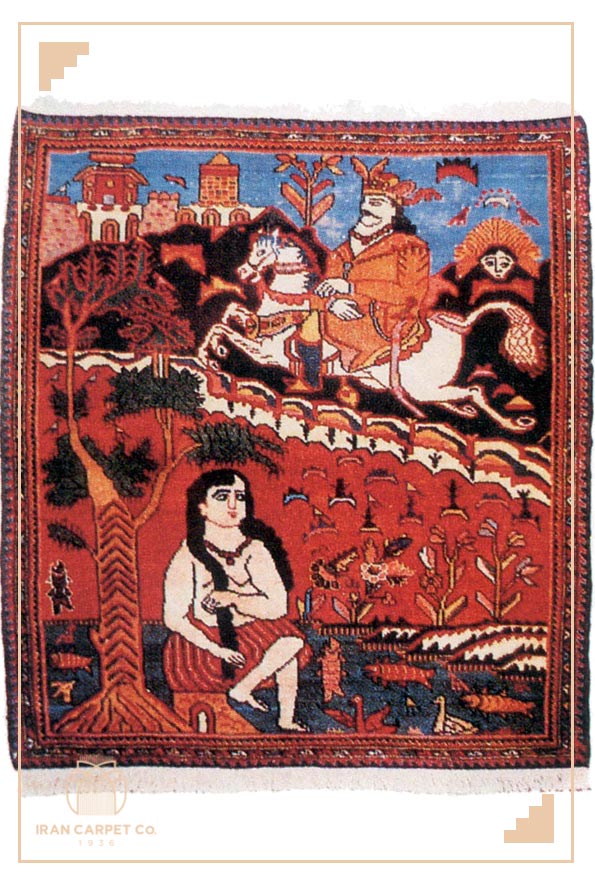 Figurative design, woven in Lilian, 14th century SH.
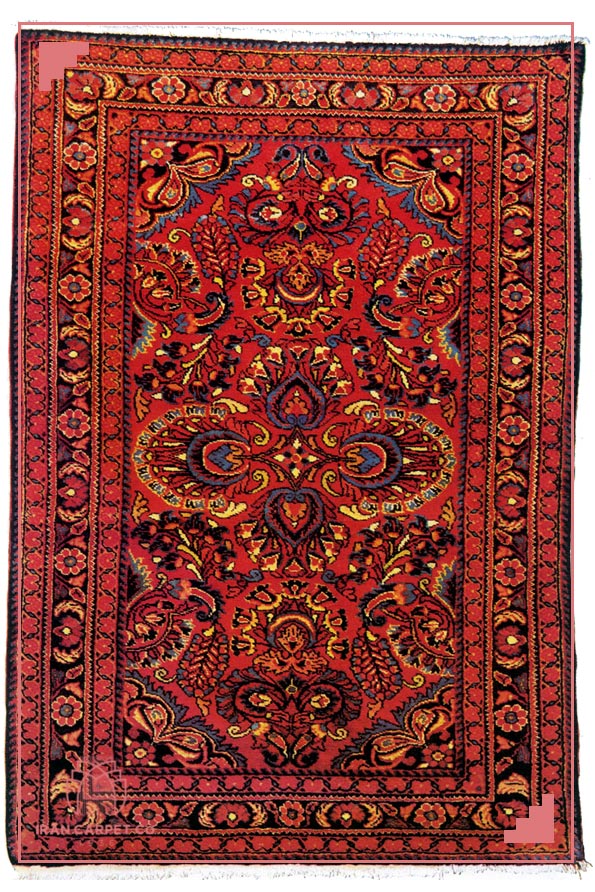 All-over Afshan motif, woven in Lilian, 14th century SH.
Reyhan: A village in Khomein, known for its Joshaghan design, the distinctive Band-e Reyhan motif, and its thick weave.
Taremadz: Northeast of Arak, known for its distinctive henna flower design, also called the Taremadzi pattern.
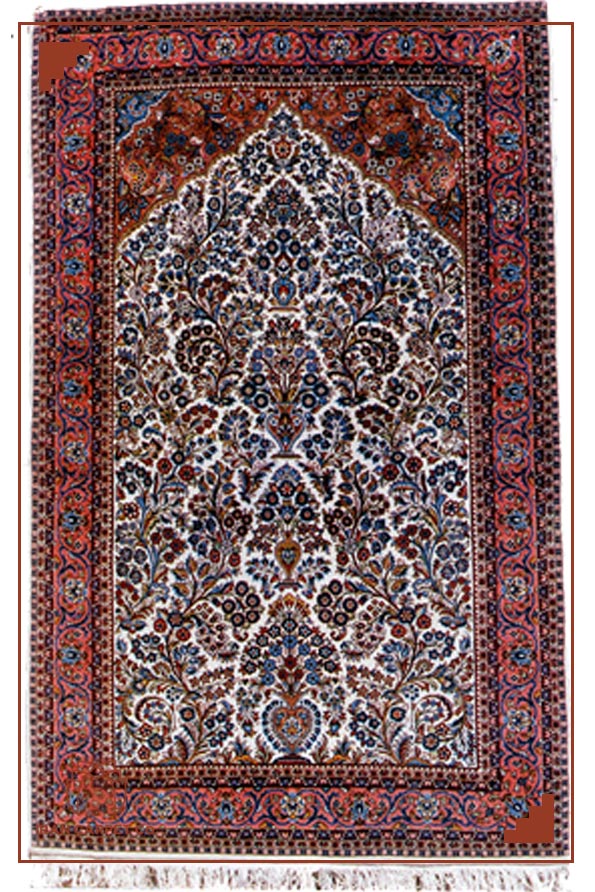 Woven in Ghiyathabad, combined design (a composite vase motif)
Technical Characteristics of Arak Carpets
Arak carpets are woven with the asymmetrical Persian (Senneh) knot, and knot counts vary considerably between the city of Arak and its villages. Villages north of Arak, such as Saruq and Ghiyathabad, produce rugs with knot counts of 40 and 45 knots per raj. Villages to the east and south of Arak produce carpets known as Mushkabad and Mahal, with knot counts ranging from 20 to a maximum of 30 knots per raj.
The selvages are woven, and the finishing and pile trimming are carried out during the weaving process. The loom is vertical, and the warping follows the Persian method. Today, all Arak carpets are woven with two wefts.
The principal colors used in carpets from Arak, Mahallat, and other centers in the province include crimson, navy, green, cream, beige, copper, henna, brown, and blue, each in a range of shades.
Among the distinctive features of rugs from the Arak region are the bone- and buttermilk-colored fields, and the beautiful green, intricately winding bands in Farahan carpets.
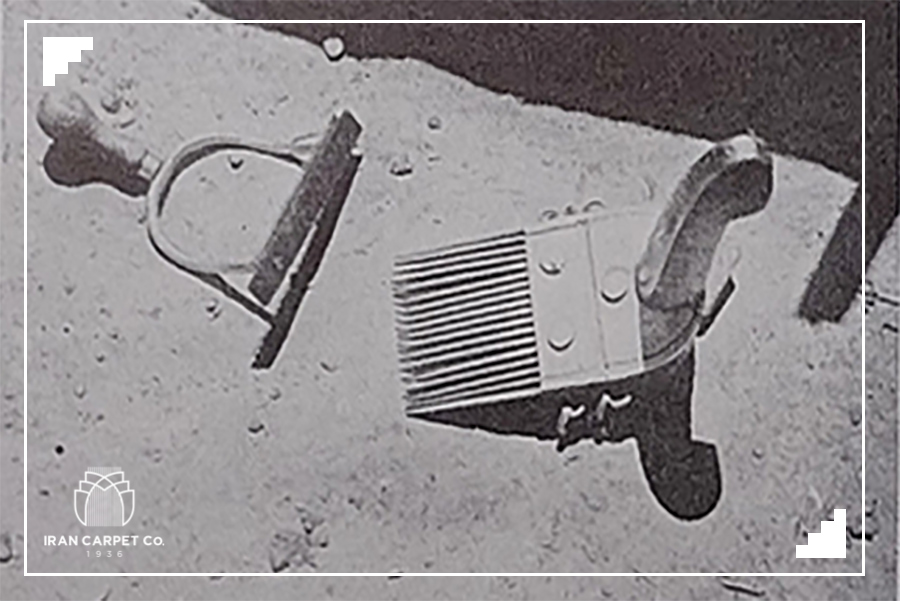 Weaving tools in Arak: on the right, a comb (beater) for beating down the wefts; on the left, a tool used to draw the woven pile forward
Notes
- In the past, this region was considered part of Iraq-e Ajam (Persian Iraq).
- After completing each row of a carpet, weavers use their hands or a comb to draw the knots forward. This prevents the ends of the knots from protruding from the back of the carpet. This process, known as pish-keshi, helps keep the back of the carpet neat and attractive.
Reyhaneh Kathiri M.A. in Handwoven Carpets
For further information on Arak carpets, consult the following sources:
- Edwards, Cecil, (1988). “The Persian Carpet,” translated by Mahindokht Saba, Book Lovers’ Association.
- Zholeh, Touraj, (2002). “A Study of the Persian Carpet,” Yassavoli Publications, Tehran.
- Nasiri, Mohammad Javad, (1995). “A Journey Through the Art of Carpet Weaving in Iran,” self-published, Tehran.
Related Reading
All Journal & Blog Regional Weaves
Tabriz Carpets: A Feast of Khata’i Motifs
Across the centuries, Tabriz has remained a cradle of art and culture. The handwoven carpets of this city seem to embody Iranian taste and creativity, their warp and weft alive with it. Tabriz’s skilled weavers intertwine delicate knots to bring inventive designs to life.