
Regional Weaves
Tabriz Carpets: A Feast of Khata’i Motifs
Jul 27, 20246 min readIran Carpet Company
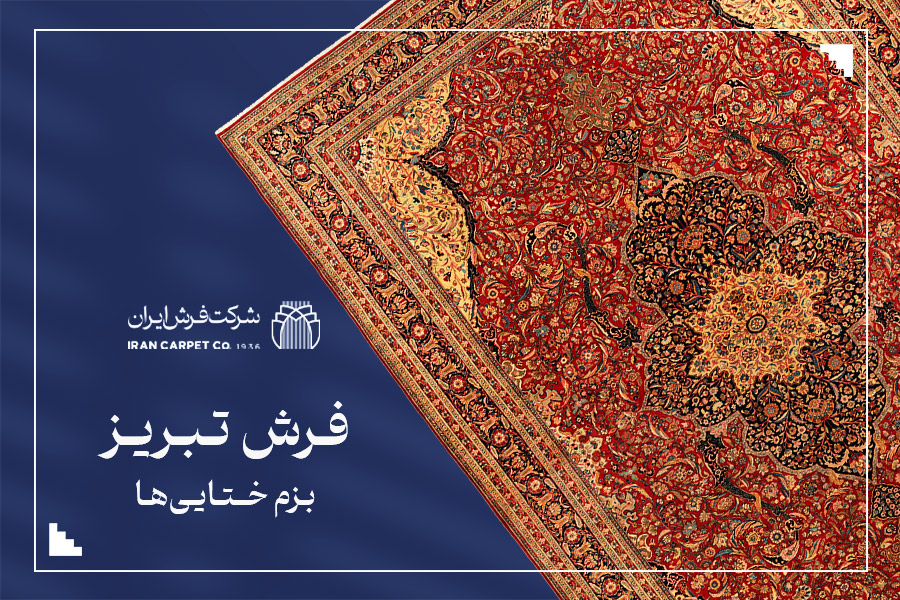
At the heart of Azerbaijan, Tabriz has pursued a long and fruitful course, drawing on a rich legacy of experience that reaches back to the Median era. The city’s history has been well documented for at least the past 1,000 years. A city steeped in feeling and artistic achievement, with a rich and flourishing culture, Tabriz finds one of its most captivating expressions in its carpets. It is widely held that many Safavid medallion carpets were woven in Tabriz and Azerbaijan. During the Safavid period, the establishment of large carpet-weaving workshops brought master weavers together in the city, where they produced exceptionally fine carpets. Some of Iran’s most celebrated and remarkable historic carpets—including the famous and historic Ardabil Carpet—were woven during the reign of Shah Tahmasp. Although it remains uncertain whether the Sheikh Safi carpet, the Hunting Carpet, or other renowned historic carpets can be attributed directly to Tabriz, the city was home to a royal library and distinguished calligraphers, painters, and illuminators, as well as centralized carpet-weaving workshops. After the decline that followed the Safavid era, Tabriz was among the first cities where the carpet trade expanded significantly in the late Qajar period, becoming a thriving market for European companies. During the Qajar period, Tabriz grew rapidly. Situated at a gateway between East and West, it enabled Iranian carpets to be exported to Europe as commercial goods via Azerbaijan and Turkey.
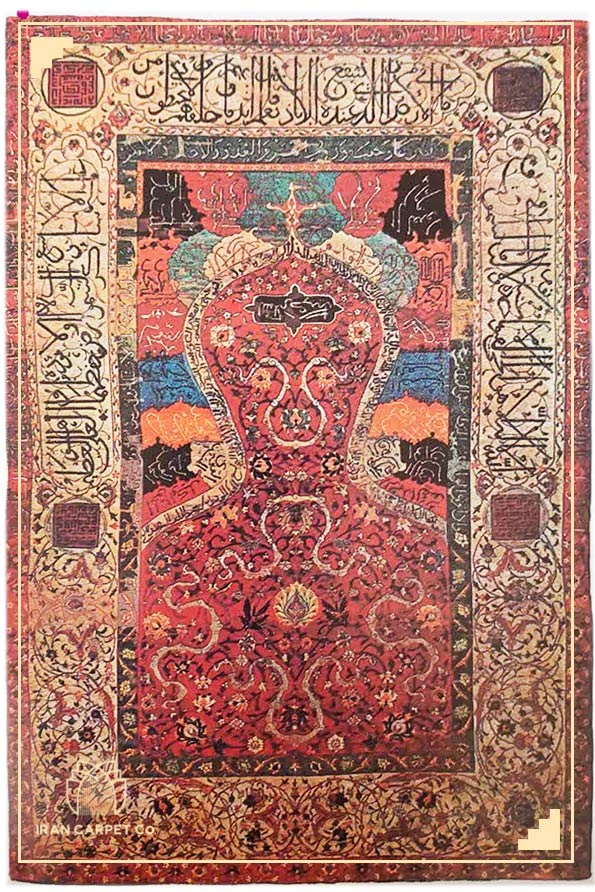 The best-known Tabriz prayer carpet, dating to the Safavid period, is held at the Metropolitan Museum of Art in New York.
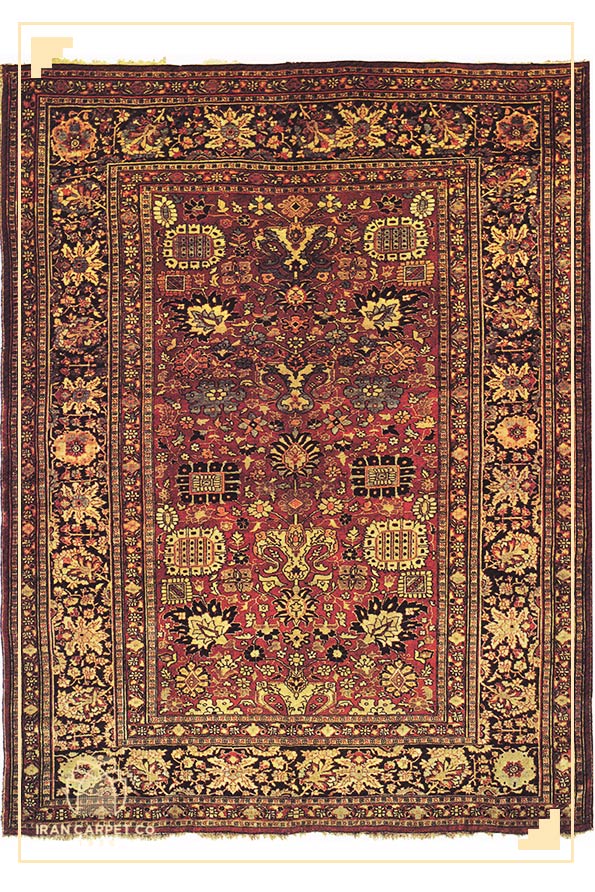 An old Tabriz rug with a composite vase design, woven in the 13th century AH; Iran Carpet Museum
What most catches the eye in Tabriz carpet designs is the dance of Khata’i motifs, which unfold across the carpet. Tabriz carpet designs are classified under a wide range of names. Some refer to the design itself: Mostofi (Gol-e Farang), the Fish or Herati design, medallion arabesque, medallion and corner (Lachak-Toranj) arabesque, vase, Mina Khani, tree, pictorial, dome, garden or Golestani, and hunting designs, among others. Others are named after their designer or maker, such as Qareh Bagh, Salari, Olya, Nami, and Khatibi—names that remain widely recognized in today’s carpet market. The borders of many Tabriz carpets are known as “samavari” or “tusbāqeh,” a border style also regarded as a defining feature of the Fish-in-Pond, or Herati, design. The palette of older Tabriz carpets was limited and strongly contrasting, often pairing reds with navy blue in the field and border. Today, however, Tabriz carpets are not constrained by a narrow palette, and designers and painters use a wide variety of colours. One notable innovation in contemporary Tabriz carpet colouring is the use of depth and perspective in a two-dimensional design, giving these carpets a distinctive identity. Another characteristic is the balance between warm and cool colours. Shading in the flowers and field gives the motifs a raised appearance; this technique lends the flowers a more natural quality and brings them closer to a realistic, naturalistic style. It is worth noting that Tabriz painters indicate colours on the design using a coded, numbered system known as the “mostureh” method. Earlier Tabriz designers such as Rassam Arzhangi, Mir Mosavvar, Khiabani, and Amin Afshar created works of exceptional value that continue to serve as models for young and emerging designers. Contemporary Tabriz designers and producers include masters Ahmad Emad, Habibollah Amin Afshar, Mohammad-Taqi Khiabani, Gholamhossein Khiabani, Mohammad-Hossein Najafzadeh (known as Banam Tabrizi), Mohammad-Ali Qareh Baghai, Master Hedayatollah Hamidzadeh, known as Salari, Jafar Pakdast, Ebrahim Pournami, and others.
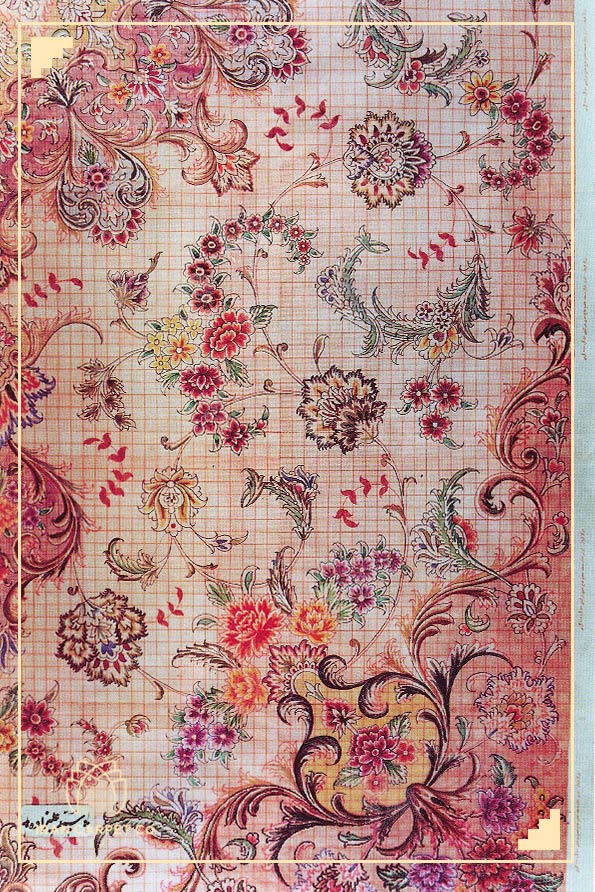 Tabriz Gol-e Farang design in the medallion-and-corner (Lachak-Toranj) layout
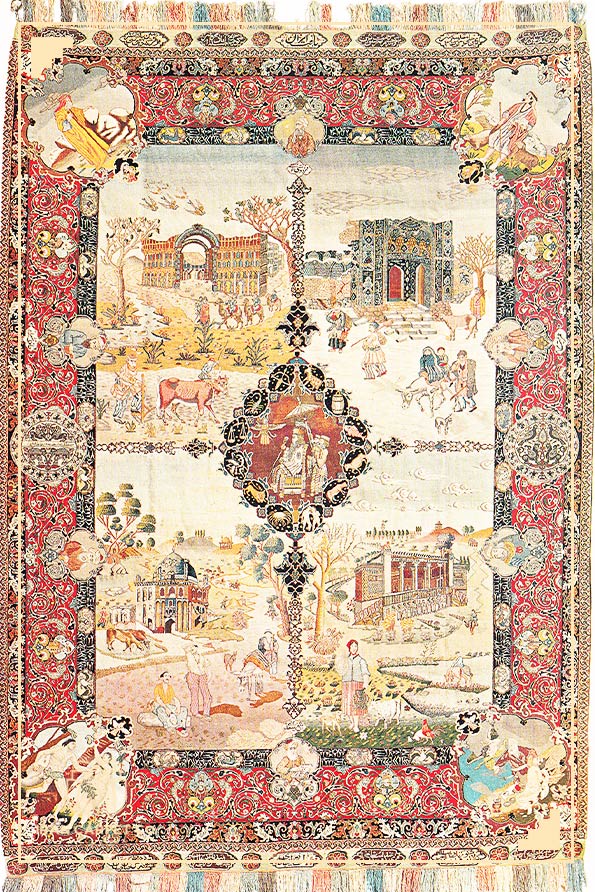 Second half of the 13th century AH; private collection
The Four Seasons carpet was designed by Master Seyyed Hossein Mirsavvar Arzhangi and woven by Master Sheikh Hasan Haddad Tabrizi at the “Sana’yeh Ijadi”1 workshop. A ghazal of six couplets appears in the upper and lower cartouches of the carpet. It begins:
A carpet beneath the feet of the rulers of the world***Honoured by the blessing of their auspicious footsteps
Tabriz carpets are generally woven to a high knot count, with short, fine pile, placing them among the finely woven carpets. The use of kerr wool—and especially silk—is common. Another characteristic is the use of white and coloured silk to outline flowers and leaves. Tabriz carpets are woven using a two-weft, loop-pile construction, and the customary knot in the region is the symmetrical Turkish (Ghiordes) knot. It is worth noting that Tabriz carpets do not use false knots. The selvage is often separate, meaning it is finished after the weaving is complete; the kilim finishing of contemporary Tabriz carpets follows the well-known Turkish style. The warp and weft are cotton, while the pile is wool and, in some cases, silk. The looms used are vertical, with Turkish-style warping. In Tabriz, knot count is measured over each 7-centimetre span; this unit is known as a panjeh. Knot counts vary from fine to coarse. In recent years, highly skilled Tabriz weavers have increasingly produced very fine silk-flowered carpets with knot counts of 50 and 60. Some of these carpets have silk warps. They are most often woven in medallion-and-corner designs, usually in light beige and buff, with raspberry, burgundy, olive, and red-lead hues frequently used in the flowers and motifs. Most workshops are located in Tabriz itself, particularly in the surrounding villages. Fine carpets are also produced in nearby cities, including Maragheh, Marand, Maku, and Azarshahr. All-silk carpets are also woven among Tabriz carpets; most are made in workshops in Ardabil and Maragheh.
Explore more examples of Tabriz carpets on this page.
FootnoteReyhaneh Kathiri Master’s degree in Handwoven Carpets
For further information on Tabriz carpets, consult the following sources:
- Edwards, Cecil (1367 SH). The Persian Carpet, translated by Mahin-Dokht Saba, Book Lovers’ Society. - Bassam, Seyyed Jalaleddin et al. (1383 SH). The Dream of Paradise (The Art of Persian Carpet Weaving), Tehran: Etka. - Jouleh, Touraj (1381 SH). A Study of the Persian Carpet, Tehran: Yasavoli Publications. - Nasiri, Mohammad-Javad (1374 SH). A Journey Through the Art of Persian Carpet Weaving, Tehran: author-published. - Tahbaz, Afsaneh, and Mehrangiz Mazaheri Tehrani, “Introducing the Characteristics of Tabriz’s Fine Carpets over the Past Two Decades,” Goljam 10.
 Regional Weaves
Kurdish carpets, with their long history, have long adorned the homes of Iran. Woven by Kurdish artisans, these carpets bring together knots, warp and weft in ways that beautifully express Iranian heritage and culture.
 Regional Weaves
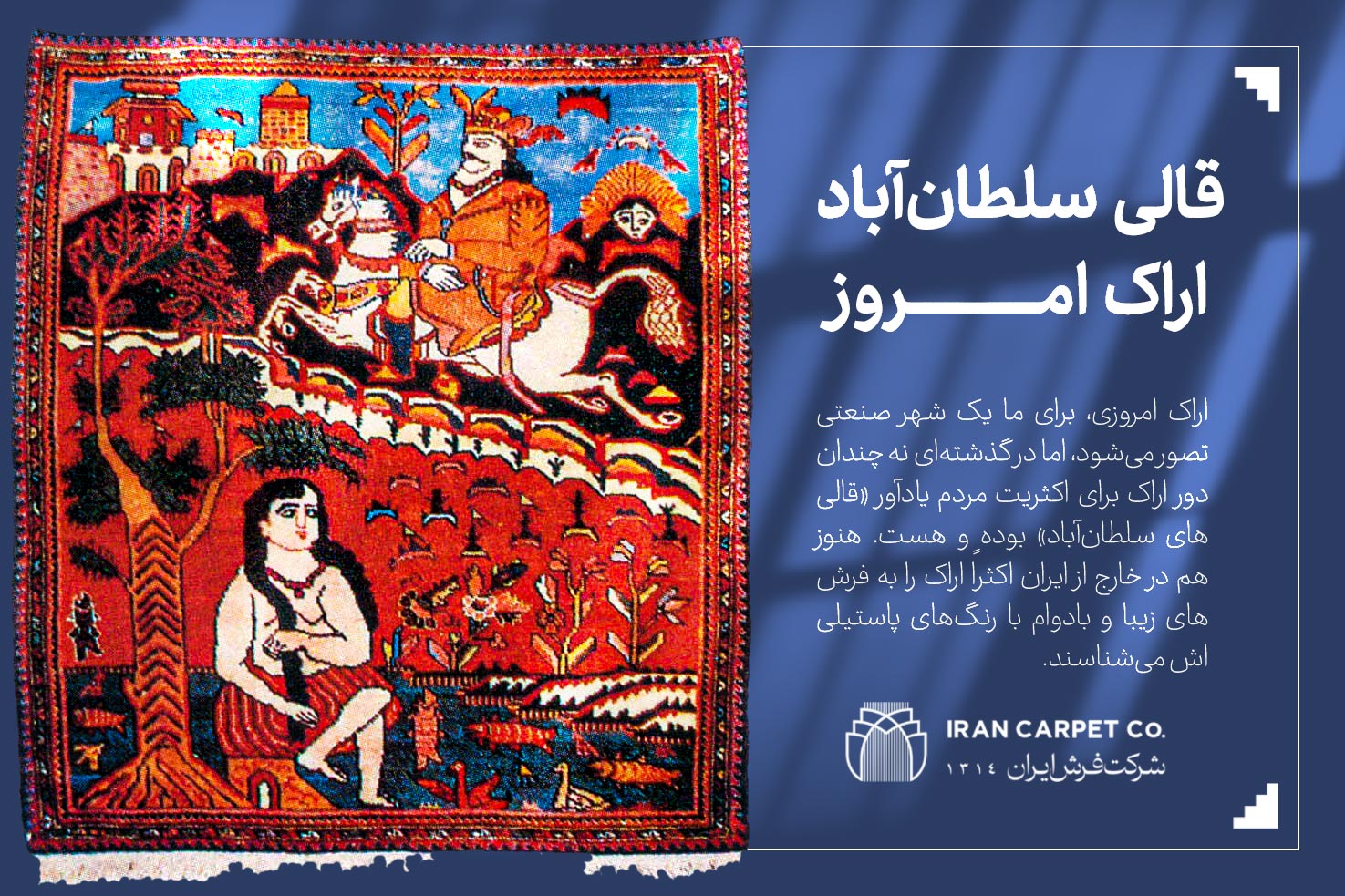
Today, we tend to think of Arak as an industrial city. Yet until not so long ago, Arak was synonymous with “Sultanabad carpets.” Even now, outside Iran, Arak is widely known for its beautiful, durable carpets in pastel colors.
 Regional Weaves
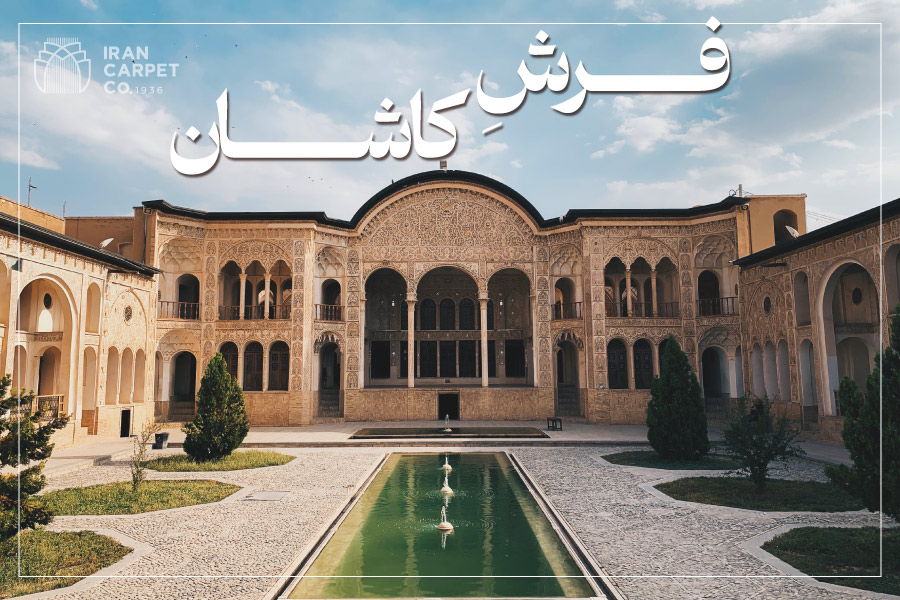
Even in the Safavid era, Kashan was a center for weaving a wide range of artistic carpets, and Shah Abbas fostered carpet weaving in the region. Its carpets are associated with gold and velvet, as well as some of the finest Persian rugs—mistakenly known as Polish carpets.