Our Art Lies in Going Unseen!
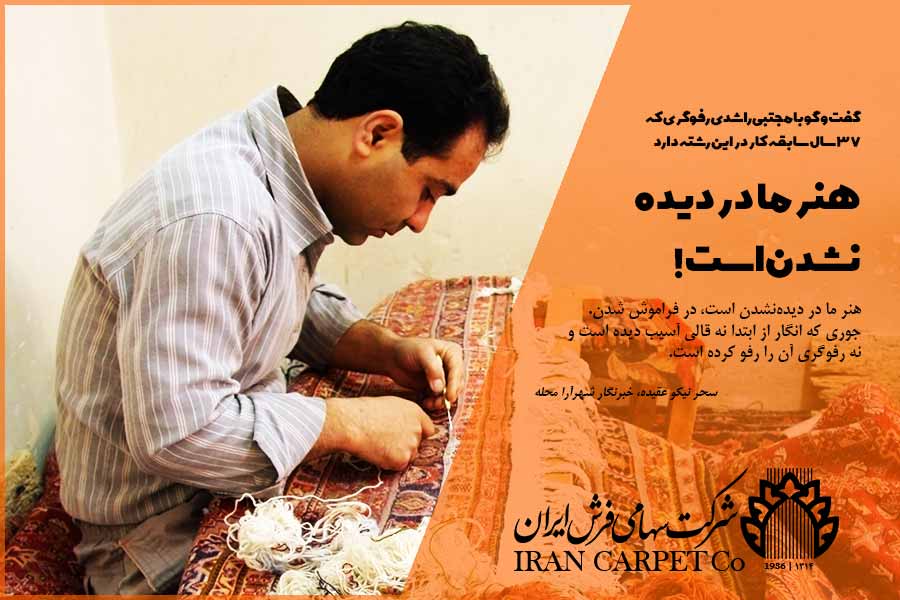
Painters usually sign their work. Conservators distinguish the areas they have restored from the original structure with different colours and shapes. In short, every artist leaves a trace of themselves in their work. But he says: “Our art lies in going unseen, in being forgotten—so that it seems as though the carpet was never damaged and no one ever mended it.” By “he,” I mean Mojtaba Rashedi, a 48-year-old carpet mender on Chaman Street, with a long career in the trade. With 37 years of experience, he is now one of its seasoned veterans. An artist who paints and practises mosaic inlay, he considers carpet mending his principal art and profession. It is his father’s trade, which he has carried on wholeheartedly. In this issue, we’re sitting down with him to learn the ins and outs of this neglected and little-known art. Alongside his mastery of carpet mending, he has also built two machines for the trade.
Mending or street sweeping? “I’ve been a carpet mender for as long as I can remember. My earliest childhood memories all go back to my father’s shop in the Abbasqoli Khan bazaar, playing with the other children among the carpets and colours… I learnt the ABCs of carpet mending at that age, just by watching the menders’ hands.” He tells me this, then lists one by one the terms of the trade that are unfamiliar to me and that I’m hearing from him for the first time. He continues: “No one taught me how to sew, do badalmeh (repair a carpet’s fringes), or qalbireh (weave the carpet’s warp and weft), but it was as if I already knew it all. Later, when my father told me, ‘Do the qalbireh,’ I did it. I didn’t ask what it was or how to do it. He’d say, ‘Repair the carpet’s fringes,’ and I’d pull them out myself…” His past is full of the colours and patterns of carpets, the bustle of his father’s crowded shop, the pile-levelers who evened out carpet pile, the weavers and… Of course, that is the sweeter side of the story. He says one of the challenges of carpet mending is explaining the profession to others: it is little known, and the word is unfamiliar to people. “From the moment the first carpet was woven, and later developed a flaw, the art of mending came along with it. And yet, despite its long history, people still don’t really know what it is. Many have never even heard the name. Over the years, I’ve had to explain it again and again. One of my memories goes back to my second year of middle school. The teacher asked what my father did. I said, ‘Carpet mending.’ He looked surprised. ‘Street sweeping?’ he said. After a lot of explaining, he finally understood what carpet mending was.” He has plenty of stories like that. I ask him to talk about himself and his first experience mending a carpet in his father’s shop. He explains that apprentices began by drawing patterns on rice sacks; once they had proved themselves, they could move on to the carpets. As he recalls his first repair, he smiles with satisfaction and tells me about the smile his father gave him when he saw his first piece of mending—a smile that has stayed with him ever since.
Hard times for carpet menders He is telling me about the past while I look at the few small carpets hanging on the walls and door of his little shop. I assume he has hung them up for the interview and photographs. Mr Rashedi follows my gaze and continues in his same warm, easy manner: “Don’t judge by the handful of menders in town who are struggling today. In the old days, even the least busy mender had at least 20 carpets waiting to be repaired in the shop. Plenty of people made their living from each mending shop, and all sorts of related jobs grew up around the trade. Some repaired the fringes and pulled them out; others were sewing specialists. There were always several weavers in the shop, too, to recreate the carpet’s patterns, and so on. Every shop had a few apprentices as well—young boys whose fathers entrusted them to the menders so they could learn the trade and eventually become master craftsmen.” I ask why business has fallen off, and he offers a long list of reasons, large and small. First, he says, machine-made carpets have replaced handwoven ones. Though no machine-made carpet can match the quality of a handwoven carpet, machine-made ones rarely wear through. Another reason, he says, is that lifestyles have changed. These days, people lay a carpet in the middle of the room and leave it there. It gets little foot traffic, no damp, and no moth damage. The wool of a handwoven carpet is sweet and oily, making it an ideal place for larvae to grow. When a carpet has been eaten by carpet moths, people call it “moth-eaten.” All things considered, people no longer bring carpets in for repair. His only customers are carpet traders who want moth-damaged handwoven carpets repaired for sale or export, and the occasional wealthy person who still uses handwoven carpets on the floor.
The ins and outs of the trade I’ve heard bits and pieces about the principles of the work, and I’ve run my hand over the soft, delicate silk carpets in the shop, but I still don’t really know how carpet mending works. I ask Mr Rashedi to explain the process from the beginning. He says it starts before the mending itself—when the carpet is first being woven. A good mender, he says, needs to understand every stage of carpet weaving. First, a weaver gets yarn and wool from the dyer, and the carpet pattern from the designer. Then they set up the loom and begin weaving. Once weaving is complete, the carpet goes to a pile trimmer, who shears off the excess yarn and wool so the pattern emerges. After washing, the carpet is stretched and straightened. The stretcher corrects any unevenness, and if the pattern is too short or too long, the carpet is adjusted row by row. After that, it is ready to be sold and used. Beyond the nature of handwoven carpets, people’s lifestyles were also such that every carpet needed mending at least once a year. For example, people used to set kerosene lamps on carpets, increasing the risk of fire and burns… From this point on, the mender’s work begins. Mr Rashedi explains: “A mender needs to be an expert on carpets. We have all kinds of knots and carpets from different cities: Kurdish carpets, Baluchi carpets, Mashhad carpets, and so on. A mender must know every type of weave in Iran. A skilled mender must also know dyeing. When a carpet is old and its colours have faded, they should be able to restore it to its original colours. They also need a good eye for colour, so they can match the carpet’s own colours exactly. A professional mender must know how to trim the pile and mend a carpet in keeping with its pile direction and thickness. When a carpet has a hole, there are ten ways to repair it. You have to know them all and choose the best one.”
Working at the area’s carpet-mending centre He learnt all these skills at his father’s side. Thanks to his interest, enthusiasm, and talent, he became a professional mender very quickly and found his own customers in his father’s shop. He strokes his sweeping moustache, furrows his brow, and says that at the time he worked with seven major carpet traders in Mashhad. They were so pleased with his work that they wouldn’t entrust it to anyone else. After his military service, he opened his first shop at the Amin Caravanserai in the Chehno neighbourhood. Then, in 2004 (1383 SH), he moved his business to one of the shops in the Barzegar Caravanserai, near Edalat Square in the same neighbourhood. At the time, the place was full of grocery shops, and his was the only carpet-mending shop. Business took off, and other menders came to the caravanserai too, each renting a shop. In those years, the caravanserai became known as the area’s carpet-mending centre. For a while, so much work came in that truckloads of carpets were unloaded there to be repaired. “We menders can guess what the weaver was like from the rows of knots: their age, imagination, talent, even their state of mind.”
Setting up a carpet-dusting workshop It was around that time that he decided to set up a carpet-dusting workshop in the same caravanserai. The decision came from an idea, followed by the invention of a machine. He says: “Until then, carpets were dusted in just one way, using a cylindrical machine. There were several steps inside the cylinder. It rotated, and the carpets fell down the steps one by one, releasing their dust. But there was a high risk of the carpet tearing in this machine, and the dust still remained deep in the carpet. There was another machine, though it was used much less often: a suction machine with a four-pronged head that beat the pile while the suction drew out the dust. I kept thinking that I needed to build a machine that would clean a dusty carpet thoroughly and deeply. I tried a few times, but got nowhere. One day, in my friend’s shop, I spotted a qashi machine on the table. It’s used to straighten the rows of knots in a carpet. It occurred to me to combine the motor and parts of those two machines. I plugged it in right there and tested it on a dusty piece of carpet. The shop filled with dust; my friend started coughing and went outside. I had two inches of dust on my head and face, and I couldn’t see a thing—but the result was excellent. I parted the yarn and wool and saw that all the dust had been removed from the carpet. Some time later, I rented a shop in the same caravanserai and set up my dusting workshop. So many carpets came in for dusting that the door wouldn’t stay shut, and there were always several workers dusting carpets, morning and night. But the work was much harder than you might imagine. Operating that machine and breathing in all the noise and dust wasn’t for everyone. The workers soon got tired and left, and the workshop closed for good.”
The maker of the Fit machine “Now, you can ask any carpet seller about Fit and they’ll know this machine.” Fit is the name of another machine Mr Rashedi invented for mending carpets. When I ask why he chose the name, he says he had in mind the way the carpet’s warp and weft fit together precisely. Before then, if one part of a carpet was damaged, it was woven from the back. Even then, a dip would form on the front and the repair would show. He says he was always thinking about how to weave the carpet from the front so it would look as it had on the first day. When he first managed it, his fellow tradespeople didn’t believe him. When they saw the work up close, they were astonished.
There’s a story behind every row of knots We are now in his latest shop. The winding road of his life has led him to a small, tidy shop in the backstreets off Chaman Street, in the Mosalla neighbourhood. It’s a little four-walled space full of old handwoven carpets he has brought from home to show us. He spreads out an old, small, faded red carpet in front of us, gently strokes it, and says it is a memento of his late father’s mending work, more than 150 years old. Then he points to a small silk prayer rug hanging on the wall and says: “This is a keepsake from a woman named Fatemeh. We don’t know her, but her artwork has found its way to us today.” It bears the inscription: “Fatemeh Mohammadzadeh. 1/3/51.” Every carpet has a story. That is the difference between machine-made and handwoven carpets: the stories and lives behind these rows of knots. One row was woven in a moment of wedding-day joy, another in grief and mourning. One reflects the weaver’s good spirits, another their weariness and low mood. He says: “We menders can guess what the weaver was like from the rows of knots: their age, imagination, talent, even their state of mind.” Just then, he spreads a partly finished white carpet across the middle of the shop. I gently run my hand over its delicate little flowers in shades of green and blue. It is soft, velvety, and fine. I ask why it was left unfinished. He says: “A grandmother in a village was weaving this carpet to support her family. But she died at the loom, and the carpet was left unfinished. After that, no one in the family knew how to weave and finish her work—not her children, nor her grandchildren.” He pauses, then continues: “That’s the fate of old arts. Traditional handicrafts are gradually being forgotten.” He puts a small, half-burnt kilim on the table. “You may not believe it, but even this half-burnt kilim is very valuable.” Seeing our surprise, he explains that the finest kilims in villages are known as “flour cloths.” When villagers made dough, they spread it over the flour cloth so the dough could rise and be ready for baking. They usually kept these kilims near the oven, the fire, and so on, which is why their edges and corners were often burnt. These kilims are usually full of floral and animal motifs, and apparently they have many admirers abroad. He says: “The villager who weaves this kilim is an artist, but they don’t even know that this art exists. There’s plenty of art here, but few people who seek it out…”
Lack of support for carpet menders “All these kilims and carpets are now exported to European countries. They don’t lay this kilim on the floor there; they hang it on the wall, because they understand the art and the story behind it. You may not believe it, but they know the different Iranian weaves better than we do, and they want them. That’s why most Mashhad menders have now become exporters and carpet traders. Let me tell you something honestly: no mender here has succeeded or made anything from mending. Anyone who left this artistic trade came out ahead.” He describes the only positive development in recent years in the country’s support for this fading profession: “In 2008 (1387 SH), the Department of Industries and Mines insured experienced weavers and menders who had been in the trade for many years, and offered some other limited support as well. That helped keep the profession from disappearing and allowed it to keep breathing.”
Gruelling work We have reached the end of our conversation. He sighs and says: “Carpet mending is gruelling work. Today, no one is willing to endure hardship. Most people are looking for easy, well-paid jobs.” Then he shows me his hands, the calluses and raised patches that seem to have taken root between his fingers over the years. He says his final words: “These calluses are no longer wounds that can heal; they’ve been with me for years. That’s what carpet mending comes down to. Just write down that one sentence, and you’ll have said it all.”
Related Reading
All Journal & Blog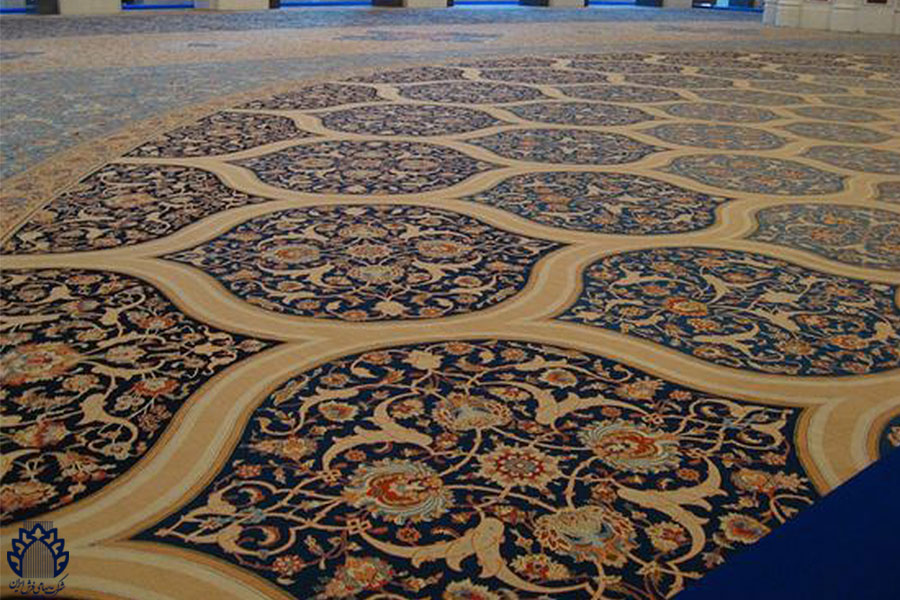 Interviews4
Carpet-Weaving Masterpieces by Iran Carpet Company
The carpet for the Sultan Qaboos Grand Mosque in Muscat is one of the large-format carpets produced by Iran Carpet Company. It was sent to Oman in 2000. On this occasion, we spoke with Reza Allahdad, who was the company’s Deputy for Production at the time.