How the Nain Carpet Rose to Prominence
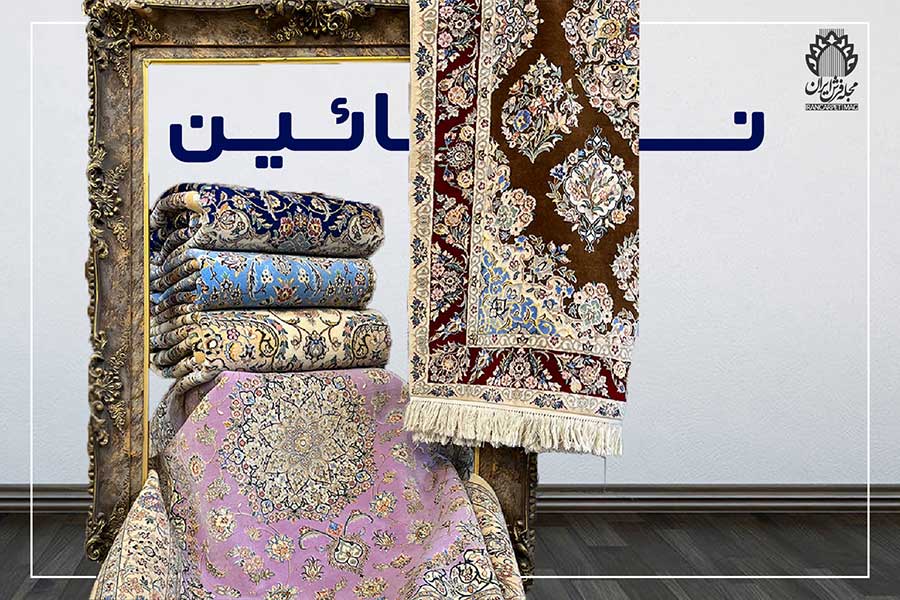
Nain lies southwest of Isfahan, on the southern edge of Iran’s Central Desert. Its desert climate and dry weather led local residents toward handicrafts, which remain an important source of livelihood and income in the region.
Nain has long been renowned for aba weaving. In the past, fine abas were woven from camel wool, and this craft brought the city renown. Gradually, however, carpet looms were set up, and the fineness and delicate weaving of aba-making found expression in carpet weaving. To this day, Nain is known for producing fine, high-quality carpets. Several factors have contributed to the Nain carpet’s reputation, including its quality, durability, colorfastness, precision in executing the design, and the range of its dimensions and shapes, including round, hexagonal, and octagonal forms.
The Technical Structure of Nain Carpets
The warp and weft of Nain carpets are cotton; silk warp is generally used for carpets with a knot count above 70 raj. The pile is made of wool and silk. White silk is usually woven around the outlines of the motifs, a technique known as silk outlining, which gives the design a raised appearance. Nain carpets are woven with the asymmetrical Persian (Senneh) knot. The standard knotting is single-pick, although double-pick knotting is also sometimes found. Single-pick carpets are considerably higher in quality. Nain carpets have two wefts, attached selvages, and Persian-style kilim weaving (karbas). Initial finishing is carried out during the weaving process.
Design and Motifs of Nain Carpets
Shah Abbasi medallion-and-corner designs and all-over Afshan motifs, featuring combinations of arabesques, floral motifs, and other designs rooted in the traditions of Persian carpets, are more commonly seen in Nain carpets than any other style. The principal designs of the region include: medallion and corner (Lachak-Toranj), Afshan, Haj Khanomi, tree, Moharramat, Mahi Darham, Khesh-ti, Shikar-Gah-e Azhdari, mihrab, framed, armband, Kumehi, Islamic architecture, domed, boteh jegheh, six-medallion, and arabesque medallion designs.
 Color card of Iran Carpet Company’s Nain branch
Colors of Nain Carpets
Although Nain carpets use a limited range of colors, the same palette and number of colors create remarkable beauty. Cream, earthy, beige, burgundy, beige-yellow, blue, white, and red lacquer, in both light and dark shades, are among the principal colors of Nain carpets. Light earthy tones, dark earthy tones, deep blue, and cream are considered the main colors; in most cases, they are used in the principal motifs without shading techniques. Following local tradition, the colors of the corners, medallion, and border are the same. Pairing two cool colors in the mils* is common in Isfahan and Nain, but less so in other regions. In medallion-and-corner designs, the outer line of the medallion and corners serves as a boundary with the field.
The Fineness of Nain Carpets
In most regions, the fineness of a handwoven carpet is described using the term “knot count” (raj). For carpets with the symmetrical Turkish (Ghiordes) knot, such as those from Tabriz, knot count refers to the number of knots across 7 centimeters of carpet width. For carpets with the asymmetrical Persian (Senneh) knot, such as Arak carpets, it refers to the number of knots across 6.5 centimeters. In Nain, however, the term “la” is used instead of knot count; it refers to the number of plies in the cotton yarn used for the carpet’s warp.
12-la is equivalent to a knot count of 30–40 raj; 9-la to 45–50 raj; 6-la to 55–60 raj; and 4-la to 70 raj. Nain carpets are generally woven as 6-la or 9-la, with single-pick knotting and, in some cases, double-pick knotting. Six-la carpets with single-pick knotting are fine, delicate, and high in quality, while 9-la carpets with double-pick knotting are less fine and lower in quality—a key consideration when pricing Nain carpets.
Sizes of Nain Carpets
Designers determine the dimensions of a pattern according to the intended number of knots across its width and length. The weaver can then adapt the pattern to the chosen warp, using 4-la, 6-la, or 9-la construction, according to a specific set of calculations. As a result, a single design may be woven in different dimensions and degrees of fineness. With each type of warp, the fineness of the yarn can be adjusted to suit the commission or the producer’s preference, allowing carpets of varying sizes and knot counts to be made from the same design. Nain carpets come in a wide range of sizes, from doormats and curtain carpets to very large formats. Nain is also one of the leading centers for weaving large-format carpets of the highest quality.
Iran Carpet Company also produces a range of Nain-style carpets at its production branch in the city, using premium materials in both centralized workshops and home-based workshops affiliated with the branch. Examples of Nain-style carpets made by Iran Carpet Company can be seen in the images below.
*The lines that separate the components of a border from one another are called mil or su. Mils are also used to separate the border from the field of a carpet.
Compiled by: Shaheen Nemati Dehkordi Carpet specialist