Carpet Weaving
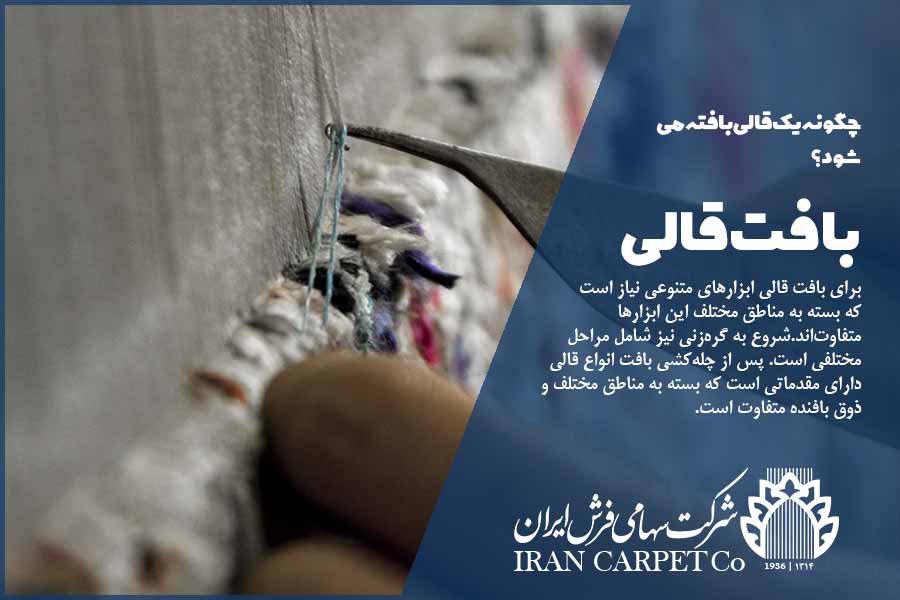
Carpet weaving requires a range of tools, which vary from region to region. The most important are as follows: Carpet-weaving knife: This tool is used to cut the pile yarn while tying knots. Since knotting is done in two different ways in various parts of Iran, carpet-weaving knives differ in shape and design to make knotting easier. Carpet-weaving spatula: This is an ordinary knife, used mainly in regions where the asymmetrical Persian (Senneh) knot is tied. Carpet-weaving hook: This tool resembles a knife, but tapers at the end to form a narrow rod one to two centimetres long. A small hook-like projection at the tip is used by weavers to bring the warp forward, tie the pile yarn, and draw the pile through the warps. Beater (daftin, dafeh, karkit, kلوzar, dastuk): A metal, comb-like tool with a wooden or metal handle. It is used to pack down the knots after each row and to beat down the carpet’s thick and thin wefts. Carpet shears: Shears are used to trim and shorten long pile. The shears commonly used in carpet weaving fall into two types: A) Persian shears (Isfahan shears): These have raised edges on both blades. The height of the edges varies according to the pile height required for different knot counts. B) Turkish shears: Similar in appearance to ordinary household scissors, but with their blades and handles set at different levels. Ordinary sewing scissors: Some weavers use the same scissors commonly used for household tasks such as sewing. Electric shears: In some regions, weavers do not trim excess pile as they work. Instead, they complete the entire carpet and then shear its full surface at once with electric shears. Comb (for carpet weaving): Used to bring the carpet knots forward and create a more orderly back. Weft-inserting rod: This tool is used to insert the weft. The weaver passes the rod between the warps, catches the weft with the hook-like tip, and places it over the woven row. Barpaki, sakk (stone), and suzani are among the tools used in different regions.
Carpet weaving—the process of beginning to tie knots—comprises several stages. Once the warp has been prepared, the different types of carpet are woven as follows: Chain weaving: This keeps the upper and lower warp threads orderly and paired at the beginning of the carpet. It also helps prevent the ends of a carpet or kilim from unraveling or tearing during use. Kilim weaving: One way to extend a carpet’s life and prevent knots from loosening or coming out is to weave kilim ends. At both ends of the carpet, colored yarns and pile wool are worked over the warps like weft, in a plain, pileless weave. A decorative knot is usually added between the kilim-woven sections to enhance the carpet’s appearance. Knotting: Knots fall into two main types: Turkish or symmetrical knot: Used mainly in Turkish-speaking regions, this is one of the strongest knots. It is wrapped around two warp threads and does not come undone easily. Persian or asymmetrical knot: Used mainly in Persian-speaking regions, this knot can be tied to the left or to the right, with each direction affecting the pile’s lay. It is also called the asymmetrical Persian (Senneh) knot because the pile yarn wraps around one warp thread and is not symmetrical in relation to the other. Weaving and creating the design: This is the most important stage of carpet weaving, when the weaver displays all their skill, imagination, and taste. Tying knots and placing colored pile yarn in position to create varied designs, inserting the weft, combing, and trimming excess pile are all tasks carried out in every row.
Weaving methods and techniques Flat (takht) weave: In this method, the carpet warps lie parallel and flat beside one another, with no angle between the upper and lower warps. The distance between them is approximately 1.5 times the diameter of the warp yarn. From the back of the carpet, one knot appears as two. Carpets woven this way are soft and highly flexible. After a row is woven, a medium-thickness weft suited to the carpet is passed between the warps. Half-lul (nim-lul): In this method, the distance between the warp threads equals the diameter of the warp yarn, and the upper and lower warps are angled. From the back, one knot appears as one and a half knots. Two wefts of equal thickness are used. Lul weave: In this method, there is no gap between the carpet’s warp threads, and the upper and lower warps are angled. From the back, each knot appears as a complete, single knot, with a groove between the knots. Two wefts are used: one thick and one thin.
Defects during weaving Inattention or error during weaving may cause defects in the carpet. The most important include high rows, low rows, looseness (hollowness), twisting, medallion distortion, several folds in one weft, sparse weaving, uneven pile, uneven coloration, a corn-like appearance (pile lying flat), uneven sides, comb marks (skewed ends), loose warps, over-beating, skewing, bagging, tearing, loose weaving, uneven shearing, and incorrect weaving.