Carpet Pattern Design
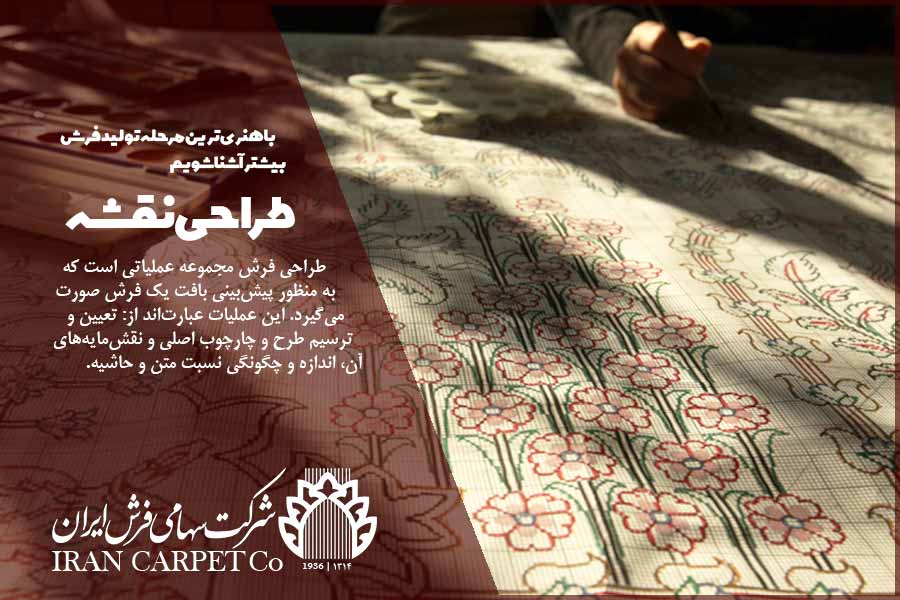
One of the distinctive characteristics of Persian carpets is the diversity of their designs and patterns, which nevertheless share a certain underlying coherence. The range of patterns found in Persian carpets is so vast that it cannot all be explained here; this article offers a brief introduction to some of the most important. Carpet design is a set of operations undertaken to plan the weaving of a carpet. These include determining and drawing its overall design and framework, its motifs, and the size and proportions of the field and border. Preparing a design is the most important factor in producing fine urban carpets. By contrast, broken and geometric patterns, often woven by rural and tribal weavers, generally do not require a pre-drawn design; weavers create their chosen pattern based on experience. A carpet design is drawn on graph paper. Graph paper is calibrated according to the knot count (raj), and comes in various types. Taking the intended knot count into account is essential when preparing a design. Knot count (raj): Knot count is the unit used to measure the density of knots in a handwoven carpet. Along with factors such as the materials used and the quality of weaving, a carpet’s knot count is one of the main factors in determining its price. It is calculated by counting the knots, or rows of knots, within a unit called the zar knot. To clarify this, we must first define the zar and the zar knot. In the past, the zar was used as a unit of length; it measured 104 centimetres in Isfahan, 112 centimetres in Tabriz, and 108 centimetres in Kerman. One-sixteenth of a zar is a zar knot. Accordingly, knot count is calculated for every 6.5 centimetres in Isfahan, every 7 centimetres in Tabriz, and every 6.75 centimetres in Kerman. For example, a carpet with a knot count of 60 has 60 knots in every 6.5 centimetres according to the Isfahan measure, every 7 centimetres according to the Tabriz measure, and every 6.75 centimetres according to the Kerman measure. Definition of design: A design is an overall plan or framework, such as the medallion and corner (Lachak-Toranj), Muharramat, prayer-niche, all-over Afshan, or repeating-unit designs. Definition of motif: Motifs are the elements that make up a design. They lend variety to a design’s details, colours, and composition. Examples include Shah Abbasi, boteh, arabesque, leaves, European flowers, and round flowers. In discussing patterns, we divide the regions into two broad categories: urban and rural areas, and tribal and nomadic areas.
Characteristics of designs, patterns, and colours in tribal and nomadic carpets The range of colours used is generally limited. Bold, contrasting colours are used. They are usually woven at a knot count of 30 or lower; higher knot counts are less common. They are small-format pieces, especially zar-o-nim rugs, small rugs, curtain rugs, and pieces measuring less than six square metres. The designs and colours of most are created from memory, and they generally have no classical, designer-drawn pattern. Most carpets have geometric designs or combine geometric and curvilinear forms. Products woven by nomadic communities include gabbeh rugs, jal (saddle cloths), sofreh (cloths), namakdan (salt bags), bedding wraps, and poshti cushions.
Rural carpets Carpets from areas such as Hamadan, Malayer, Arak, and Chaharmahal and Bakhtiari have traditionally been woven in rural parts of Iran. Their designs are generally less varied, with one design commonly used throughout a region and woven according to a general pattern, with minor variations in the motifs. The palette is limited and the sizes are medium; large-format carpets are rarely found. There are, of course, exceptions, such as Heris, where carpets measuring as much as 20 square metres are also produced.
Urban carpets Carpets woven in cities are fine in quality, have a high knot count, and feature distinctive designs and patterns. Urban carpets come in every size, from the smallest to the largest. Depending on the needs of the market and the place of production, an urban carpet may be considered a more complex and varied form than its rural or nomadic counterpart; this does not, however, necessarily make it superior. Urban carpets display far greater variety in design and colour than rural and nomadic examples. Touraj Joulah identifies five principal branches of urban carpet weaving: Mashhad, Tabriz, Isfahan, Kerman, and Kashan, each with distinctive characteristics of design, pattern, and colour. Urban motifs are generally connected and flowing, with branches linking one motif to another.
Curvilinear and broken patterns Carpet patterns are broadly divided into two categories: curvilinear and broken. Curvilinear patterns are more commonly found in urban carpets. They are further divided into two main groups: arabesques and khata'i motifs. An arabesque is a type of ornament composed of intricate lines and a variety of curves and sweeping arcs; it is especially striking in carpets from Isfahan. Arabesque designs come in many forms, including “simple arabesque,” “solid arabesque,” “hollow arabesque,” “dragon’s mouth,” “elephant’s trunk,” and “serpentine,” among others. Khata'i is essentially a design featuring flowers, leaves, plants, and flowering branches, particularly branches bearing Shah Abbasi flowers. Its principal elements are botanical branches and stems.
Animal motifs are also sometimes used in carpet designs. Hunting scenes, animal combat, interwoven fish, lion motifs, bird-head motifs, peacocks, mountain goats, rams, horses, and fish and birds are among them. Broken patterns should not be confused with geometric patterns. Broken patterns feature angular lines and jagged edges, and their combinations of lines often have a degree of irregularity. A geometric pattern, by contrast, is a balanced composition designed according to the principles of geometry, or one in which motifs are arranged according to those principles. Whether composed of curved or jagged lines, it retains an orderly structure. Handwoven carpets from across Iran, from its cities to its smallest villages, have distinctive designs and patterns, and to some extent this remains true today. But how can a carpet’s design, pattern, and colour reveal its authenticity and geographic origin? The first features to make an impression on a viewer and prompt an overall comparison are a carpet’s design and colour. The type of design; the proportions of its dimensions and forms; the motifs used; the manner in which flowers, leaves, and repeating units recur; the distribution and movement of branches and flowers across the field; the proportions of the borders, corners, and medallion in relation to one another and to the field; the number of borders; the degree to which arabesque and khata'i motifs are used; the presence of a particular motif; the colour scheme and range; the use of distinctive colours; the relative prominence of animal or botanical motifs; and whether motifs are connected or separate—all these factors, when studied closely, help distinguish the designs and patterns of different geographic regions.
Types of carpet design Medallion and corner (Lachak-Toranj): A widely used, beautiful, and celebrated design in Persian carpets, rooted in the Shah Abbasi school. Its defining features include a central medallion and cornerpieces. All-over Afshan: A design without cornerpieces or a medallion, in which leaves, flowers, stems, birds, and animals are motifs spread across the entire field. Prayer-niche: The principal design is inspired by the prayer niche, with additions such as hanging lamps, columns and capitals, and flowers and leaves. Muharramat: A striped design drawn along the length of the carpet, dividing the field across its width into several bands. Each band carries a distinct colour and design that continues from one end of the carpet to the other. Repeating-unit (banded) designs: When a small element of a design is repeated lengthwise and widthwise across the field and connected by frames or bands, the result is called a repeating-unit or banded design. Well-known examples include interwoven fish, banded arabesque, kheshti (panel), banded lion-and-sugar, deer-antler branch, bouquet, Minakhani, and others. Designs inspired by ancient monuments and Islamic architecture: This group includes all designs derived from the decorative motifs and forms of buildings, architectural structures, and their tilework. Tribal and nomadic designs: These designs are generally woven by Iran’s tribal communities, and their patterns and ornament are often drawn from the weavers’ imagination. Symmetry is not a defining principle. The simplicity and asymmetry of the motifs are among the main sources of beauty in this group. Composite designs: These designs emerged over time through the merging of different patterns. Some composite designs are highly appealing because their varied motifs are combined with skill and balance. Subgroups in this category include khata'i vase, double-sided vase, prayer-niche vase, all-over vase, Zill al-Sultan vase (flowers and nightingales), Haj Khatami vase, repeating vase, medallion-and-corner vase, and one-sided vase.
Related Reading
All Journal & Blog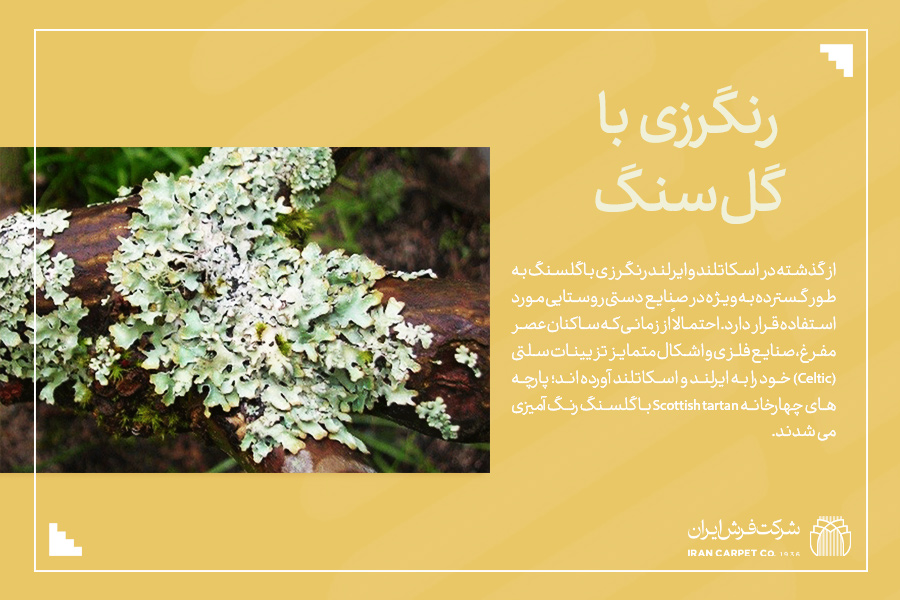 Weaving & Dyeing
Dyeing with Lichens
A lichen is a living partnership between two organisms—an alga and a fungus—sharing a single body. Lichens usually grow on rocks, walls, and tree trunks, forming patches of yellow, whitish gray, or greenish gray.