Regional Weaves
Baloch Handwoven Carpets
Jul 12, 20236 min readIran Carpet Company
A History of Baloch Carpets
The two main areas in Iran identified as settlements of Baloch communities are Khorasan and Sistan. Contrary to popular belief, Baloch rugs are not made in the province of Baluchistan; they are woven by nomadic communities settled in northern Khorasan, around Torbat-e Heydarieh, Torbat-e Jam, Kashmar, and Sarakhs. A small number are also woven in Sistan.
Some Baloch tribes were relocated from Baluchistan to Khorasan during the reign of Nader Shah Afshar to defend Iran’s northeastern borderlands against invading Turkmen and Uzbek groups. In time, these communities established themselves in the region through animal husbandry and carpet weaving, and even introduced the Khorasani Baloch style of weaving to the local population. Baloch carpets are said to have been influenced by Turkmen weaving, while also influencing it in turn. Khorasani Baloch weavings, however, owe more to Sistani, Khorasani, and Turkmen traditions than to those of Baluchistan.
Today, Baloch weaving centers are scattered across many towns and villages in Khorasan. The most important area for Baloch carpet weaving is in Razavi Khorasan, around Torbat-e Heydarieh. The Bahluli, Bayazidi, Kolah-Darazi, Jan-Mirzai, Rahim-Khani, Brahui, Salar-Khani, Hasan-Zai, and Jan-Beg (New Baloch) are among the nomadic Baloch tribes.
Unfortunately, Baloch carpet weaving has declined considerably in recent years and is now limited to weavers living in some villages in central and southern Khorasan.
 Characteristics of Baloch Rugs
Baloch rugs are lightweight and woven in small sizes. The smallest are about 80–90 centimeters wide and 120–140 centimeters long. Larger examples measure approximately 100 by 150 centimeters, while the two-zari size is about 110 by 200 centimeters.
Baloch rugs are traditionally woven on horizontal, or ground, looms, though vertical looms have also come into use in recent years. In the past, black wool was used for both warp and weft; today, yarn is used for this purpose. The oldest Baloch rugs were made entirely of wool, with two wefts and the asymmetrical Persian (Senneh) knot. Today, a single thin weft is used, one of the most distinctive features of Baloch rugs. The knot used in this region is asymmetrical (Persian). The kilim-woven ends of Baloch rugs are relatively long. The side bindings are generally wrapped with goat hair and are mostly black or dark brown, although the use of wool instead of goat hair has gradually become more common in newer weavings. Blue glass beads, tassels, and shells are used to decorate the side bindings, kilim-woven ends, and fringes. Baloch carpets generally have a knot count of 25–40 knots per raj.
 Baloch Carpet Designs
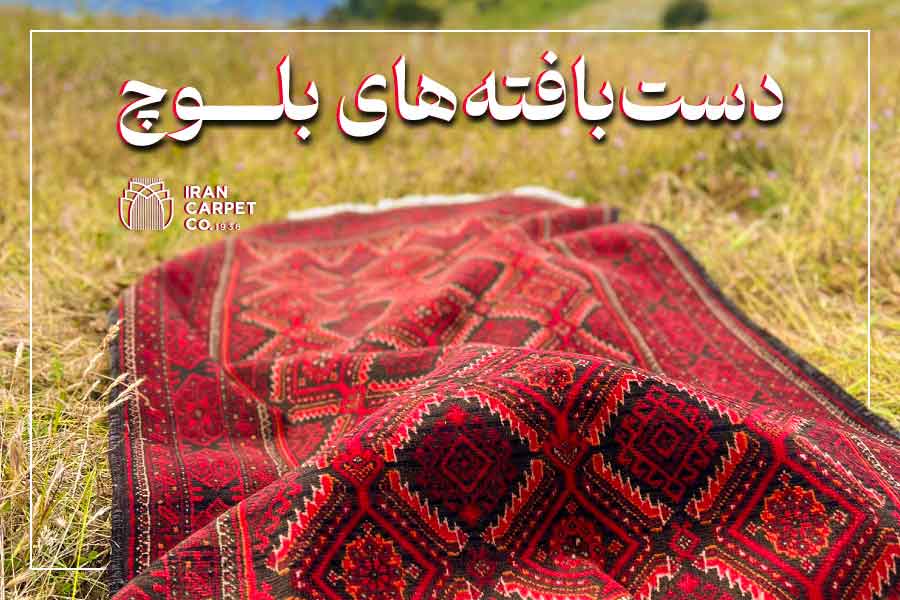
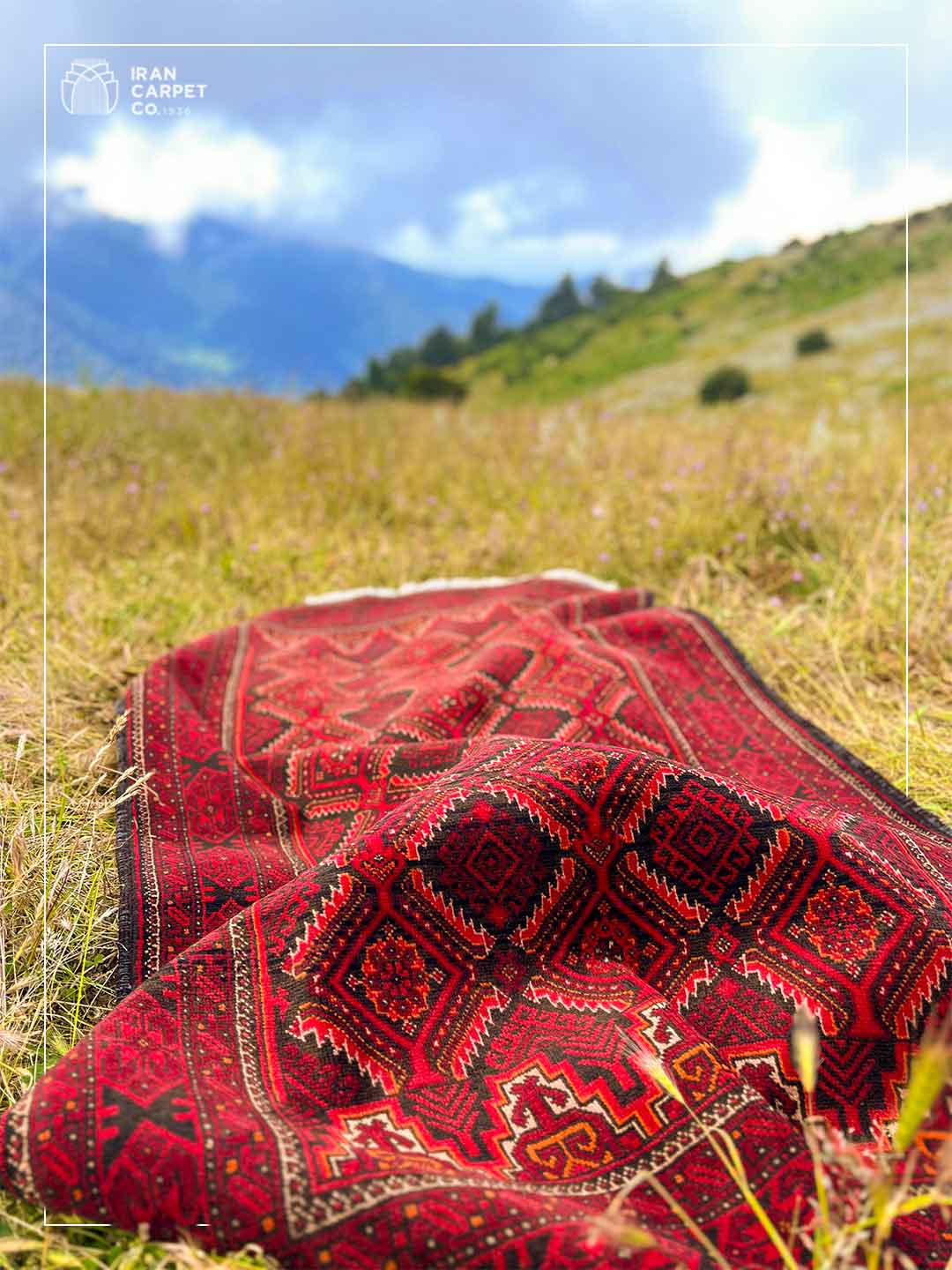
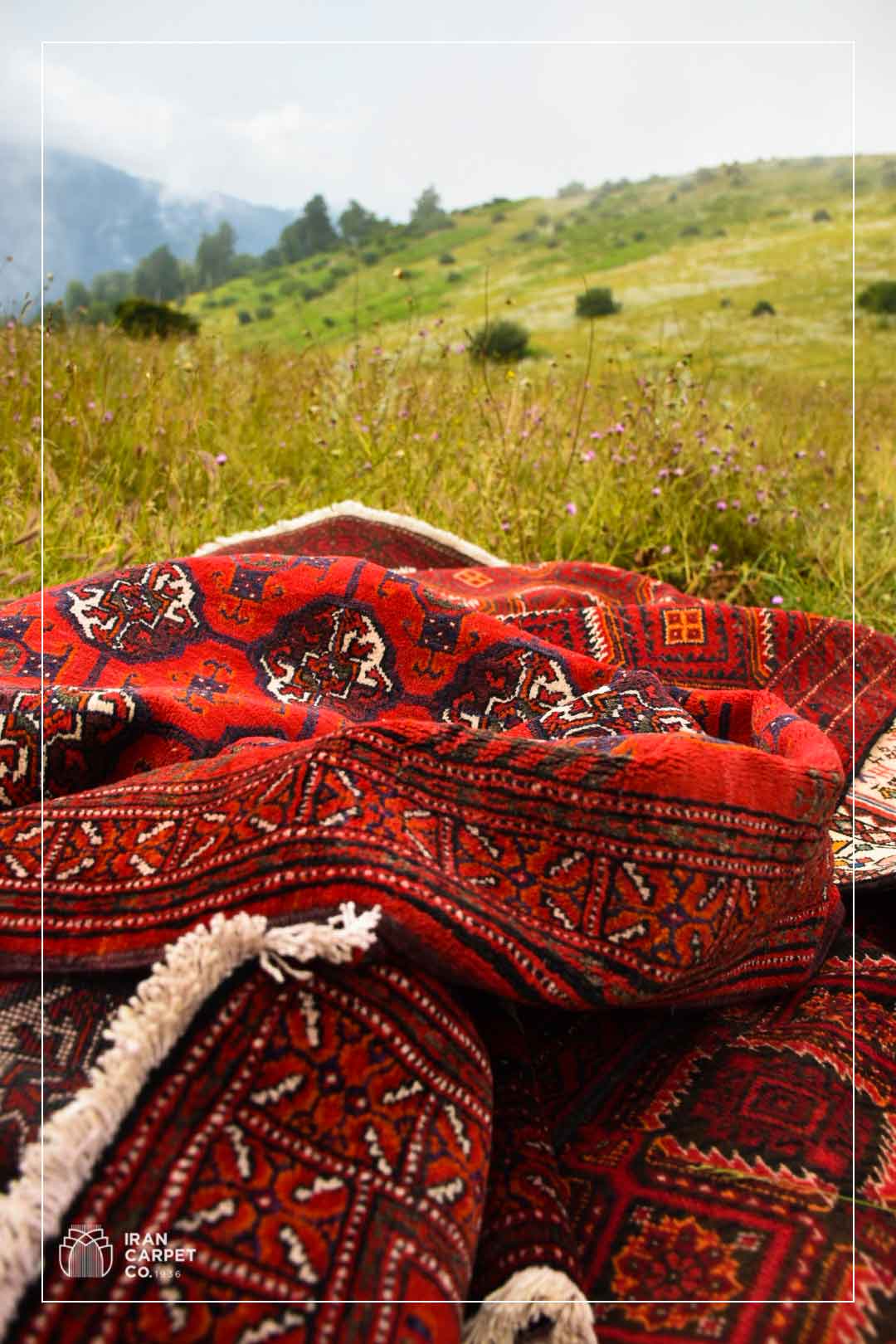
A distinctive feature of Baloch carpet design is the repetition of a single motif throughout the field. In most designs, specific motifs are repeated in orderly rows across the carpet, and the motifs in the field relate to those in the border. Baloch designs are geometric and do not use flowing lines, though curved forms may be created using short straight lines. A network-like structure, floral character, and repetition are three defining features of Baloch carpet designs and motifs (Figure 1). The borders are relatively wide, and a design usually has more than three border bands.
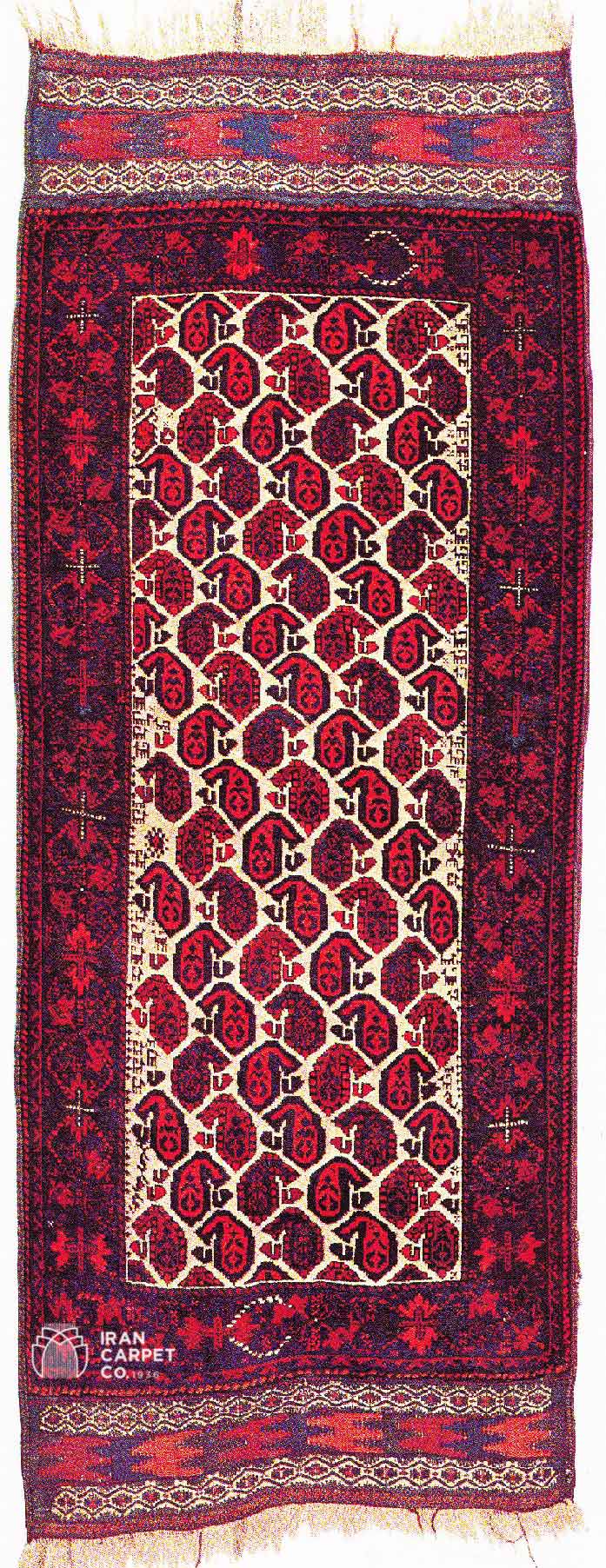 Figure 1: A boteh-jegheh design, with the direction of the boteh motifs in each row reversed from that of the preceding row. The kilim-woven ends are decorated with Baloch armband and comb motifs, and the side binding is woven with goat hair.
Among the best-known Baloch rugs worldwide are prayer rugs, whose design evokes a mihrab. Their most common central motif is a tree with horizontally branching limbs, usually placed on either side of the central axis.
Along each branch, or at its tip, appears a geometric motif resembling a leaf. Known as the willow-leaf or vine-leaf motif, it is, as its name suggests, derived from the leaves of the willow tree.
The regular triangular spandrels above the mihrab, on either side, form additional spaces whose motifs complement the mihrab. These include:
- Motifs of the human hand
- Plant motifs
- A combination of plant and human-hand motifs
- Inscriptional motifs
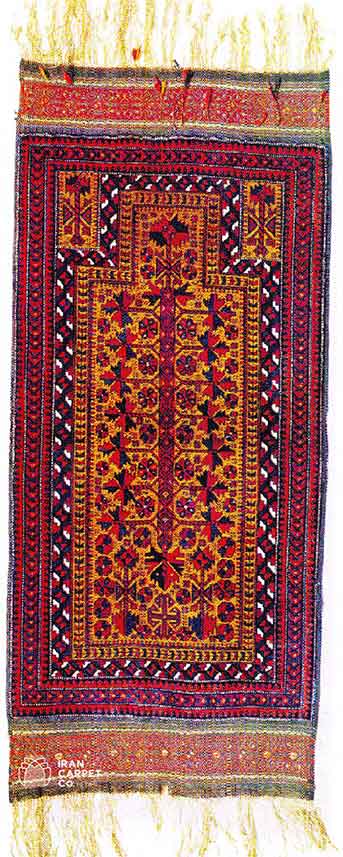 The hand motif in the spandrels above the mihrab—especially through the correct orientation of its fingers—underscores the placement of the worshipper’s two hands during prostration. Known as Panjeh-ye Akbar, this motif appears on most Baloch prayer rugs (Figure 2).
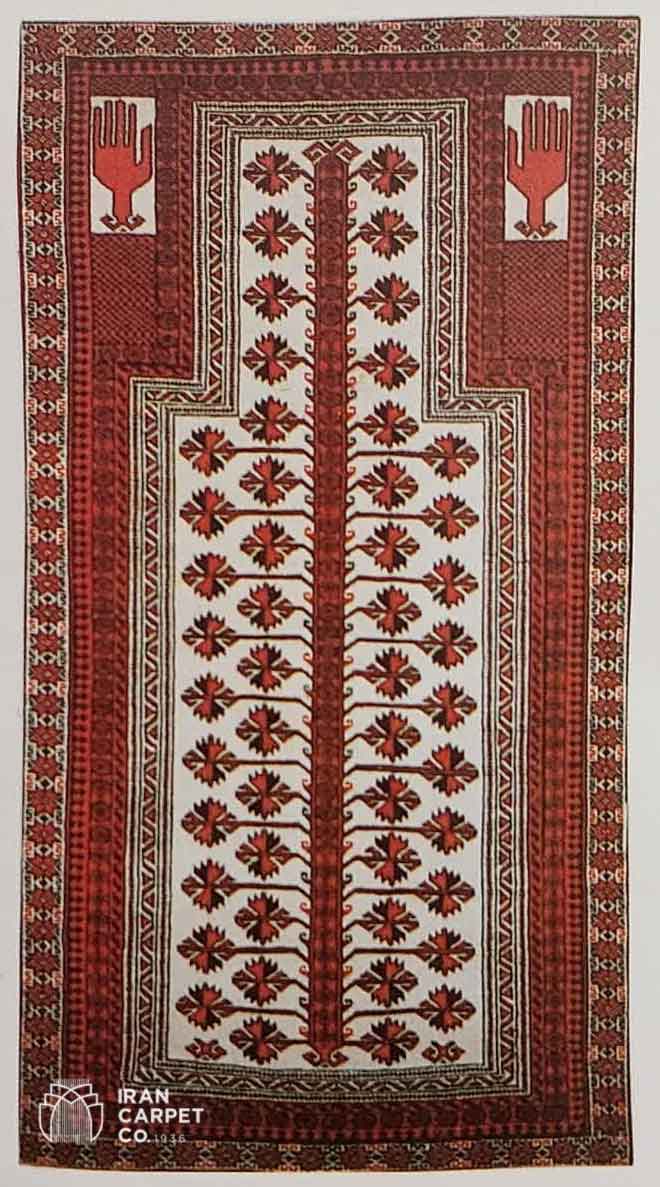 Figure 2: A Baloch mihrab rug with vine-leaf and hand motifs.
The principal and best-known designs of Baloch rugs—woven from memory and known by the same names—include Kolah-Daraz or Kolah-Boland, Se-Kheshti, Gav-o-Borj, Sang-Chuli, Gol-e Shaftalu, Fathollah-Khani, Yaqub-Khani, Madad-Khani, Ali-Akbar-Khani, Guzani, Cheshmeh-Gol, and Dokhtar-e Qazi.
Baloch Carpet Colors
The colors most commonly used by Baloch tribal weavers include peacock indigo for shades of blue; madder for red; walnut husks for camel tones; willow leaves for yellow and green; and willow and peacock indigo for orange, along with henna. Baloch dyers generally use alum as a mordant to fix the colors. For black, they use black wool, usually dyed with a local iron-rich mineral known as mak. Aniline red has become widespread in Baloch weaving today.
The dark palette of Baloch rugs—deep red, dark and medium blue, and black—is one of their defining features. Black is used for the main design lines, green or camel tones for smaller motifs, and white is frequently used in the narrower borders. The use of chemical dyes, which can produce an artificial brightness, is another characteristic of Baloch rugs.
For further reading on Baloch rugs, consult the following sources: - Edwards, Cecil (1988 SH). The Persian Carpet, translated by Mahin Dokht Saba. Book Lovers’ Association. - Bassam, Seyyed Jalaleddin, et al. (2004 SH). The Dream of Paradise: The Art of Persian Carpet Weaving. Tehran: Etka. - Jouleh, Touraj (2002 SH). A Study of Persian Carpets. Tehran: Yassavoli Publications. - Nasiri, Mohammad Javad (1995 SH). A Journey through the Art of Persian Carpet Weaving. Tehran: author-published. - Ahmadi Payam, Rezvan (2015 SH). “Design and Motifs of Khorasan Baloch Prayer Rugs.” National Conference on Handwoven Carpets of South Khorasan, University of Birjand. - Foroughinia, Maryam, and Morteza Shahsavari (2015 SH). “A Comparative Study of the Structural Features and Design of Khorasan Baloch and Sistan Carpets.” National Conference on Handwoven Carpets of South Khorasan, University of Birjand.
Characteristics of Baloch Rugs
Baloch rugs are lightweight and woven in small sizes. The smallest are about 80–90 centimeters wide and 120–140 centimeters long. Larger examples measure approximately 100 by 150 centimeters, while the two-zari size is about 110 by 200 centimeters.
Baloch rugs are traditionally woven on horizontal, or ground, looms, though vertical looms have also come into use in recent years. In the past, black wool was used for both warp and weft; today, yarn is used for this purpose. The oldest Baloch rugs were made entirely of wool, with two wefts and the asymmetrical Persian (Senneh) knot. Today, a single thin weft is used, one of the most distinctive features of Baloch rugs. The knot used in this region is asymmetrical (Persian). The kilim-woven ends of Baloch rugs are relatively long. The side bindings are generally wrapped with goat hair and are mostly black or dark brown, although the use of wool instead of goat hair has gradually become more common in newer weavings. Blue glass beads, tassels, and shells are used to decorate the side bindings, kilim-woven ends, and fringes. Baloch carpets generally have a knot count of 25–40 knots per raj.
Baloch Carpet Designs
A distinctive feature of Baloch carpet design is the repetition of a single motif throughout the field. In most designs, specific motifs are repeated in orderly rows across the carpet, and the motifs in the field relate to those in the border. Baloch designs are geometric and do not use flowing lines, though curved forms may be created using short straight lines. A network-like structure, floral character, and repetition are three defining features of Baloch carpet designs and motifs (Figure 1). The borders are relatively wide, and a design usually has more than three border bands.
Figure 1: A boteh-jegheh design, with the direction of the boteh motifs in each row reversed from that of the preceding row. The kilim-woven ends are decorated with Baloch armband and comb motifs, and the side binding is woven with goat hair.
Among the best-known Baloch rugs worldwide are prayer rugs, whose design evokes a mihrab. Their most common central motif is a tree with horizontally branching limbs, usually placed on either side of the central axis.
Along each branch, or at its tip, appears a geometric motif resembling a leaf. Known as the willow-leaf or vine-leaf motif, it is, as its name suggests, derived from the leaves of the willow tree.
The regular triangular spandrels above the mihrab, on either side, form additional spaces whose motifs complement the mihrab. These include:
- Motifs of the human hand
- Plant motifs
- A combination of plant and human-hand motifs
- Inscriptional motifs
The hand motif in the spandrels above the mihrab—especially through the correct orientation of its fingers—underscores the placement of the worshipper’s two hands during prostration. Known as Panjeh-ye Akbar, this motif appears on most Baloch prayer rugs (Figure 2).
Figure 2: A Baloch mihrab rug with vine-leaf and hand motifs.
The principal and best-known designs of Baloch rugs—woven from memory and known by the same names—include Kolah-Daraz or Kolah-Boland, Se-Kheshti, Gav-o-Borj, Sang-Chuli, Gol-e Shaftalu, Fathollah-Khani, Yaqub-Khani, Madad-Khani, Ali-Akbar-Khani, Guzani, Cheshmeh-Gol, and Dokhtar-e Qazi.
Baloch Carpet Colors
The colors most commonly used by Baloch tribal weavers include peacock indigo for shades of blue; madder for red; walnut husks for camel tones; willow leaves for yellow and green; and willow and peacock indigo for orange, along with henna. Baloch dyers generally use alum as a mordant to fix the colors. For black, they use black wool, usually dyed with a local iron-rich mineral known as mak. Aniline red has become widespread in Baloch weaving today.
The dark palette of Baloch rugs—deep red, dark and medium blue, and black—is one of their defining features. Black is used for the main design lines, green or camel tones for smaller motifs, and white is frequently used in the narrower borders. The use of chemical dyes, which can produce an artificial brightness, is another characteristic of Baloch rugs.
Reihaneh Kathiri
Master’s degree in handwoven carpets
For further reading on Baloch rugs, consult the following sources: - Edwards, Cecil (1988 SH). The Persian Carpet, translated by Mahin Dokht Saba. Book Lovers’ Association. - Bassam, Seyyed Jalaleddin, et al. (2004 SH). The Dream of Paradise: The Art of Persian Carpet Weaving. Tehran: Etka. - Jouleh, Touraj (2002 SH). A Study of Persian Carpets. Tehran: Yassavoli Publications. - Nasiri, Mohammad Javad (1995 SH). A Journey through the Art of Persian Carpet Weaving. Tehran: author-published. - Ahmadi Payam, Rezvan (2015 SH). “Design and Motifs of Khorasan Baloch Prayer Rugs.” National Conference on Handwoven Carpets of South Khorasan, University of Birjand. - Foroughinia, Maryam, and Morteza Shahsavari (2015 SH). “A Comparative Study of the Structural Features and Design of Khorasan Baloch and Sistan Carpets.” National Conference on Handwoven Carpets of South Khorasan, University of Birjand.