Untold Stories of the Design and Painting of the World’s Largest Handwoven Carpet
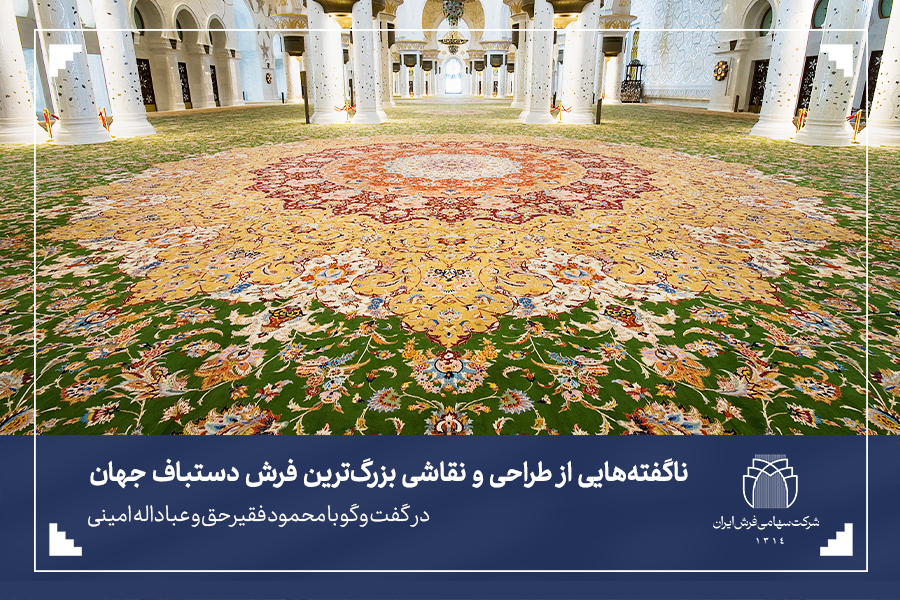
This article presents the full interview with Master Mahmoud Faqirhaq, designer of the world’s largest handwoven carpet, and Master Ebadollah Amini, one of its principal painters. The interview was published in the third issue of Dastbaft magazine and conducted in December 2025 (1404 SH) by Dr. Seyed Mohammadmehdi Mirzaamini, Commercial Director and Head of Research and Development at Iran Carpet Company.
Much has been said about the world’s largest handwoven carpet, rightly a source of pride for Iranians. Yet less has been explained about its design process, and the details of its early stages have rarely been discussed. In this conversation, Masters Mahmoud Faqirhaq and Ebadollah Amini, the project’s principal designer and painter, recount how this exceptional work took shape. The Iranian carpet’s name shines proudly in the Guinness Book of Records. In this issue of Dastbaft, we spoke with two of the designers and painters involved in this major project: Master Mahmoud Faqirhaq, the principal designer of the world’s largest handwoven carpet, and Ebadollah Amini, one of the principal painters of this monumental carpet.
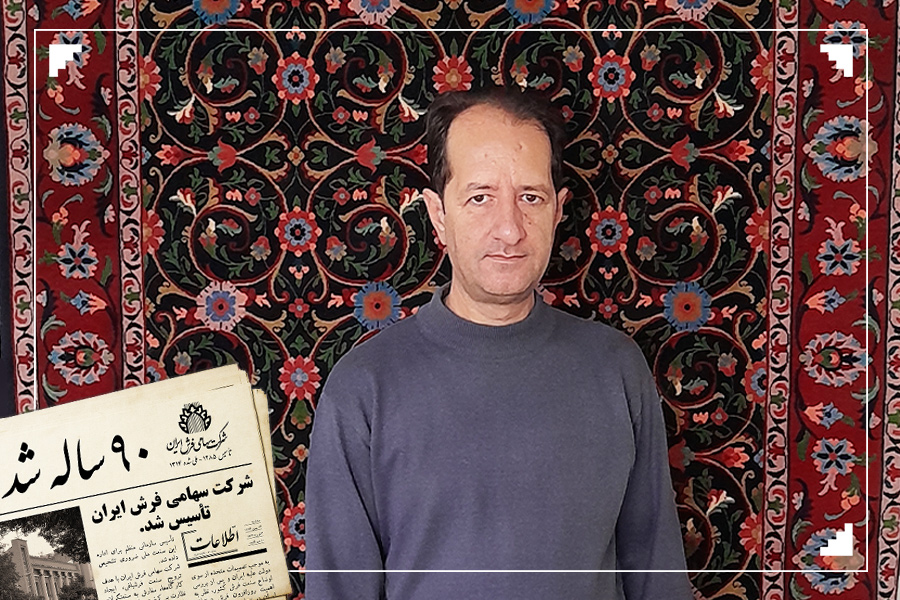
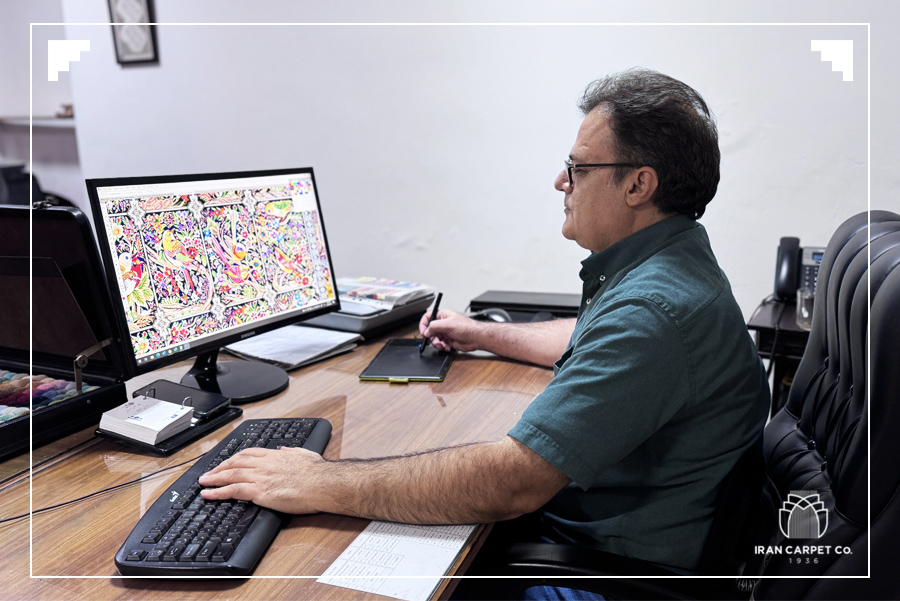
Mahmoud Faqirhaq is one of Iran’s distinguished and experienced carpet designers. He began his professional career in the mid-1980s. Born on 5 August 1961 (14 Mordad 1340 SH), he embarked on his specialist path in carpet design after completing his military service, apprenticing under Master Jami in Tabriz. This period was a turning point in the development of his artistic vision and skills. After several years of professional work in Tabriz and Marand, Faqirhaq established himself as an independent designer through perseverance and sustained effort. His close collaboration with leading masters, his upbringing in a family where his father, Hossein Faqirhaq, was also a well-regarded designer at Iran Carpet Company, 11 years of work in the design market, and the creation of designs known for their authenticity and innovation have made him a trusted figure in the field. His formal entry into Iran Carpet Company in the 1990s (1370s SH) marked a new chapter in his career, allowing him to expand his personal experience through institutional work and production. Faqirhaq also pursued university studies in English. With notable and commissioned designs to his credit, he continued his work as a designer approved by Iran Carpet Company’s central office, serving as Head of Design for two terms. In 2011 (1390 SH), he began teaching specialist carpet design and started collaborating with the University of Art, the Carpet Museum of Iran, and the National Carpet Center of Iran. In addition to teaching, Faqirhaq has served as a judge at national carpet competitions and events, and has been active in the revival of authentic Iranian patterns and designs. His many years of professional experience, involvement in education, and significant contribution to Iran Carpet Company productions have made Mahmoud Faqirhaq a prominent and respected figure in contemporary Iranian carpet design. Faithful to tradition yet always looking ahead, he has influenced younger generations of designers and trained many students in the same spirit.
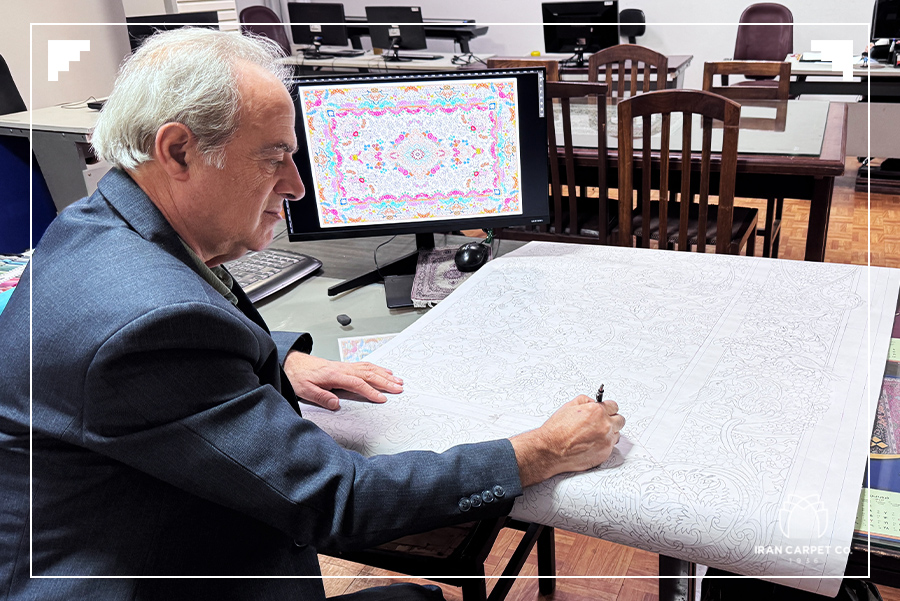
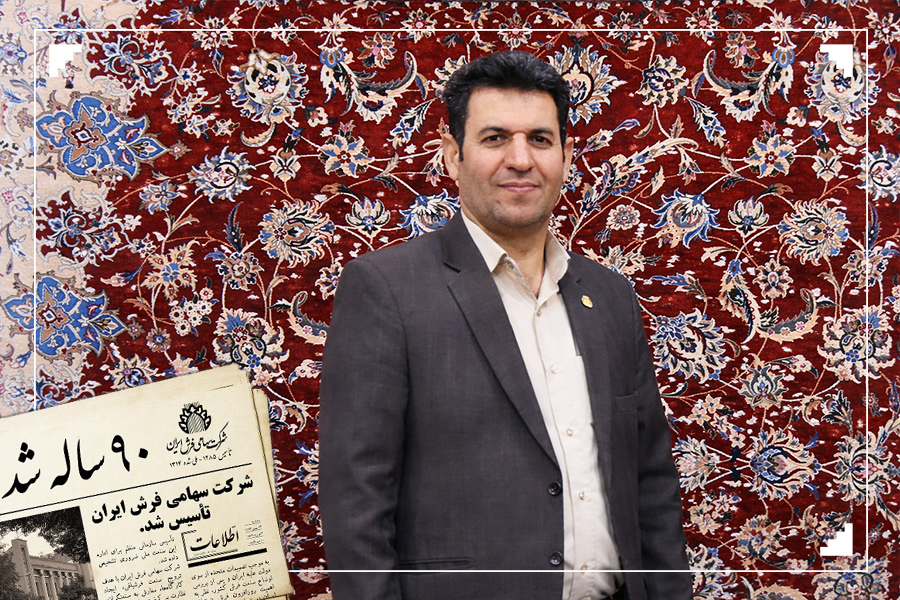
Ebadollah Amini, born in July 1969 (Tir 1348 SH) in Kermanshah, is a little-known yet exceptionally industrious figure in Iranian carpet painting. He began his artistic practice in high school, producing charcoal drawings and oil paintings, and his talent for illustration was quickly recognised. The rising cost of art materials led him to experiment with carpet design and painting—a path that soon became both his profession and artistic identity. Amini’s entry into the world of carpets began with individual effort and local experience in Kermanshah. He acquired his first skills by redrawing local patterns on graph paper he had made by hand. Soon afterwards, introductions from masters and managers in the field brought him to the Design and Colour Unit at Iran Carpet Company. From the mid-1990s (mid-1370s SH) onward, first at the Kermanshah branch and later in Tehran, he played an important role in improving the quality of design and colour application. He was among the designers who pursued the revival of authentic motifs and the development of local designs with care and creativity. He was among the first carpet painters to make a serious move into computer-aided design when Iran Carpet Company’s digital unit was established, and played a pioneering role among the first generation of professional carpet painters working with graphic software. His deep experience in classical design and his skill in adapting that knowledge to new technologies have made Amini an influential figure in the transition from traditional to digital carpet painting. Over several decades of work, Amini has maintained his artistic vision and respected the fundamental principles of motif and colour, contributing significantly to distinctive designs and major Iran Carpet Company projects. He remains one of the industrious and influential painters involved in the production of the world’s largest handwoven carpets.
To begin, please tell us about the paths and early milestones that led you to the design project for the world’s largest handwoven carpet.
- Master Mahmoud Faqirhaq: I joined Iran Carpet Company’s Design Unit in 1998 (1377 SH). At the time, the company’s design office was on Shahid Kalantari Street, and two floors of the building were assigned to the Design Unit. The colour, graphing, and design sections had a combined staff of 36. After staff reductions, the number of designers fell to 12. By the time the project for the large carpet for Sheikh Zayed Mosque began, the team had already been reduced in practice. Taking on the project meant accepting a heavy responsibility for its design and execution.
- Master Ebadollah Amini: The project began in 2005 (1384 SH). At that point, there were five or six people in the Design Unit. Besides Mr Faqirhaq and me, the team included Messrs Javad Kamel, Naser Parsasarasht, Rahim Seddiq, Gholamhossein Mahmoudi, Mohammadreza Arab, and Ms Peykani, who was then a trainee.
- Master Mahmoud Faqirhaq: Before the commission was confirmed, we were asked to prepare a few initial sketches. Several designs were prepared, and Mr Khalighi, who was Head of Design at the time, submitted a sketch as well. In the end, his sketch was selected as the principal design.
- Master Ebadollah Amini: We all prepared sketches, but it later became clear that the other designers’ proposals had not been considered very extensively. In any case, the selected design had five medallions, including a central medallion. The process was always competitive and collaborative. For example, for the subsequent project for the Omani Parliament—which consisted of three sections—one of my sketches was selected, along with another by Mr Parsa.
- Master Mahmoud Faqirhaq: The work officially began in 2005 (1384 SH); I can’t remember the exact month. Once the sketch had received final approval, we were told to begin the design work.
- Master Ebadollah Amini: I remember the timing more clearly. I was on leave when I was told that the project had been approved and we had to move straight into the design phase. Design began in July 2005 (Tir 1384 SH), and the colour and graphing stage started about three months later.
- Master Mahmoud Faqirhaq: Designing at full scale was naturally impossible, or at least extremely difficult. After several rounds of testing and consideration, we decided to work at half scale. Once the design was complete, its lines were redrawn with a Rapidograph on white paper and then scanned. It was sent to the other team members for colouring, graphing, and shading. At these stages, Mr Haseli, Mr Khalighi, and Mr Mahmoudi reviewed and approved the work. Sometimes a representative from the UAE would also be present to monitor progress.
- Master Ebadollah Amini: The work proceeded in a very organised and collaborative way, and no one directly interfered in the execution of the design. The truth is that we worked almost around the clock during that period. Sometimes I had to stay overnight in the unit to make sure my section, or work assigned to colleagues who had been delayed for one reason or another, was ready on time. The design was divided into sections for colouring and graphing; each section was about one metre wide and, altogether, 70 to 80 metres long. It was an exceptionally demanding, sensitive, and time-consuming project.
Once design work began, how many designers were working on the project? Were they designing directly?
- Master Ebadollah Amini: Mr Faqirhaq was responsible for the overall design. Mr Ali Khalighi, who headed the Design Unit when the project began, was also one of the carpet’s designers. He designed just one repeat unit from the main medallion and one from the middle medallion. The repeat units were executed at 1:32 scale. Apart from the medallions, Mr Faqirhaq designed the entire field and borders. Even within those sections, no flower was repeated; all the flowers were designed as varied, composite forms.
- Master Mahmoud Faqirhaq: The design process took about 10 months. With colouring and graphing included, the work took around 12 months. Colouring began three months after design work started. I began with the border, working at half scale. But once the design had been graphed, I saw that the border looked visually weak—what we call “short on detail”—and too sparse. So I asked the colour and graphing team to work on it again. I added 32 flowers to the border repeat unit to bring it to the desired level. At that stage, I understood exactly what proportions to use in designing and arranging the flowers. Some of the Shah Abbasi flowers in the large-scale sample measured around 30 × 38 centimetres, and some reached 35 × 42, but despite their size, they did not look large in the overall composition. To compose the field, I first divided the entire space and placed the required spirals in position within the system. The design required 63 spirals, each about 320 centimetres in diameter. To improve accuracy, I drew the first spiral at full scale—that is, 3.2 by 3.2 metres. I then entered it into the system so that any flaws in the circles and curves could be identified and corrected. Once it was approved, I printed it at half scale (160 × 160 centimetres); this became the main reference for the work. The flowers were designed to this standard so that, when enlarged twofold, they would reach the desired size exactly. I drew each spiral separately on its own sheet, and marked the positions of the columns as well. I always tried to keep large flowers away from the column lines so that they would not be cut in half and lose their beauty.
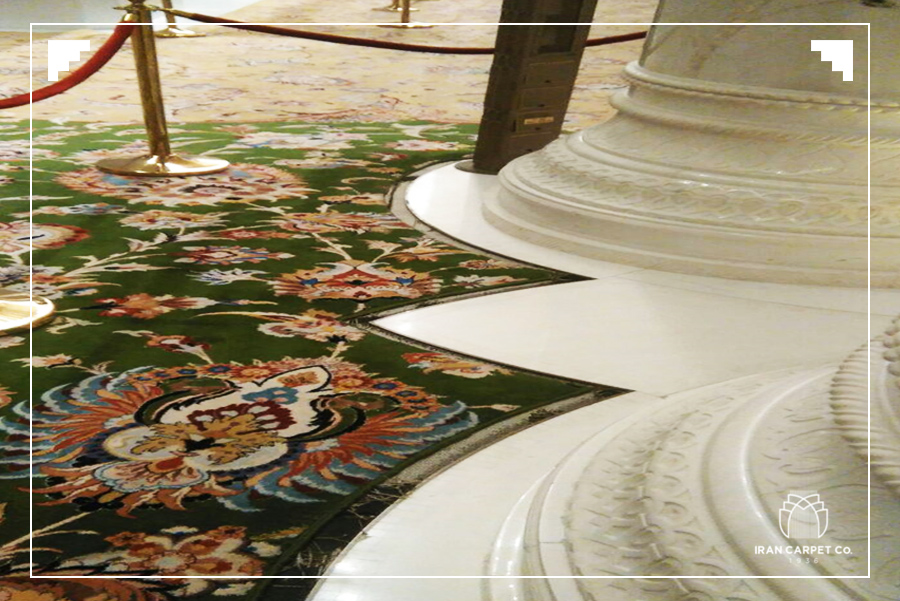
- Master Ebadollah Amini: The positions of the columns were marked in the complete design, but executing it involved considerable risk. If we had left plain-woven areas where the columns stood, there was a chance of misalignment during installation, which could seriously damage the work. Master Faqirhaq is right: we had to make sure no flower fell on a column cut-line and was damaged.
From what you’ve said, the border was ready for colouring by the third month. How many people worked on the colour? Did you do the graphing and colouring yourselves, or were those tasks divided?
- Master Ebadollah Amini: First we applied the main colours, then we did the graphing. We used the final colours for graphing too, to speed up the work. The colour and graphing team consisted of me, Mr Seddiq, Mr Javad Kamel, Mr Parsa Sarasht, and Mr Mohammadreza Arab. We worked on the border in half-metre sections. As soon as a section was ready, we sent it to be printed. It was printed using the state-of-the-art equipment of the time, mounted on boards, and sent to the weaving workshops so that the three workshops in Neyshabur would not be left waiting for the design and weaving could continue without interruption.
It must have been very important to ensure that the design sections reached the workshops correctly and without being mixed up. How did you manage that with several people working on it?
- Master Ebadollah Amini: Each painter would usually mark the completed sections with their own distinctive fluorescent colour, so it was clear which parts had been sent for weaving. At the workshop, Mr Mehdi Izadi—now the head of the company’s Hamedan branch—supervised and checked all the sections. So we had no problems; there was not a single mistake or mix-up.
How many colours did the design have? And why was green chosen for the field?
- Master Ebadollah Amini: The entire design had 25 colours. The client was very particular about the ground colour and insisted that it had to be a shade of green; the painters were responsible for choosing all the other colours. I remember that the Emirati representative spent two or three days choosing one of the eight green samples we had suggested. Interestingly, he compared the colours with the leaves of a potted plant, and the final choice was whichever sample best matched the plant. When he finally chose the green he wanted, he gave us a few banknotes as a gift—I don’t remember how many dollars—and said, “Ah! That’s it!”
The final green was produced at the Karaj dyeing workshop by Mr Jalali, precisely to match that selection. It is the same green seen in the carpet today.
Was a test sample woven before the project began?
- Master Mahmoud Faqirhaq: Yes. Once the border design was finished, we had one square metre of the field woven at full scale so that we could check the work and obtain the client’s approval. It was shown to the Emirati client so they could see how the design and colours would look when woven. The border was already being woven, but they also wove a one-metre-square sample of the field, both as plain green and with the pattern, so the client could confidently authorise the work to continue.
- Master Ebadollah Amini: After finishing the design of the main carpet, we designed smaller versions of the same pattern and colour scheme, up to 12 square metres in size, and many of them were woven too. These carpets were mainly commissioned for the mosque’s rooms and offices—something like models or secondary versions of the main carpet. Throughout the project, which lasted about a year, we worked at our workplace until midnight, even on holidays and during the Nowruz holidays.
Master Faqirhaq, did you also take part in the colouring and graphing for this project?
- Master Mahmoud Faqirhaq: No, I had no involvement in the colouring and graphing; I worked only on the project’s design. I designed the entire border and field myself. The carpet featured around 1,100 large and medium composite flowers and 700 small flowers, all different and varied. Because the project was moving so quickly, I had to draw directly with a Rapidograph, without first sketching in pencil. That required great precision and concentration.
Master Amini, did you work on the graphing, colour, and shading at the same time, or was shading done separately?
- Master Ebadollah Amini: Yes, graphing and shading were done at the same time. Very fine, complex shading was not necessary, but we shaded as much as we could to give the flowers greater presence. The production manager believed that this level of detail was unnecessary given the knot count, but we completed the work as we were accustomed to doing, even though it slowed production a little. Overall, I personally completed about a quarter of the entire colouring and graphing work, which I think was a larger share than that of my colleagues.
What particular challenges did you face while designing and painting this project—the largest of its kind, and one that has not been repeated since?
- Master Mahmoud Faqirhaq: There were no particular challenges, and overall the work proceeded in an orderly way. We did run into a problem when we started designing the field after completing the border. Our usual method was to design linearly, beginning at one end and working our way along. But because the carpet was to be woven in nine sections, production asked us from the outset to begin work on the middle section as well. We had not yet completed the design for the initial section. We had to prepare a part of the design that had not yet taken shape while also preserving the coherence and unity of the whole. That kept us occupied for about two months: one end of the carpet was being woven while they were asking for the other end. We had to keep working out how the two sides would eventually align exactly. In the end, this challenge was resolved through coordination among the team.
- Master Ebadollah Amini: I don’t remember anything unusual during the design process, but the time pressure was immense. We spent long hours in the Design Unit, and many nights we worked until morning to get the designs to production on time. One night, at around three in the morning, I was exhausted and decided to go home. As I stepped out of the elevator, something happened that I will never forget. The security staff did not know we had been working on the sixth floor so late. They suddenly came face to face with us, weapons in hand, and for a few seconds the situation was extremely dangerous. After hearing the commotion and our explanations, they understood what was going on. Fortunately, everything ended well, but it was a strange experience.
Have you ever seen the finished carpet in person?
- Master Ebadollah Amini: Yes. We visited the workshop once while it was being woven and saw the work up close, and we saw it again at its unveiling at Tehran’s Mosalla. Unfortunately, after it was installed in the mosque, we never had the opportunity to see it in its intended setting. We were not invited, and no arrangements were made for us to go ourselves. The same has happened with other projects, and I don’t know why designers, who are the intellectual creators of a work, are so often overlooked—not even their names and titles are recorded accurately.
This project differed greatly from the previous one, the Oman project. In Oman, the colouring and graphing were done by hand, whereas here the work was computer-based. What software did you use?
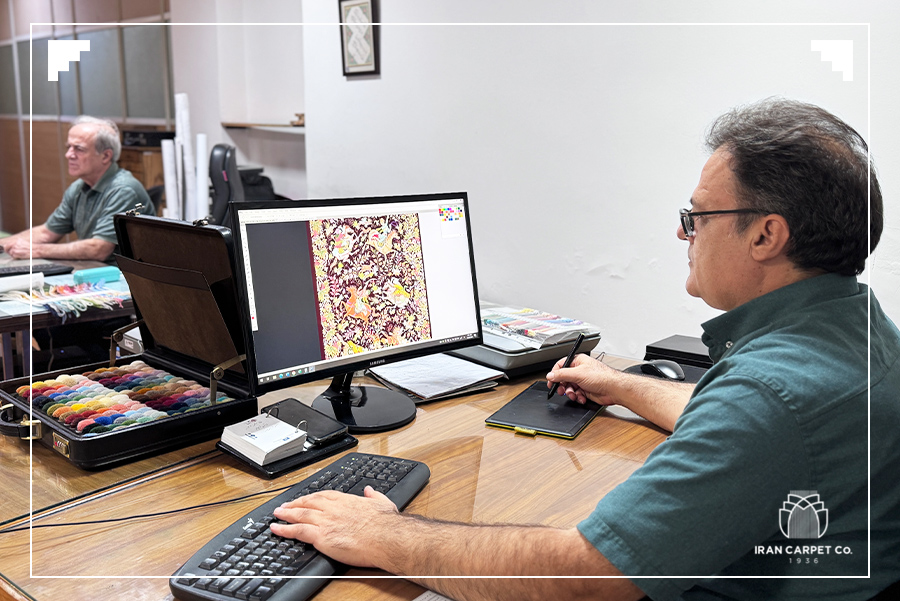
- Master Ebadollah Amini: The colouring and graphing for the Abu Dhabi project were done entirely in Photoshop. The delivery schedule was extremely tight, and we had to follow it precisely; from the beginning, the work had been planned as a computer-based process. I should also mention the Oman project. Before the Abu Dhabi project, it was the world’s largest handwoven carpet. The initial sketch was prepared by me and Mr Hasan Vazifeh. Mr Vazifeh drew the design on a small square sheet of paper, and I coloured it with coloured pencils. That sketch was approved. Mr Vazifeh—may he rest in peace—did not believe in using repeat units at all. He designed the border from beginning to end without repeating any part. The Oman project was the same: although the design included repeat units, the entire pattern was designed, coloured, and graphed by hand. For a carpet measuring more than 4,000 square metres, it was truly a masterpiece. Mr Masoud Farahani supervised the colouring. He divided the designs into six-square-metre sections among the designers; each was coloured, then assembled and sent to production. I was at a branch at the time, and they even sent a few sections out to me in the provinces, where I worked on them. In the final stages, both the designer and the painter—Mr Vazifeh and Mr Farahani—went directly to Neyshabur and stayed there for a month or two. They designed and coloured the sections as they went, then handed them straight to production.
If you were to design the world’s largest handwoven carpet again today, would you create a better work than the existing one?
- Master Mahmoud Faqirhaq: Definitely—both better and faster. My outlook has not changed, but my abilities have grown considerably. That project itself was a real masterclass for me, an experience I had never had before. It was the first time I designed directly with a Rapidograph. My method was to place the completed 160-centimetre spiral under a sheet of white paper and redraw all the motifs with a new model and structure. The original design helped me position the elements correctly, but I completely changed the forms, buds, and details. Alongside Shah Abbasi flowers and composite flowers, I also used Farangi flowers in this project, though very sparingly, because I felt that too many Farangi flowers would compromise the work’s authenticity. Because the design was all-over Afshan, arabesque motifs featured more prominently in the medallions and borders.
- Master Ebadollah Amini: There was also one requirement imposed on us. We had to draw inspiration from the motifs and elements of the mosque’s ceiling and dome so that the carpet would harmonise visually and in character with the mosque’s architecture. That was natural, since the carpet was designed and woven specifically for that mosque.
Do you know what happened to the printed designs after the weaving was complete?
- Master Ebadollah Amini: All the designs were handed over to the Emirati client after the weaving was finished. They were transported together on a plane, but I don’t know how they are being stored today or what use is being made of them.
Even though I had no part in this project, it has always given me a sense of pride and connection. Did it bring you personal or professional benefits as well?
- Master Mahmoud Faqirhaq: Yes, of course. It had a significant impact. It also improved my financial situation, although the design team’s share was smaller than that of the colouring and graphing team. I moved to a different home and managed to save some money. I wish more projects like this one, which was entirely for export, had been undertaken.
- Master Ebadollah Amini: It was an excellent project for all of us. There may have been some dissatisfaction, but overall it was a valuable and influential experience. I can say that almost everyone on the team was able to buy a home with the income from this project. The total design fee that year was 180 million tomans. It was a project that became a source of pride and a lasting memory for us, both economically and as an important part of our professional experience. I hope projects like this will come about again and that we will be able to take part in them.
The world’s largest handwoven carpet is more than a record of size and scale. It tells of the precision, refinement, and remarkable coordination that went into its creation. Woven in nine separate sections, it was ultimately laid in the mosque as a single, unified whole—as though it had been designed and woven in one continuous breath. Behind this extraordinary work lay years of experience, concentration, and collective effort on the part of its designers and painters, artists who represent a substantial part of the identity of Iranian carpets. Among them, Mahmoud Faqirhaq and Ebadollah Amini each played a vital role. Faqirhaq’s meticulous, sustained, and richly detailed design work—from creating more than a thousand composite flowers to resolving the challenges of coordinating the pattern across separate sections—and Amini’s work in managing colour, graphing, and shading, along with his tireless efforts to deliver the designs, both deserve recognition and admiration. So too do the thousand weavers, dyers, supervisors, and others, each with many unheard stories of their own. The accounts of these two artists offer a small glimpse into the untold stories of this project: nights spent at the design studio until morning; split-second decisions that changed the future of the design; trials and errors; and the immense responsibility felt in every flower, every border, and every colour. The world’s largest handwoven carpet stands as a testament to the technical and artistic heights of Iranian carpet-making. It will remain an exceptional work not only in the world of carpets but also in the history of contemporary art. This issue of the magazine turned its attention to these hidden and less-heard aspects: stories from the design studio, from the designers’ minds, from the discipline and sleepless nights, and from the artists who made such a large contribution to this achievement. The work now laid across the floor of the mosque is more than a carpet. It tells of the skill, experience, and vision of Iranian artists, who offered beauty to the world on an unprecedented scale.
Photo Album (6)
Related Reading
All Journal & Blog History & Heritage
Iran Carpet Company at 90: A Conversation with Abbas Hesari
This interview was conducted to mark the 90th anniversary of the nationalization of Iran Carpet Company and to record and preserve the experiences and memories of its long-serving and veteran colleagues.