It All Began with a Heris Carpet
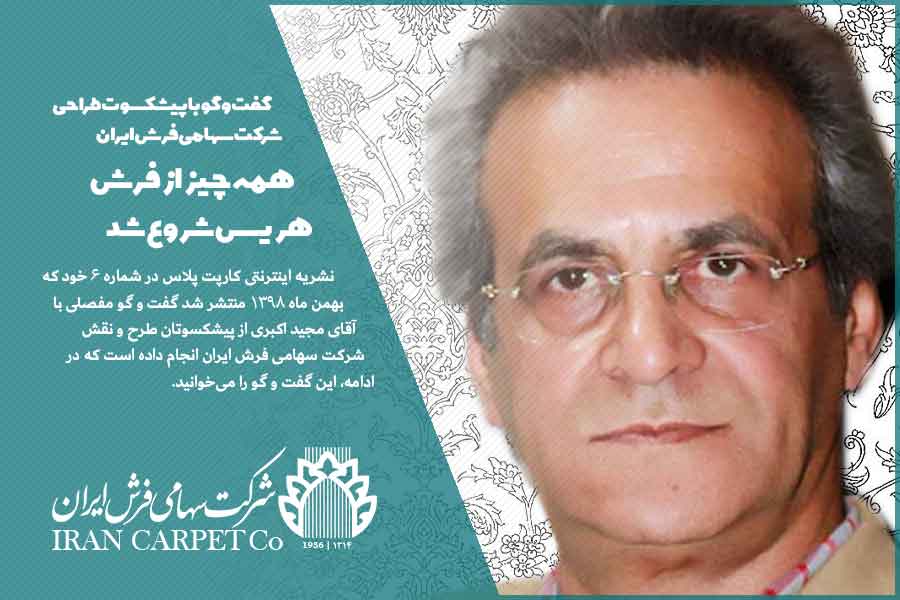
- Please tell our readers about your background and how you entered the field of carpets.
- I am Majid Mohammadi Akbari, son of Karim, born in 1337 (1958–59) in Tabriz. I completed my primary education at Fayyaz Elementary School in Tabriz and my secondary education at Tamaddon High School. During high school, I became acquainted with carpet designs and developed a keen interest in them. Although I had taken private drawing and design lessons with Master Khiabani, I used to practise گل و مرغ (Gol-o-Morgh, the flower-and-bird motif) during class, and was consequently disciplined many times. Around that time, my older sister married. My brother-in-law was a designer and owned a carpet-weaving workshop. The first time I saw the workshop up close, I was so overwhelmed with excitement that I did not know what to say or how to express my feelings. From that moment, I was captivated by this time-honoured art. Although I had learned and worked with designs from Azerbaijan, I had commissions of my own and was earning my own money. I began researching carpet design and colour. When I looked at the books of that period, especially Professor Pope’s book on carpets, I felt disheartened, because I was unfamiliar with the designs of Isfahan, Kerman, Kashan, and other regions.
- In 1357 (1978–79), on the recommendation of Master Tabrizi, I went to Tehran to study with the late Master Naderi. I began gathering information about coloured carpet designs—their colours and dotting—and realised that I had never tried dotting with a brush, so I needed to learn it. In his workshop, the late Master Naderi taught me the brush-dotting technique. On his recommendation, I went to Isfahan to meet Master Archang. He looked at my designs and accepted me as a student. His influence on me was considerable. Although I studied with him for two years, I learned a great deal. At the time, the Revolution was taking shape and strikes were taking place across Iran. For me, however, this was an opportunity to practise and work more diligently, since the commissions I had in hand were on hold. I immersed myself in work and research day and night. I studied the different design traditions of various regions, rendered their colours and dots, and examined a wide range of designs. At that time, I drew more heavily on what I had learned from Master Archang. In Ordibehesht 1363 (April–May 1984), I had come to Tehran to obtain a German visa. As I was passing Ferdowsi Street, I noticed a sign in a shop window saying that a carpet designer was wanted. I went in to make inquiries and was shown to the office of the late Master Pakdast. He told me, “It is time for me to retire, but the company’s management will not agree unless I find a designer like myself to take my place.”
- To assess my work, Master Pakdast commissioned a small carpet design and said that if the company approved it, I would be hired; otherwise, the design would be returned. I agreed. About a month later, I completed the design and brought it in. Master Pakdast took one look at it and showed it to Mr. Allahdad, who approved it. It was immediately approved by the managing director, Mr. Mohammadreza Abed, as well, and that is how I joined the company.
- Where did your first encounter with carpets and carpet design begin?
- My first encounter with carpets was when I was very young. We had a Heris carpet at home, and its border, with its samovar-like motif, caught my attention. I used to play with its shapes. In other words, Heris design was my point of entry into the world of carpets. Gradually, this led me, even as a child, to pay closer attention to other carpets. I looked at the birds, arabesques and scrolling motifs. This was my starting point. As a teenager, I began copying these designs in pencil and, as we say, drawing out the patterns. That helped me realise how much I loved these images and how naturally I connected with them.
- Which masters had the greatest influence on you as a designer?
- The first was my dear teacher, Mr. Hossein Tabrizi, who did a great deal for me. I also drew many ideas from Master Khiabani. Since I worked in the Tabriz bazaar, I became familiar with the designs of the region and its surroundings, especially Heris. My attention was drawn to Persenkov’s book, where I saw designs that were new to me and unfamiliar. I decided to research and study them, and asked my teacher to introduce me to the region in Fars Province—to help me become familiar with these areas. That conversation led to his introducing me to Master Archang. I loved his work—may he rest in peace—and some of my motifs were inspired by it. Fortunately, I was able to earn his regard and had the honour of studying with him for about two years. I learned a great deal from him during that time. Beyond carpet design, I also learned miniature painting. Since Master Tajvidi would visit him then, I had the opportunity to meet him and developed a close connection with miniature painting as well. Before that, I had only seen miniatures in books and on postcards. Alongside this, I was very interested in tilework, and spent five or six months working in a tile workshop. I wanted to understand how they used carpet elements in their work. I was also passionate about painting and quite good at it. All of this helped me stay in the field and choose carpet design as my profession.
- In your view, does a carpet’s greatest impact lie in its design or its colouring?
- I believe carpet design encompasses both the pattern and its colour-and-dot rendering. This is particularly evident in regions such as Isfahan, where great importance is attached to colour and dotting. In Azerbaijan, the approach to colour placement is different from Isfahan’s. Tabriz carpets generally use a greater range of colours, and are woven with beautiful colour combinations. Isfahan, by contrast, works with a more limited palette and must create a masterpiece of beauty with those few colours. Both regions achieve this through their particular strengths. To me, colour and dotting complement the design. You cannot look at a carpet and say, “Only the design is good.” The two complement one another; any weakness in either one has a direct effect on the carpet’s beauty.
- Have you ever designed a carpet but not had the opportunity to colour it, leaving that to someone else? Did you notice a difference in the result? Has another person’s colouring ever improved or diminished your design?
- I remember that in 1373–74 (1994–96), we received a commission from Jahad for a circular design measuring about 200 square metres. I designed it, and we worked on the colouring in our own office—you were there, too. After completing the design, I had an idea for the colours and conveyed it to the client. Some people find it difficult to accept certain colours in a carpet. We worked very hard to carry this out. Computers were not available for this kind of work then, so we had to join very large sheets of paper together, draw the design at full scale, and then colour it. Mr. Mohammadzadeh, who was my colleague at the time, took responsibility for the colouring and, fortunately, did a beautiful job. In general, though, when a carpet is being designed, a strong design will make itself known even if it is not paired with particularly appealing colouring. The reverse is also true: suitable colours cannot save a weak design, which will inevitably suffer. These days, we see carpets being made that truly do not befit the status and standing of Iranian carpets. Unfortunately, there is no organisation or agency taking responsibility for this or following up on the matter.
- Do producers and clients understand the importance of your work? If they ask you to make changes to a design, are those requests based on sound principles? Please explain.
- Producers usually do not express many opinions about the colours when they commission a design, because they want it to reflect their original idea. If we, as designers, insist on our own approach, we can only present it on paper as a preliminary sketch. If they like it and agree, we can then develop the design according to our own vision. Sometimes, a producer has a particular design in mind and does not want any changes at all. Whether to intervene is a matter of the designer’s skill: a highly professional designer can make changes that improve a design. Otherwise, the work falls into a second tier of design. I usually work on older designs and revive patterns associated with particular regions—these are often the designs I am commissioned to make. I tend to have distinctive ideas both for the design itself and for its execution and colouring, which I share with the producer and client. Most of them accept these ideas, and that has helped us remain active in this market and continue working with clients. It has been a great encouragement to us.
- In your private moments, which regional carpet designs from Iran do you enjoy most?
- That is a very difficult question for me to answer. In the roughly 30 years I have been working, I have worked with designs from most regions, and each has its own particular appeal. I would not say I prefer Tabriz designs just because I am from Tabriz—that is not the case. Each is like a seasonal fruit, with its own shape, taste and flavour. Personally, I cannot say which region I would choose, or that one region is superior to another. Perhaps a better question would be: which regions are producing the best designs today?
- Have you ever combined the designs and colours of several cities to create a design that transcends regional traditions? Have producers and the public responded positively or negatively?
- Most of my work is done this way, and I have always had a very positive response to it. In our designs, we try to do the best possible work, as everyone does in their own profession. We can combine designs from different regions if we do so professionally and are familiar with the distinctive elements of each region. Otherwise, the work can be seriously compromised. If the designer is highly skilled, well informed and able to bring these elements together professionally, the result can be much more beautiful and distinctive. I work this way on most of my designs.
- In your view, which city’s carpets are the most popular in Iran, and why?
- At present, I think the most popular Iranian carpets come from two regions: Tabriz and Qom. This is because, recently, both have been producing distinctive work rather than repeating the same designs. The variety in their designs and colours seems to inspire greater enthusiasm and interest among people. That is what we are told when we ask about it at domestic and international exhibitions. Isfahan also produces fine carpets in its own right, but I think that, at this point, producers in Isfahan should reconsider some aspects of their work.
- Are you satisfied with the current state of handwoven carpets? What proposals or solutions would you offer to move beyond the present situation?
- In my view, the carpet industry is in a deep slump at present. To emerge from it, I think officials need to make sound decisions, because the issue has become entangled to some extent with the country’s political situation, and that is harming us. For example, the sanctions imposed by the United States have dampened the Iranian carpet trade, both in domestic production and in exports. To move beyond this, I think a global shift is now under way in carpet design and colour. If we pay some attention to the designs that are popular with people in different countries, we can learn a great deal. I have noticed that some carpets popular with younger generations in the United States may be called “modern,” but I would describe them as designs using muted, light colours that harmonise better with contemporary interiors. If we adopt this approach, we can achieve much better results. We could even use our own classical designs in this way and regain the market. Despite the sanctions, there is still much we can do. Apart from political, customs, administrative and banking issues, and many other matters I will not go into, we first need to do our own work better—in colour, design and dyeing, as well as in the systems for selling carpets and the fibres and materials we use. If everything is done properly and well, we can still achieve greater success.