
History & Heritage
Iran Carpet Company at 90: A Conversation with Ebadollah Amini
Jan 31, 20267 min readIran Carpet Company
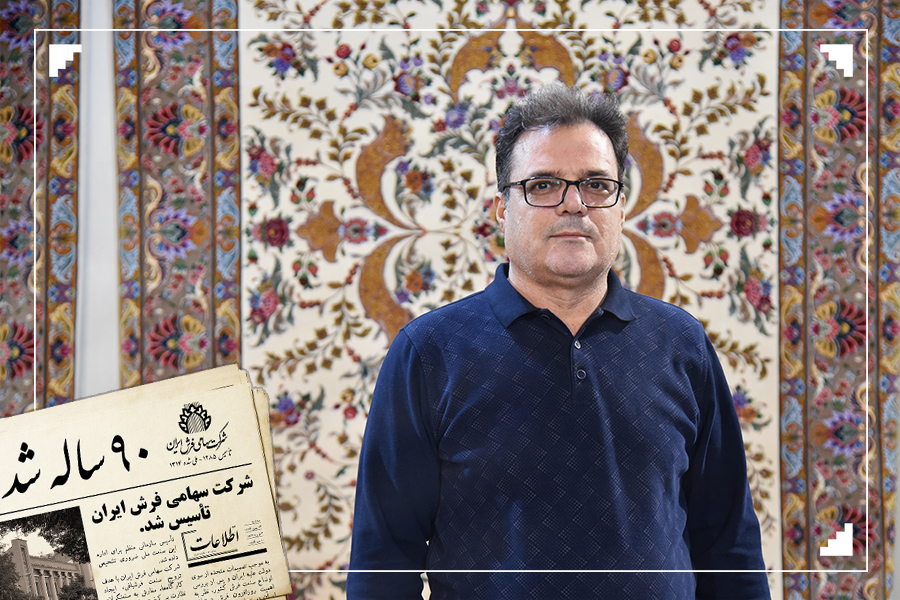
To mark the 90th anniversary of the nationalization of Iran Carpet Company, we have held a series of conversations with the Company’s veteran colleagues—people who have devoted many years of their professional lives to preserving, producing, and advancing Iranian handwoven carpets. In this installment, we speak with Mr. Ebadollah Amini, a handwoven carpet designer working in Iran Carpet Company’s Design and Color Department. He reflects on his professional experience and memories, and on the course the Company has followed over its decades of activity.
I am Ebadollah Amini, born in Kermanshah, and I am Kurdish. I began working with Iran Carpet Company in 1995. From the outset, I worked in the Design and Color Department, and I have been active in this field for around 33 years. My chief interest has always been color, although I also worked in design during my early years.
I attended painting classes from my teenage years and won awards at the school, city, and even provincial levels. One day, my mother bought a carpet design for 400 tomans, intending to have a carpet woven from it, and that was when an idea first came to me. I thought, “I paint all these oil paintings, but no one buys them—so why not draw carpet designs?” That was how I began. Even graph paper was unavailable in our city, so I made it myself. I faced many difficulties before finally finding my way to Iran Carpet Company. Joining the Company felt like entering a new world. During my apprenticeship, the first design I drew for the Company was purchased—a major turning point in my professional life. About a year later, I was formally hired.
After spending about a year in Tehran as an apprentice, I was hired for the Kermanshah branch. At the time, we did not yet have a branch in Kermanshah; it had only just been established. I worked there for about ten years. In those days, designs were produced in printed form, and once completed, the woven carpets were returned to the branch. This was a valuable opportunity, because I could see the finished work up close and the carpets were reviewed. From the very beginning, I was therefore closely connected to the final outcome of the work: the woven carpet. Over time, the branch’s working methods changed. Repeated printed designs were phased out, and each carpet was designed to have its own unique pattern. This was an important turning point for the Kermanshah branch, especially in design and color, and it allowed us to move away from repetition.
The most important factors are the Company’s authenticity and the standing of its name, in both design and color. Iran Carpet Company wove only a limited number of carpets from each design, after which the design was kept in the archive as a “master design.” Even ten or fifteen years later, perhaps only one or two more carpets might be woven from it. This approach was entirely different from mass production and helped preserve authenticity. Alongside it, meticulous expertise in design and dyeing, together with high-quality weaving, established the Company’s position as the custodian of Iran’s carpet heritage. These factors have built customers’ trust over the years.
One of my most important memories is of the Abu Dhabi carpet project. Four of us worked in design and pattern drafting, while several hundred weavers were involved in the project. Sometimes the designs would run out after just a few days, and if we fell behind, the entire weaving process would come to a halt.
There were many times when we stayed at the Company around the clock, preparing and printing the designs and getting them to the weavers as quickly as possible. The workload was intense—we even worked through the Nowruz holidays—but it remains one of the most valuable and memorable experiences of my career.
On projects such as the Oman Carpet, all the work was done by hand. The medallion design for this carpet was created by the late Mr. Pakdast, while Mr. Hassan Vazifeh-Rezaei designed its overall structure and principal form. I also helped prepare and complete each individual preliminary drawing for the work. The designs were made at full scale, and the preliminary drawing was colored with colored pencils (70 × 70 centimeters). Even during the color and dotting stage, Winsor gouache paints were prepared by hand in large quantities—in 3–4-kilogram buckets—so that every designer would use exactly the same color range and not introduce personal preferences into the work. Achieving this consistency was very challenging, but the result was uniform and precise. At one point, several colleagues, including Mr. Masoud Farahani, Mr. Vazifeh, and Mr. Parsa, were even stationed in Nishapur to speed up the work. They prepared the designs directly in the workshop for the weavers, so production would not stop. Sections were also sent to me at the branch to complete. This experience was extremely valuable in bringing me into close contact with the weavers and giving me a practical understanding of the production process. Then, in the early 2000s, computer-based work was just beginning. At first, only one person worked with a digital system. Gradually, our department went digital, and we used software such as Photoshop. In the early days, we also used a program called “Tradis Sanat,” which was eventually phased out completely.
Above all, carpet design requires passion and artistic aptitude. The work may not be physically demanding, but it is deeply engaging mentally and emotionally. Without love for the work, perseverance, and artistic sensibility, the result will have no soul, however technically flawless it may be. There have been people who knew the technical side of the work, but whose pieces did not endure because they lacked an artistic spirit. A good carpet, after all, is one that carries imagination and life within it. I believe that genuine interest and perseverance are essential to lasting in this profession. Carpet design is not merely a technical task; it is an art that must have a “soul.”
I hope conditions for handwoven carpets can change so that the work once again offers a fair livelihood and renewed motivation for designers, weavers, and producers. The field faces many difficulties today, and if it is to continue, it needs meaningful change and serious support.
 History & Heritage
This interview was conducted to mark the 90th anniversary of the nationalization of Iran Carpet Company and to record and preserve the experiences and memories of its long-serving and veteran colleagues.
 History & Heritage
This interview was conducted to mark the 90th anniversary of the nationalization of Iran Carpet Company, and to record and preserve the experiences and memories of its veteran and long-serving colleagues.
 History & Heritage
This interview was conducted to mark the 90th anniversary of the nationalization of Iran Carpet Company and to record and preserve the experiences and memories of its long-serving and pioneering colleagues.