Iran Carpet Company: A Foundation for Carpet Documentation
According to the Public Relations Office of Iran Carpet Company, the practice of preserving government records in Iran dates back to the Achaemenid period. It is said that the Achaemenid state was founded upon a “royal archive.” This regard for documentary records has continued into the present day, where their value has only grown.
The establishment of the National Archives of Iran was approved at a session of the National Consultative Assembly on 17 Ordibehesht 1349 (7 May 1970). Its origins, however, reach back to the Constitutional Revolution (1280–1309 SH / 1901–1930) and the adoption of modern French methods for classifying documents.
Handwoven carpet is one of Iran’s enduring arts and has long attracted considerable interest, including from foreign and multinational companies that produced and exported carpets in cities across Iran from the late Qajar period into the twentieth century. After foreign companies were prevented from operating, Iran Carpet Company became the custodian of their legacy. From its earliest days, it maintained a coherent administrative framework and set of procedures; eight decades later, its records had themselves become a foundation for the documentation of the country’s handwoven-carpet heritage. In 2013, under an agreement with the National Library and Archives of Iran, the company donated 3,102 carpet designs and 1,176 documents to the institution.
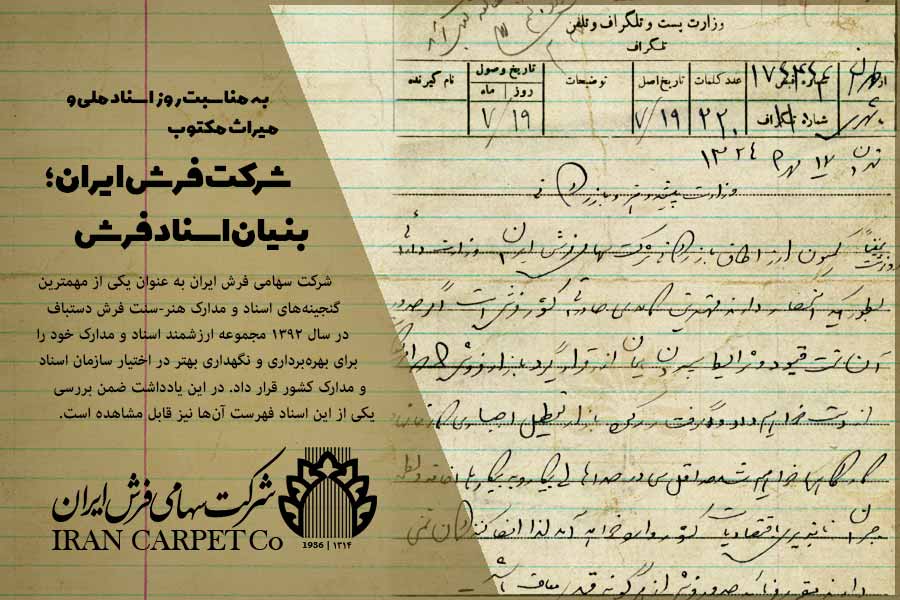
To mark National Archives and Written Heritage Day, we examine one of these documents, which has particular resonance today. It is a telegram sent to the Ministry of Industries, Arts and Commerce, dated 19/7/1324 (11 October 1945), concerning exemption from the requirement to lodge a foreign-exchange undertaking for handwoven-carpet exports. The full text reads:
Tehran, 12 Mehr 1324 (4 October 1945) Ministry of Industries, Arts and Commerce Copy to: Foreign Exchange Commission of the Chamber of Commerce; Iran Carpet Company; Ministry of Finance As you are aware, carpet is the country’s most important export commodity. If its export is made subject to the restrictions and conditions of lodging a foreign-exchange undertaking, we shall lose the American market and face a stagnation of trade and the forced closure of factories and workshops. At least thirty per cent of the population will be left without work, adding to the number of unemployed, and irreparable damage will be done to the country’s economy. We, the undersigned, therefore respectfully request that you order carpet exports to be exempt from all such restrictions.
 Document description
The requirement referred to in the telegram also affected this art and tradition in the preceding year. Documents such as these, preserved over time, can illuminate both the strengths and the vulnerabilities of a field.
Below is a selection from the company’s archival catalogue. The 1,176 Persian-language and visual records were transferred to the National Library and Archives of Iran.
| Archive catalogue | Source |
| The collection includes company correspondence, telegrams, ledgers, financial statements, personnel files, carpet designs, sales and export records, workshop and production reports, and records relating to branches throughout Iran and overseas. The catalogue encompasses material concerning Kerman, Tabriz, Isfahan, Mashhad, Kashan, Qom, Hamadan, Arak, London, New York, and many other locations. The original catalogue contains 1,176 entries. | |
Related Reading
All Journal & Blog History & Heritage
Iran Carpet Company at 90: A Conversation with Abbas Hesari
This interview was conducted to mark the 90th anniversary of the nationalization of Iran Carpet Company and to record and preserve the experiences and memories of its long-serving and veteran colleagues.