From Carpets to Nima
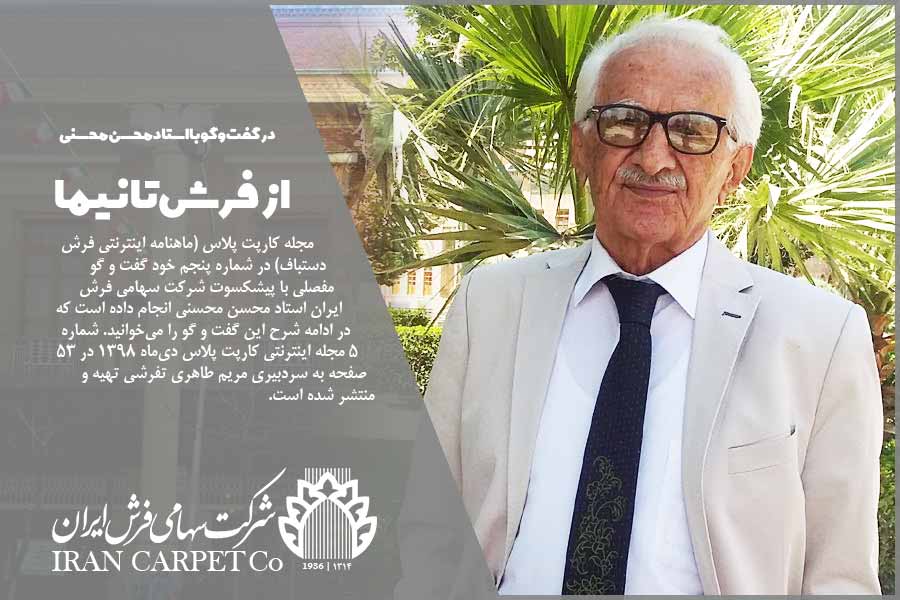
According to the Public Relations Office of Iran Carpet Company, the fifth issue of Carpet Plus, an online monthly magazine devoted to handwoven carpets, features an in-depth interview with Master Mohsen Mohseni, a veteran of Iran Carpet Company. Read the interview below. The fifth issue of the online magazine was prepared and published in Dey 1398 SH (December 2019–January 2020), in 53 pages, under the editorship of Maryam Taheri Tafreshi.
Please tell us about your life. I was born on 7 Khordad 1310 SH (28 May 1931) in Rostam Rud, in the county of Nur, Mazandaran Province. I lived there until 1330 SH (1951), then moved to Tehran to continue my education. As I was liable for military service, I served as a conscript in the medical unit of the country’s Customs Police. Since my work was administrative, I attended evening classes after work, from seven o’clock onward, and managed to earn my diploma through an intensive two-year course. In 1333 SH (1954), I was hired in the administrative department of Iran Carpet Company. In 1334 SH (1955), I married my cousin. Because of my great interest in literature, I went on to study for a diploma in literature, which I also obtained. I later entered university and received a bachelor’s degree in Persian Literature from Allameh Tabataba’i University. I had hoped to continue my studies through to a doctorate, but unfortunately, the demands of work and family life, as well as my father’s illness, left me no opportunity to do so. I continued, however, to research and study carpets, and became a specialist in Iranian handwoven carpets.
While studying, I worked continuously in different departments of Iran Carpet Company, including administration and office work, finance and accounting, and commerce. Later, I became branch manager in Abadan, where I served for seven years. In 1345 SH (1966), I organized a carpet exhibition in the reception hall of the Abadan Oil Company. In those same years, I also arranged a major carpet exhibition in New York, at the Pan Am building, to introduce carpets more widely in America and facilitate their purchase, sale, and exchange with Iran Carpet Company. In 1351 SH (1972), we decided to compile a collection of Iranian designs and carpets. After considerable work photographing the carpets and recording their details accurately, we published two magnificent volumes, The Masterpieces of Iranian Carpets, in Esfand 1351 SH (February–March 1973). This remarkable collection is still held by Iran Carpet Company. It contains hundreds of photographs and descriptions of the company’s carpets from every region of Iran.
Please tell us about Iran Carpet Company. Before Iran Carpet Company was established, carpet production was in the hands of provincial producers and bazaar merchants. The flourishing of carpet art during the Safavid and Qajar periods attracted foreign companies to Iranian goods, including handwoven carpets. Foreign merchants and companies such as Ziegler entered Tabriz from Turkey, then expanded their operations from Tabriz to Sanandaj, Bijar, Hamadan, and Sultanabad (Arak). The East India Company also began production and exports in eastern Iran, in cities including Yazd, Kerman, Mashhad, and Birjand, with its head office in Kerman. In 1314 SH (1935), the Ministry issued an order, under Reza Shah, to establish a joint-stock company. Iran Carpet Company was founded with 51 percent government ownership and 49 percent private ownership. The decision was made to remove the foreign companies from the business, and their properties were purchased so that they could be bought out. These companies had branches in most major cities, including Tehran, Kerman, Kashan, Mashhad, Tabriz, Isfahan, and Arak. Since they had been removed from the business, they had to be compensated. Iran Carpet Company undertook to settle the accounts over ten years and completed payment by 1325 SH (1946–47), partly in carpets. Two or three of the foreign companies’ principal managers, who were neither British nor Russian, were retained. One was Timo Yanaki, a Greek who became so thoroughly established in Iran that he found an Iranian bride from the Ameri family for his son, Roger. His son remained in Iran and was involved in carpet production until the end of his life; he died here. Another manager was Robert Simon, who oversaw the company’s carpet operations in Hamadan and western Iran. On 3 Shahrivar 1320 SH (25 August 1941), when Allied forces invaded Iran, he joined the army, wearing a French officer’s uniform. Years later, in 1351 SH (1972), when I was head of commerce at Iran Carpet Company, Mr. Simon came to me to buy several carpets, which he took to France.
In which years did you manage the Kerman branch? I managed the Kerman branch from 1347 to 1350 SH (1968–1972), and I was the one who established the branch in its new form. I set up a centralized workshop with around 40 to 50 workers, with two large halls on a 3,500-square-metre site available to me. I also established a dyeing workshop and a proper place for the dyeing furnaces. Previously, they had been set up primitively in a sort of pit below ground, where workers had to stand inside and pour diesel fuel into the furnace. This caused burns to their hands and faces and serious injuries. I built a shed on the site and installed above-ground pipes to feed diesel fuel from a storage tank to the furnace. I insured all the workers, including every carpet weaver. I was personally the one who proposed insurance for carpet weavers and implemented it after the proposal was approved. Other producers in the region objected, saying I had raised the weavers’ expectations and that they would no longer work for them; they all wanted to come to the company’s workshop.
What were the characteristics of Kerman carpets? Before I arrived, Kerman carpets were affected by fraudulent practices, including jofteh weaving. When people said “80 jofteh” in Kerman, they meant the equivalent of 40 raj in Tabriz. One characteristic of Kerman carpets was their very wide range of colours, whereas Kashan carpets used three or four principal colours and a few secondary ones. In Isfahan, green, blue, and diamond hues were widely used. Tabriz weavers used several shades of green, from deep jade to the light green of plane-tree shoots, while Mashhad carpets were coarser in weave and used more reds and navy blues. In fine-woven carpets from both Kerman and Tabriz, however, the number of colours was especially important. Kerman carpets used a range of golden yellows, purples, dark and light pinks, and dark and light greens. Their designs were generally dense and finely detailed.
Did you oppose the jofteh-weaving method in the region? Yes. I prohibited jofteh weaving, and dismissed anyone who engaged in fraudulent weaving. Since there were many weavers in the region, I set standards for hiring master weavers and submitted those standards to the governor’s office. Applicants had to bring a recommendation from their masters before I would hire them. In this way, I brought the most skilled designers, cartoonists, weavers, and master artisans together at the company. In return, I provided the workers with the best possible facilities.
I established a kindergarten and nursery for mothers and their babies on the premises. I built separate bathing and restroom facilities for women and men, and the weavers could bathe after work before going home. There was a separate dining room for lunch. I did not employ children under 12; I sent them to school instead. To make up for their lost earnings, I gave their parents, who worked in the workshop, denser, more demanding, and finer-woven designs, which paid more. In that region, it was very common for girls as young as four or five to weave carpets alongside their mothers in the workshops, and this was distressing. Insurance was also a fundamental condition of employment. For that reason, I insisted that they engage in no fraudulent practices and produce work of high quality. The finest carpets, with the most beautiful designs, in Kerman, Ravar, Rafsanjan, and Jupar were made for Iran Carpet Company.
Why are Kerman carpets so densely patterned? Is there a story behind it? There were two kinds of carpet weaving in Kerman. One was “American-style” weaving, produced on a large scale for American customers. We did not produce it during my time, but before I arrived, American-preferred carpets in five soft, subdued colours were among the region’s products. They had no navy backgrounds at all; instead, the grounds were light cream, pale blue, light green, pale pink, and soft red. They were woven quickly, with a coarser knot count, long fringes, and a few other pale colours.
Which region produced the best-woven carpets? There was a manager in the Rafsanjan region whose name I have forgotten, and he worked under my supervision. I supplied him with the best yarn, dyes, and designs, and he produced the finest carpets and sent them to the head office. Rafsanjan was not the only region; I also prepared and sent designs to Zabol, Qazvin, and elsewhere. The Qazvin branch had closed in 1327 SH (1948–49). We found its designs in the market, restored and rewove them, and sent them to Zabol. Because there were so many weavers in the disadvantaged region of Zabol, they produced exceptionally fine carpets. Even today, the Qazvin-design carpets woven in Zabol for Iran Carpet Company are among its finest. At one time, the company’s carpets were its best export products. The town of Bam had no weaving tradition, but Ravar was entirely independent and wove the most complex designs. Most of its designs were tree motifs, densely composed and very finely woven. The crowded designs associated with Kerman carpets, with their rich patterns and numerous colours, actually originated in Ravar.
With their beautiful weave and dense designs, are Kerman carpets considered fine carpets, and do they sell well? The United States brought Kerman carpets to a standstill on three occasions. The first was during the First World War. With a large number of weavers and foreign companies directing production, Kerman had been producing in bulk. Orders were placed for, say, 100 carpets of a particular design. Kerman carpets were usually large-format pieces, from nine square metres up to 48 square metres, and runners were five metres or longer. This reflected both the large houses in which Kerman residents lived and the nature of foreign orders. Weavers were also very fast because of jofteh weaving. During the war, these carpets remained in Iran. Since the United States was at war, it did not buy them. Then, during the Second World War—only ten years after the first, with orders having been cancelled—Kerman’s carpet industry again suffered a severe downturn. The carpets woven in Kerman remained there until the British arrived and bought them at very low prices, then sent them to America under the name of Russian and Caucasian carpets. Because the United States severed relations with Iran several times, this happened more than once. Kerman carpets’ designs and colours were especially suited to American tastes, and this dealt the region’s carpet industry a heavy blow.
Which region produces the most technically standardized carpets? Kashan. When you look at the back of a Kashan carpet, its knots form a perfect square. This is because a warp is drawn thinner than the warp and weft, and the pile yarn used for the knot is made equally fine; together with the weft, these form a square of the same size as the warp. The reputation of Kashan carpets is tied to the skill and artistic sensibility of their weavers, who have passed their craft from generation to generation. Kashan can produce more authentic, better, and more beautiful carpets—combining the visual beauty of Tabriz carpets with the strength and durability of Kashan carpets. It is the only city where traditional, local, and natural vegetable dyes are used in carpet dyeing. Dyeing is one of the handicrafts associated with carpet weaving in Kashan, and its history is as old as the textile crafts. Efforts must be made to protect and revive this precious heritage, which is on the verge of disappearing in the seclusion of people’s homes.
Was this why you presented Kashan carpets to UNESCO as an expression of the authenticity of Persian carpets? What happened? Yes. Kashan is home to both nomadic and urban-woven carpets; the carpets of Meymeh and Josheqan are examples of Kashan’s nomadic weaving. Historically, the Kassites, or Kashis, were able to master nature through agriculture and craftsmanship, and this capacity can be seen in many different fields. Carpet weaving is one important expression of the Kashis’ abilities. This art began to flourish in the Safavid period, with royal support, at a time when textile machinery and the production of chintz and broadcloth were also developing in Europe. In Iran, various arts were set in motion alongside the Western Renaissance. Their successes and failures continued into the Qajar period. With the revival of industry in architecture and textiles, expertise in silk and silk processing—including two-ply and multi-ply twisting, gold thread, and gold wire—became distinctive features of Kashan. At the beginning of the tenth century, when Iran’s Renaissance began, the Kashanis played a leading role. The first authentic Shah Abbasi carpet, with large Shah Abbasi flowers, was made by Kashani artisans and dedicated to the shrine of Imam Reza. The importance of Kashan carpets has endured through different periods. Carpet-weaving skills are part of the intangible heritage of this ancient region. Urban weaving became widespread in the Safavid period—not that it had not existed earlier, but it had not yet reached maturity. One example is in the Metropolitan Museum: a Seljuk-period arabesque design, shown in a weaving pattern, which is not in the style of today’s urban weaving. Nor should it be, because today’s weaver is so skilled that they can weave whatever colours they see in the pattern’s squares and continue upwards, even without knowing what the design represents. If given the pattern in sections, they can weave half a carpet with great skill and still may not recognize the carpet’s overall design.
Kashan was the first city where urban carpet weaving became common, after Isfahan. The standards of its weaving included regular warping and a two-weft structure, which produced a proper square weave and an orderly carpet. Another advantage of Kashan weaving is the joined warps at the bottom of the carpet, which strengthen the warps and make them more durable. With its system of urban weaving, Kashan developed the most standardized Persian-knot weave. In collaboration with the Cultural Heritage Organization, and with the work I carried out alongside carpet scholars, we succeeded in having Kashan carpet weaving registered by UNESCO’s Paris office in 2010 as a symbol of Iranian urban carpet weaving and as part of the intangible heritage of humanity. This was officially announced, and subsequently UNESCO’s National Commission in Iran honoured me at the Carpet Museum of Iran. A number of local organizations and offices, as well as Kashan University, also held a ceremony at the university to recognize my efforts to register the traditional skills of Kashan carpet weaving with UNESCO. I am deeply grateful for the appreciation shown by the art-loving and culturally engaged people of Kashan.
Master, you held a dedicated exhibition of carpet designs from 2 Azar to 24 Aban 1387 SH. What led you to organize such a large and unique exhibition? I am a member of the Forgotten Treasures research group at the Iranian Academy of Arts and a member of the specialist council for evaluating artists at the country’s tourism organization. When Mr. Mousavi was directing the Academy of Arts, they wanted to honour me, but I objected. I said that if the plan was simply to hold a gathering where people came to applaud and give me a plaque and a statuette, I would not be satisfied. The designers and cartoonists do the hard work, yet their work disappears into the business of selling carpets, and their names are never mentioned. They asked what we should do instead. I suggested that, to preserve the work of these artists, show the precious carpet designs kept away in people’s homes and workshops, and encourage carpet students, we should organize an exhibition of their work at the Museum of Contemporary Art for 20 days. That way, the public could get to know these artists better. Mr. Mousavi agreed, the exhibition was held, and I was appointed its director. My first step was to invite submissions of carpet designs from every province. Since I had held various positions over the years, fortunately I was well known, and people trusted us enough to send their designs. At the Academy, a committee of experts and carpet designers reviewed and selected the designs. We chose a great many and displayed them for public viewing over 20 days.
At the Academy of Arts, with the support of several other organizations, a commemorative event was held in recognition of my efforts to preserve and sustain the art of traditional Iranian carpet design and pattern. It was arranged around the beautiful designs of carpet designers and cartoonists and took place at the Museum of Contemporary Art from 1387/9/2 to 1387/9/24 SH (22 November–15 December 2008). At my own request, this group exhibition became the finest possible tribute to the art and its artists. The closing ceremony was attended by the Director General of Visual Arts, the Secretary of the Academy of Arts, the head of the Traditional Arts departments, the exhibition secretary, members of the Noor community living in Tehran, and a group of artists and carpet enthusiasts. At the end of the ceremony, I received a certificate of appreciation from the Academy of Arts, calligraphed by Master Amirkhani, president of the Iranian Calligraphers Association, illuminated by Master Dr. Saeedabadi, and signed by Engineer Mir-Hossein Mousavi. The Association of Researchers and Artists of Iranian Handwoven Carpets also presented me with a crystal comb. I am deeply grateful for their recognition.
We have heard that the Academy of Arts’ research institute published a book about your life. How did that come about? The book Naqshband-e Khiyal is my autobiography. It includes some of my articles and lectures, as well as my poems and personal verse. It was compiled through the efforts of Ms. Akram Aziz Ta’emeh, the wife of the late Mr. Doroodchi, and published by the Academy of Arts’ research institute. My articles had previously appeared in Honar-e Pou and the magazines Naqsh and Farsh. My lectures on current issues in carpet art, design, and pattern were delivered at the Cultural Heritage Organization, Kashan University, and the second exhibition of works by veteran Iranian traditional artists.
We have heard that you were involved in transferring the remains of Nima, the celebrated poet and father of modern poetry, from Tehran to Yush. Could you tell us how this happened? Yes. I remember that about four or five years after I came to Tehran, on the morning of 14 Dey 1338 SH (4 January 1960), Nima Yushij’s body was placed on a small carpet in one of the porticoes of Ghaem Mosque. His relatives and admirers accompanied him from the mosque, on North Saadi Street in Tehran, to Imamzadeh Abdullah. Among those who came to the funeral were Montakhab-ol-Moluk Esfandiari (Nima’s cousin and the wife of Abolhasan Saba), Khalil Maleki, Jalal Al-e Ahmad, Ahmad Shamlou, Forugh Farrokhzad, Siavash Kasraei, Houshang Ebtehaj (Sayeh), Nosrat Rahman, Sirous Tahbaz, and Ahmadreza Ahmadi. Azam-od-Doleh Ashtiani, Nima’s brother-in-law, said that the Iranian Literary Society had decided to bury Nima on Zardeh Band hill, near Lashkarak, on land belonging to Engineer Soltani. Nima’s followers would build a beautiful tomb for him, and until it was completed, his body would be kept temporarily at Imamzadeh Abdullah. That plan did not come to pass, and Nima Yushij was buried at Imamzadeh Abdullah in Shahr-e Rey. Eventually, in Shahrivar 1372 SH (September 1993), the “Review of the Culture of the Land of Nur” group formed a committee called “Transfer of Nima’s Remains to Yush.” The committee was chaired by Colonel Ali Pasha Nouri Esfandiari, a cousin of the late Nima Yushij, with the late Brigadier General Asadollah Ru’infar as deputy. Its members included Haj Masih Esfandiari, Tabibzadeh Nouri, Jafar Mohaddes, Hamzeh Rafiei, Mohammad Esfandiari, Bahador Esfandiari, Amir Abbas Malekmohammadi Nouri, Ramadan Jamshidi (Amini), and me; I was chosen as the committee’s secretary. The plan was to bury Nima on the plot where the Yush telecommunications building now stands. After the committee considered the matter, it was decided that, in order to honour Nima’s ancestral home, his remains should be buried in its courtyard. A ceremony was held at Roudaki Hall on 25 Shahrivar, where I gave a speech about the great poet, known as the “Archer of the Mountains.” Finally, on 26 Shahrivar, his remains were laid to rest in his ancestral home, carried in the arms of his admirers.
Could you explain your role in editing the Encyclopaedia of Iranian Carpets? The encyclopaedia, written by Mr. Ahmad Daneshgar, was the result of nearly 20 years of work. It was a book of around eight volumes, covering various carpet terms, and needed editing and revision. Mr. Daneshgar took this valuable collection to the National Carpet Center of Iran for publication. They suggested that a committee be formed under my direction. Since I had compiled a specialized carpet glossary in Iran, I agreed. I brought together a group of other experts, including Mr. Allahdad, Mr. Abed, and Mr. Daneshgar himself. Our meetings continued for a long time, until we were able to prepare a four-volume edition. With funding from the National Carpet Center of Iran, two of the volumes were first published in a large format. Several years later, under Mr. Kargar’s direction at the Center, the complete collection was published in four royal-octavo volumes and unveiled at the Iran Carpet Exhibition.
And finally, what advice would you offer to the carpet community? Iranian handwoven carpets are a true mirror of the traditional arts and crafts of this land. They bring together every expression of the Eastern human spirit: taste, affection, feeling, emotion, perception, and love. In a language that carries the music of life and existence beyond what the eye can see, they speak to the soul. In profound silence, through a hundred thousand visual languages, loving allusions, and an impassioned voice, they convey the creators’ innermost feelings to the heart and depths of their audience.
This is especially true for an audience with some affinity for the art, who have spent time with its practitioners at different stages of its journey: who have experienced the processing of raw materials, carpet production, and the toil, anxieties, and heartache of the artisans; stood for hours beside the dyers’ vats as an attentive apprentice; drawn visual and intellectual inspiration from the designers and cartoonists and their experiments; taken part in washing and finishing, restoration, and the laying out and arranging of carpets; and finally witnessed the bustle and competition of the market and understood its subtle stratagems, absorbing the dust of this sacred commodity as though it were holy earth. At the same time, they must have spent their later years in the company of academics and scholars, practicing the art of carpets with them.
They must have shared classes with inquisitive, keen-minded students; spent hours among researchers, experts, and so-called theoreticians; and, at last, with a trembling hand unable to hold the pen, a faltering voice, and a broken heart, withdrawn into the solitude of their own exhaustion—only to witness the indifference of government officials. These are the same people who make a great show of championing this golden page of national identity, loudly professing their commitment to independent domestic production, while in practice we watch one of the country’s greatest national carpet institutions face death. With a century of bitter and sweet experience in management, it could today be the government’s strongest support for carpets. Instead, it may be put up for sale—or, God forbid, compromised—in the name of privatization. Its name, standing, and commercial “brand” are worth billions, yet it is left in a corner like an ageing mother or a stooped father, while its heritage is poured into the pockets of future adoptees: a spiritual heritage painstakingly built up over time. What remains today for Iran’s handwoven carpets? What remains for domestic production and self-sufficiency in a craft like handwoven carpets, which needs no imports, imported pretensions, or the arrogance and conceit of foreign or colonial powers for its tools, materials, designs, designers, artisans, experts, specialists, dyers, restorers, and all the skills involved? Why should such an independent industry, which provides millions of labour-intensive—not capital-intensive—jobs and is an ideal source of supplementary income in villages, among nomads, and throughout towns and provinces, be left to neglect and oblivion? Is there any other productive force capable of holding its own among domestic and international consumers as handwoven carpets can? Whether these words from an old man with a troubled heart are taken seriously or dismissed as the ramblings of old age, I have told you what a mature person ought to say. Take my words as counsel, or take offence. I stand to gain nothing, and I expect nothing.
Years passed, and none came to know the path of love; now the eyes of the world are watching you and me.