Artistic Evaluation of Iran’s Handwoven Carpets: A Necessity Being Forgotten
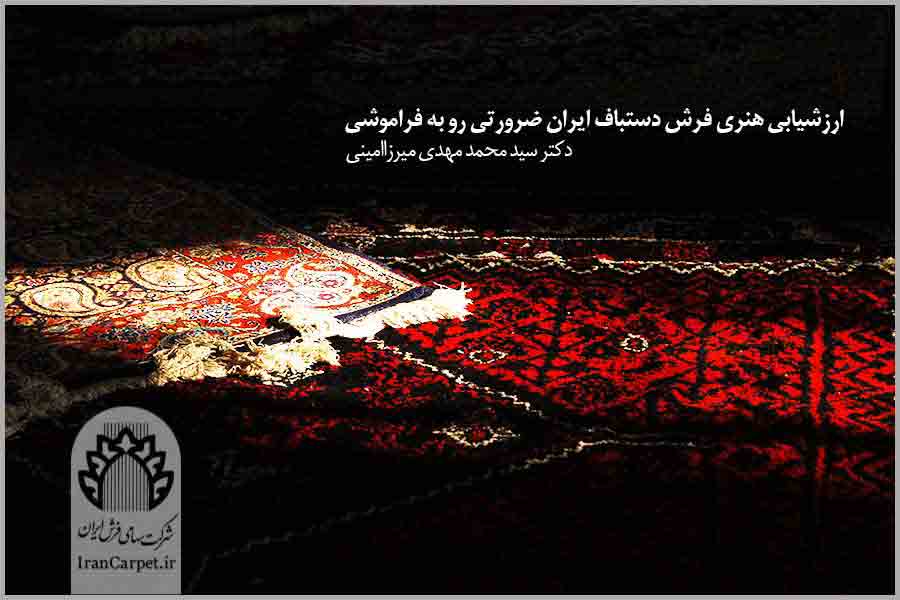
Dr. Seyyed Mohammad Mehdi Mirza Amini
Today, in Iran and in our discourse, the handwoven carpet is described as both an art and an industry. Given the expansion of handwoven carpet markets from earlier periods to the present, the industrial and commercial dimensions of this designation have grown more prominent, gradually turning the handwoven carpet into a commodity valued for its particular profit-making potential. Yet although the artistic value of handwoven carpets has fluctuated across different periods, it is precisely the continued presence of these values that has set Iranian handwoven carpets apart from their competitors in the eyes of audiences around the world. If a mechanical, industrial outlook comes to dominate, these qualities and artistic values will face serious risks. It is therefore essential to give increasing attention to the artistic criticism and evaluation of handwoven carpets. Carpet researcher Toraj Juleh believes that the appraisal, criticism and study of handwoven carpets require a form of knowledge that should be approached and appreciated as the work of an art critic. It makes no difference whether the carpet being examined is antique, contemporary or even newly woven: in every case, it should be approached with expertise, its information carefully drawn out, and its unknowns and uncertainties presented as logical and reasonable hypotheses. In this endeavour, we should follow the example of art critics who classify subjects and works according to styles, historical periods, transformative movements and other such categories, and examine and analyse each carpet in light of their experience, learning and specialist interests (Juleh, 1392 SH [2013]). On the understanding that the Iranian handwoven carpet is, above all, an authentic traditional art—and given that, in recent times, criticism and study of handicrafts and traditional arts have acquired a distinctive standing, with one of their aims being to establish a rational basis for understanding art—it is essential to critique and examine the carpet as an art form, assessing its values apart from its particular commercial dimensions, consumer markets, and the behaviour and preferences of the end consumer. This essay offers a brief foray into this field: the artistic criticism of handwoven carpets.
The Work of Art and Its Values Works of art have value for us. At the very least, we are willing to spend money on them and devote our time to seeing, reading or listening to them. These are signs of the value we attribute to them. But what qualities lead us to consider works of art valuable? And can we offer supporting reasons for believing that such judgements are valid? Answering these two questions about a city-woven Tabriz carpet or a Bakhtiari rug leads us towards a rational inquiry into our claim that these carpets are works of art. If we cannot substantiate that claim, our belief in their artistic status remains a subjective matter. But can our understanding of a carpet’s value be defined and explained according to rational criteria? It must be said that not every reason for which we might consider a work valuable relates to its artistic value. For instance, if we choose a handwoven carpet as a luxury object, is the value that its luxuriousness holds for its owner among the carpet’s artistic values? Or does a preference for green living—the avoidance of synthetic materials—and the value of a handwoven carpet from this perspective amount to artistic value? Clearly, it does not. We must therefore try to distinguish, among the valued qualities we attribute to a carpet, only those that we unequivocally use to assess its artistic merit.
Accepting or Rejecting the Opinion of a Carpet Critic or Expert Suppose two experienced handwoven-carpet experts hold diametrically opposed opinions about the same carpet. One praises and commends it, while the other considers it to have no particular merit. In such situations, we are keen to ask the critic or expert to prove the truth of their claims. What interests us, or prompts our questions, is whether the two critics agree in their artistic assessment or criticism of the carpet. We might assume that the critics are simply expressing their personal preferences or aversions—unless one of them can substantiate their view. Without a method for resolving such disagreements, criticism appears to be an entirely subjective matter. If we accept that criticism is a rational activity, however, the critic must be able to provide reasons and offer propositions that readers can believe, or find themselves able to believe, thereby making it reasonable to accept the truth of what the critic says about a carpet. Yet even if the critic does offer reasons, what matters is whether that opinion satisfies us. One important and subtle point about the reasons offered to establish the truth of a critic’s claims is their generality. In other words, if a particular feature makes one carpet superior to another, that feature should always be a mark of superiority in comparison with a carpet that lacks it. But this may not hold true for every carpet. For example, if colour contrast enhances the artistic value of one carpet, it may diminish the artistic value of another. The same can be seen in other cases: balance and symmetry, for instance, may have entirely opposite effects on the artistic value of two different carpets, increasing it in one and diminishing it in the other. For this reason, some researchers and critics maintain that “every authentic work of art is unique.” If works of art—in this case, handwoven carpets—are unique, can we place them within a framework of general rules in order to distinguish their merits from their shortcomings? In answering this question, we must consider different levels of judgement. At the first level, there are three fundamental, general criteria of artistic merit: unity, complexity and depth. Accordingly, to accept the claim that a work possesses unity, complexity or depth is to accept that it has a positive quality. It is essential to attend to and critique handwoven carpets—not by devising and promoting mechanical scales and instruments to measure their value, but by first guiding the weaver’s perspective and then that of the audience and consumer towards the artistic and distinctive values of each handwoven carpet. The argument just made draws attention to the fact that, for example, the use of colour contrast in a carpet is a positive quality if it contributes to the work’s unity and allows unity to emerge through contrast. But colour contrast alone cannot substantiate the claim that a work contains something admirable. Even so, the three criteria—unity, complexity and depth—cannot, in themselves, serve as a universal explanation for a carpet’s artistic quality and beauty. A carpet may possess unity, complexity and depth, yet evoke an overall sense of ugliness; or a non-artistic object may meet these criteria without being considered a work of art. How, then, should we accept the claims or arguments of a critic or carpet expert? One particularly important and subtle point is that, when we encounter a carpet, we first form a judgement through our powers of taste and discernment. Only afterwards, if necessary or if our curiosity is aroused, do we seek confirmation of that judgement. Thus, aesthetic judgements are confirmed by reference to non-aesthetic judgements, while general judgements, in turn, are confirmed by aesthetic ones. Here, aesthetic judgements are a kind of perceptual judgement. Every viewer needs to see and understand for themselves what makes a work artistic. In such circumstances, reasons and logic may not be needed at all, since what is called a “reason” or “justification” can sometimes be understood as an inference drawn from a personal opinion or feeling—so long as that reason remains subjective for the viewer and has no objective presence in the work.
The Task of a Successful Handwoven-Carpet Critic For this reason, if countless books on carpets offer a variety of arguments in praise of the Sheikh Safi carpet, but I cannot see its artistic and aesthetic qualities and value, all those arguments will become, in effect, an ineffectual justification by the critic and author. The critic will not have helped me arrive at a similar understanding of the carpet. If that is the case, all the critic can do is direct the viewer’s attention, in particular ways, towards something the critic has seen. Put simply, a critic may use an argument to persuade me that a certain carpet possesses a particular quality or feature that makes it a notable work of art—or an ordinary one. But I cannot accept, on the strength of that argument alone, that the carpet has the stated quality. I want to see it for myself. Therefore, when critiquing a handwoven carpet, instead of offering reasons that may be subjective or not necessarily generalisable, we should direct the viewer’s gaze towards what we ourselves have observed and towards the perceptual judgement we have formed about the carpet’s artistic, aesthetic and distinctive qualities. On this account, a critic’s task is to help viewers see and feel the valued qualities of a carpet. The critic must then show how these qualities relate to the fine details of the work. For instance, how has the rhythmic movement of the khata’i motifs in the Sheikh Safi carpet created a mutually supportive, complementary effect within the overall design, suited to a religious setting? Understanding such effects is a matter that individuals may need help from others to discern. Such a person is one we may call a carpet expert or art critic.
A Mistake in the Artistic Criticism of Handwoven Carpets A common problem that may arise when critiquing a handwoven carpet is the use of a general procedure and set of rules without providing a coherent account of the carpet’s artistic value. For example, a carpet may exhibit balanced motifs, a harmonious arrangement of colours, carefully proportioned elements, and a suitable repetition of flowers. But what do these features tell us about the artistic quality or value of the carpet? What effect do they have on the viewer? Or what value do they offer? In fact, these examples reflect a kind of quantitative thinking. Unless they serve an artistic quality or value, they are effectively meaningless and reveal nothing of the carpet’s artistic values to the viewer. This problem is evident in many critical studies. One need only leaf through books on carpets that describe historical or contemporary carpets. These sources point to a collection of appealing, particular features and, on the basis of those features, ultimately declare the carpet an artistic and distinguished work—without clearly addressing its expressive quality or trying to direct the viewer, through those details, towards an artistic value. A particular clarification is needed here. It is generally assumed, for example, that balanced motifs enhance a carpet’s value—in other words, that balance is a positive quality. But this is not enough to conclude that balance necessarily indicates merit in a given carpet. To determine whether the balance of motifs in a carpet is admirable, we need to make a judgement for which no mechanical method of proof can serve as a substitute. We must ask: Is the balance in this carpet appropriate? Does it conflict or clash with the carpet’s other qualities? One point requires attention here. Qualities that are generally considered desirable or positive fall into two categories: they are either “additive” or “interactive.” The desirable qualities of a good knife, for example—such as a good handle, rust resistance and sharpness—are additive. A knife with these qualities is better than one without them. But the desirable qualities we have in mind in relation to art are interactive. It is not enough simply to add them or include them and assume that this makes the work better. We must see how these qualities come together, and that requires judgement, taste and discernment. Under these conditions, simply identifying and describing a carpet as having predominantly positive, desirable and appealing qualities does not mean that we have ultimately arrived at an understanding or judgement of its artistic and aesthetic value. The reverse may also be true.
Artistic Criticism of Handwoven Carpets Beyond Clichéd Patterns A challenging issue concerning handwoven carpets, raised at the outset of this discussion, is the description of this ancient Iranian art form as both “art and industry.” Artistic criticism makes the boundary between the artistic and industrial dimensions of this practice clear. It is often claimed that art cannot be produced mechanically: there are no ready-made rules for creating a work of art. Many producers, designers and carpet painters may overlook this point, seeking instead fixed formulas and patterns for design, motifs, colour, weaving and other elements in order to produce what they call an artistic carpet. This narrow outlook—and the treatment of the handwoven carpet as an industry, whereby “art and industry” is understood as the industrial and mechanical transformation of the carpet’s artistic dimension—has weakened and diminished the artistic quality and value of carpets in Iran, despite healthy production and the presence of diverse markets. The situation has reached the point where, even in artistic criticism and evaluation, we seek fixed, general principles. We often look for the finest carpets, and those with artistic value and distinction, by measuring them against accepted and desirable patterns, markets and consumer preferences, while overlooking their artistic merits. This is what makes Iranian carpet production more mechanical than anything else, and imbues it with a mechanistic mindset.
In Conclusion Above all, today we must regard the handwoven carpet as a work of art with genuine artistic integrity, and approach its criticism, study and evaluation accordingly. Otherwise, the handwoven carpet will become a commercial commodity shaped by market forces, consumer behaviour and lifestyle. Its value will then be assessed according to commercial criteria, and policies and strategies for its production and development will follow the same course. As this process continues, the artistic dimension of the carpet as both art and industry will grow increasingly faint and may ultimately disappear. It is therefore essential to attend to and critique handwoven carpets—not by devising and promoting mechanical scales and instruments to measure their value, but by first guiding the weaver’s perspective and then that of the audience and consumer towards the artistic and distinctive values of each handwoven carpet. Under these conditions, we may hope that art, which is always alive and dynamic, will find its way forward in a fitting and productive manner, creating favourable conditions first for Iranian art and culture and, secondly, for its markets and trade.
References Juleh, Toraj. (1392 SH [2013]). Understanding Carpets: Some Theoretical Foundations and Intellectual Underpinnings. Tehran: Yassavoli. Lace, Colin. (1388 SH [2009]). “Art Criticism,” in Essays on the Philosophy of Art and Aesthetics, translated by Amir Maziyar and Amir Nasri, 2nd edition. Tehran: Academy of Arts.
Related Reading
All Journal & Blog History & Heritage
Iran Carpet Company at 90: A Conversation with Abbas Hesari
This interview was conducted to mark the 90th anniversary of the nationalization of Iran Carpet Company and to record and preserve the experiences and memories of its long-serving and veteran colleagues.