
Corporate News
A Chronicle of the Creation of the 5,000-Square-Metre Sultan Qaboos Mosque Carpet
May 31, 20254 min readIran Carpet Company
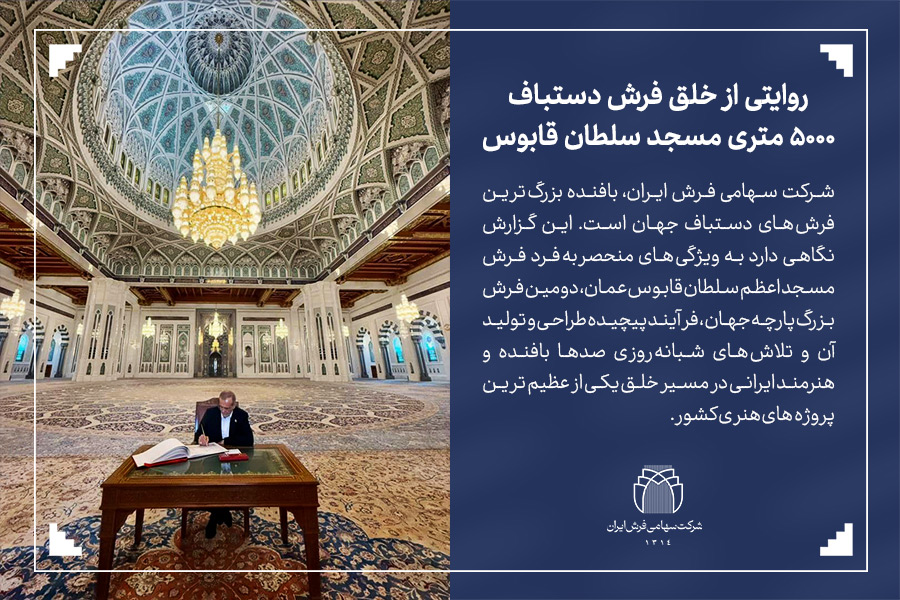
The carpet of the Sultan Qaboos Grand Mosque in Muscat, Oman, is the world’s second-largest single-piece handwoven carpet. It is remarkable not only for its unprecedented dimensions, but also for the exceptional quality of its design, dyeing and weaving. Its design was created at the Design and Colour Department of Iran Carpet Company’s head office in Tehran, then sent to specially established workshops in Nishapur for weaving.
The design of the immense Sultan Qaboos Mosque carpet draws inspiration from the dome of Sheikh Lotfollah Mosque in Isfahan. Traditional motifs from Tabriz, Kashan and Isfahan were brought together to create a design that remained distinctly Iranian while also appealing to the tastes of the Omani royal court. The initial design was completed in just 24 hours, and the project began after receiving the personal approval of Sultan Qaboos. Translating the full design into a 5,000-square-metre format—through hand-drawing, applying colour point by point and producing colour printouts for the weavers—was an arduous undertaking, rarely matched in the history of Iranian carpet weaving.
To weave the Sultan Qaboos Mosque carpet, workshops equipped with 50-metre looms were built in Nishapur. Their distinctive features included high-quality warping and the installation of cranes to manage the excess warp threads. The weavers first received specialised training in the asymmetrical Persian (Senneh) knot, then began weaving on the enormous looms. Between 30 and 40 weavers worked simultaneously on different sections in each workshop. The carpet comprises 42 sections, the largest covering 1,200 square metres. A blend of Iranian wool from Torbat and New Zealand wool, combined with complex natural vegetable dyeing, provided uniform fibres for the project. To achieve the desired madder-red hue, three tonnes of natural madder dye were used. This required a complex process to separate particles and re-card the fibres.
After weaving, the carpets were taken to Karaj for finishing. There, they were trimmed, finished and lined before being carefully packed. Cooperation among customs authorities, the Islamic Revolutionary Guard Corps and the Air Force, together with arrangements made with a Ukrainian airline, enabled the carpets to be loaded directly at Mehrabad Airport and transported to Muscat. Moving 22 tonnes of carpet was comparable to transporting heavy industrial structures.
The Sultan Qaboos Mosque carpet was more than an export project; it represents the art, culture and collective endeavour of Iranian artists and craftspeople. Thoughtful design, precise dyeing, technical management, engineered workshop structures and, ultimately, the art of carpet weaving all came together at the highest level in this project. From a small A4-sized design to an immense carpet spread across the mosque’s prayer hall, every stage was carried out with skill and care.
| Title | Sultan Qaboos Mosque Carpet |
| Area | 4,343 square metres |
| Approximate dimensions | 60 by 70 metres |
| Knot count | 40 knots per 6.5 centimetres |
| Materials | Cotton warp and weft; wool pile |
| Number of colours | 28 colours |
| Place of weaving | Nishapur, Iran |
| Knot type | Asymmetrical Persian (Senneh) knot |
| Number of knots | Approximately 1,700,000,000 knots |
| Weight | 22 tonnes |
| Time required | Three years from design to completion of weaving |
| Year installed | 1380 SH (2001–02) |
During Iranian President Dr Masoud Pezeshkian’s important official visit to Oman in June 2025, he visited the Sultan Qaboos Grand Mosque and sat proudly on this exquisite carpet. The symbolic visit underscored the cultural ties between the two countries and once again drew attention to this masterpiece of Iranian carpet weaving. Years after it was laid in Oman, the carpet remains a vivid expression of Iranian artistry.
Maryam Ghanbari Adyavi Senior Handwoven Carpet Specialist
 Corporate News
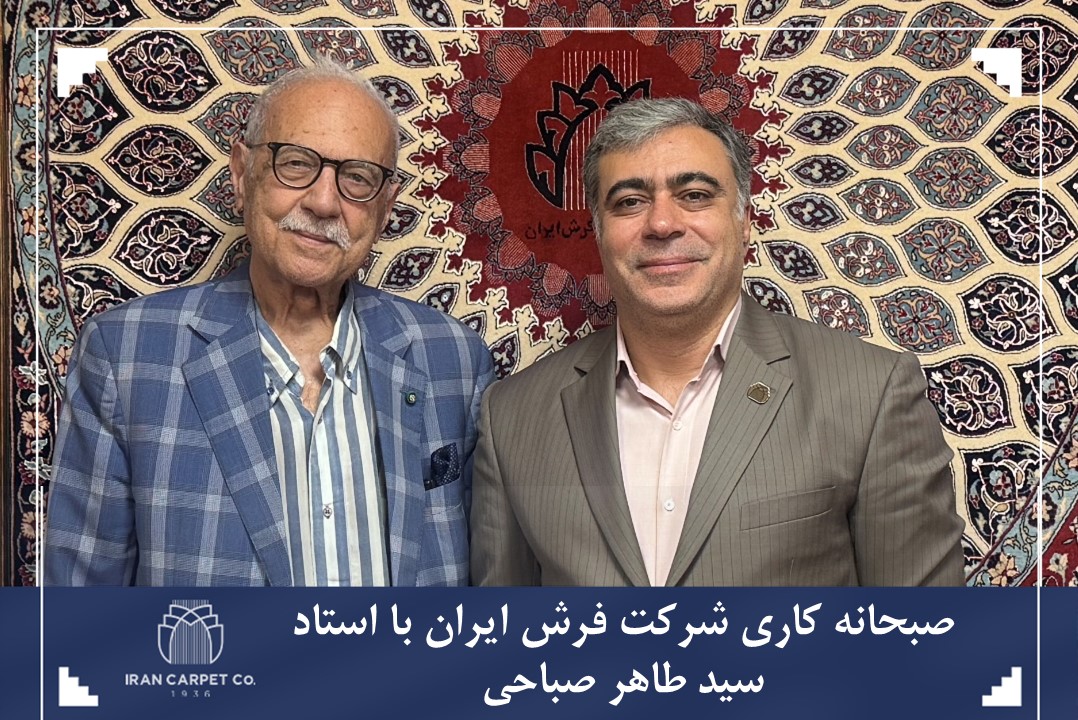
Master Seyyed Taher Sabahi, the renowned Iranian researcher, author, collector, and carpet scholar, was a guest of Iran Carpet Company this morning. During the cordial meeting, the participants explored opportunities for collaboration on reweaving distinguished historic works, publishing specialist books and journals on carpets, and holding joint training courses with academic and educational institutions in Iran and Italy.
 Corporate News6
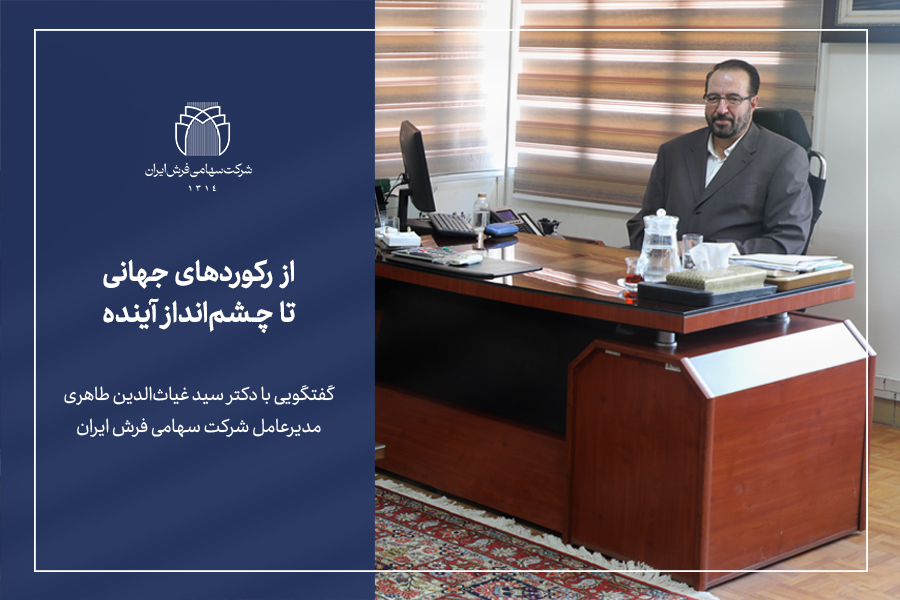
In this candid conversation, the CEO of Iran Carpet Company reflects on the brand’s history and global achievements, from producing some of the world’s largest handwoven carpets to bespoke projects for international hotels.
 Corporate News18
On 20 Khordad 1403 (June 9, 2024), coinciding with National Handwoven Carpet Day and World Crafts Day, the second ceremony honoring the luminaries of this field was held in Qom. Eight distinguished figures in Iranian carpetmaking and 121 other leading practitioners were recognized.