
Events & Highlights
A Look at Parviz Tanavoli’s Career in the World of Carpets
Mar 22, 20227 min readIran Carpet Company
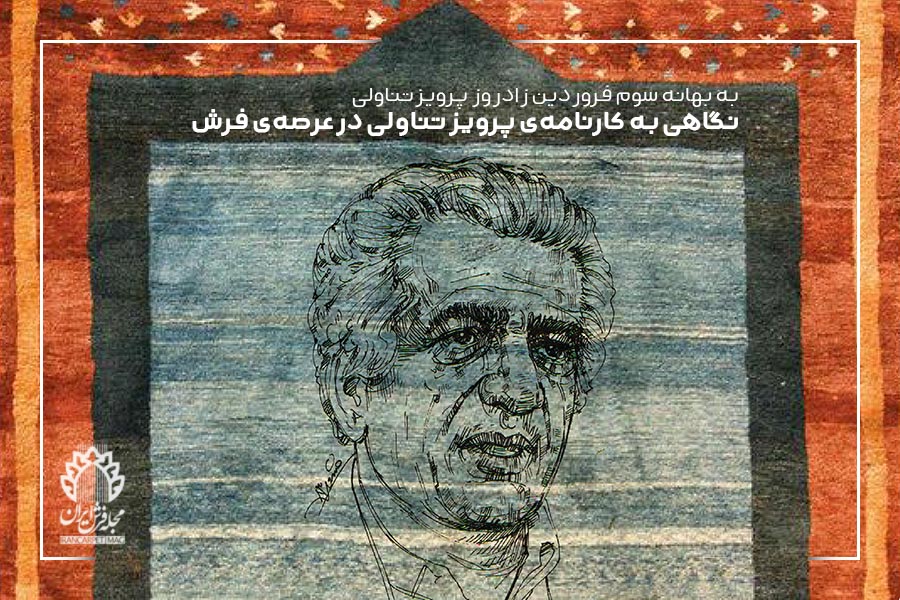
Touraj Juleh
Parviz Tanavoli’s name is well known in national and international circles for his distinctive perspective on Iran’s diverse indigenous and traditional arts, as well as for the many books and articles he has written on the subject. Born in Tehran on 23 March 1937, Tanavoli began his artistic pursuits at the age of ten, studying the violin under such a distinguished master as Abolhasan Saba. His interest in painting led him to attend the free painting classes at the Kamal-ol-Molk School of Fine Arts from 1944 to 1949, where he studied with Hossein Sheikh. His enrollment in the sculpture program at the Tehran School of Fine Arts, however, marked his serious and transformative entry into the world of art. Three years of study there brought a profound change to Tanavoli’s artistic life—a change that heralded a major independent movement in Iran and secured his place among contemporary artists of international renown. From 1956 to 1976, his many innovative works in sculpture and painting, exploring the themes of “Heech” (“Nothingness”) and “Walls of Iran,” drew the attention of critics and art lovers around the world.
Tanavoli and Persian Carpets
From the outset of his artistic career, Parviz Tanavoli’s distinctive and penetrating gaze was especially drawn to Iran’s weaving arts, and in particular to the tribal and rural textiles of the country. His many journeys to hundreds of villages across Iran, as well as his experience of living among the Fars, Bakhtiari, Shahsevan, and Kurdish tribes, among others, attest to his deep interest in these communities and their weaving traditions.
His enduring passion for weaving inspired him to introduce Iran’s tribal and rural textiles and to keep alive the names, art, and weaving culture of the communities that produced them. His dozens of articles and books on the many kinds of tribal and rural textiles of Iran together form a major encyclopedic body of work on the subject.
The first event at which Parviz Tanavoli exhibited carpets was held at the Borgese Gallery in Tehran in November 1965. The exhibition brought together paintings, sculptures, and a variety of objects, some even at odds with one another, in a palette of vivid and at times discordant colors. It included calligraphic pieces, copper and plastic vessels, fluorescent lamps, and, finally, fragments of carpets. Tanavoli’s love of Persian carpets became still more evident in 1973, when he founded the Society of Friends of Persian Carpets to preserve tradition and support Persian carpets. The society’s first meeting was held at Tanavoli’s home, with five members in attendance.
 Some of Parviz Tanavoli’s books
The society’s members included the painter and graphic artist Monir Farmanfarmaian; Abolbashar Farmanfarmaian, Monir’s husband and the son of Abdolhossein Mirza Farmanfarmaian; Jenny Housego, a writer and researcher of tribal carpets; Amedeo Francesi, the Italian Embassy’s consul general in Iran; and John Wertheim, a collector and specialist in tribal carpets. In the society’s second year, Dr. Cyrus Parham also joined them. In 1974, Tanavoli’s first carpet exhibition, titled “Lion Rugs from Fars,” opened at the Textile Museum in Washington. In December of that year and January 1975, the Smithsonian Institution published his book Lion Rugs from Fars as the exhibition catalogue.
The exhibition was a sign that we would be hearing much more about Persian carpets in the years to come. Tanavoli also designed and made carpets, but found this to be a difficult path, as he explains:
From the moment I entered the world of carpets, the thought of having a share in it led me to create designs suited to carpets. Before long, however, I realized that I had taken on a difficult task. The firm, long-established principles of Persian carpet weaving, shaped over several thousand years, have made it a distinctive art, set apart from other arts. For this reason, it does not admit of unreasonable intervention. This does not mean, of course, that Persian carpet is a frozen, inflexible art. A brief look at the different periods of carpet weaving reveals its vital and sustained evolution. Yet these changes have always been in harmony with the paradisiacal world of the carpet ...
A look at the course of Parviz Tanavoli’s artistic work confirms the beginning of a new chapter in his professional life, marked by an interest in Fars lion rugs and other tribal and rural textiles of Iran.
The Gift of Tribal Textiles
One morning in January 2020, I received a voice message from Parviz Tanavoli informing me that he intended to donate his entire collection of tribal and rural textiles to the Ministry of Cultural Heritage. The collection was the result of more than 50 years of work. Tanavoli hoped to leave a legacy for generations to come by establishing a dedicated museum. Some time later, discussions began on an agreement for this remarkable donation. To my knowledge, a gift on this scale—whether of handwoven textiles or of other works of art—has no precedent in the history of museums or among collectors worldwide. It may be considered the largest art donation ever made by an individual collector. Finally, on 9 November 2020, an agreement was signed by Parviz Tanavoli and Dr. Mohammad Hassan Talebian, Deputy Minister of Cultural Heritage. Under its terms, Tanavoli donated 1,408 tribal and rural textiles.
Under the agreement, the Ministry of Cultural Heritage undertook to establish an independent museum dedicated to Parviz Tanavoli, where all 1,408 donated textiles would be preserved and displayed permanently. A short time after the agreement was signed, the ministry selected an old house in Shiraz, dating from the early Pahlavi period, as the site for the Parviz Tanavoli Museum.
The importance of Tanavoli’s gift lies in the diversity of these textiles and the many roles they played in the lives of tribal and rural communities; it cannot be described simply as a major donation. Through this gift, a significant part of the culture, art, customs, and history of Iran’s tribal and rural communities will be brought into focus through 1,408 textiles—an exceptionally important resource for anthropology and sociology. Since the tradition of making some of these textiles has been entirely forgotten or is at risk of disappearing, the collection will also be of great value to researchers, particularly students of carpet studies in Iran. Although Parviz Tanavoli’s name is already part of the history of modern Iranian art, this generous donation and the establishment of a museum in his name will greatly strengthen his enduring legacy in the history of Iranian art.
To read the full essay, see pages 26–33 of issue 16 of Angah magazine
Portrait artist: Ali Khosravi Events & Highlights12
Yaser Amin Mahboob, a handwoven carpet designer and researcher, presents a selection of rare nomadic and rural weavings at the Carpet Museum, bringing to light a little-known part of the heritage of Iran’s ethnic communities.
 Events & Highlights
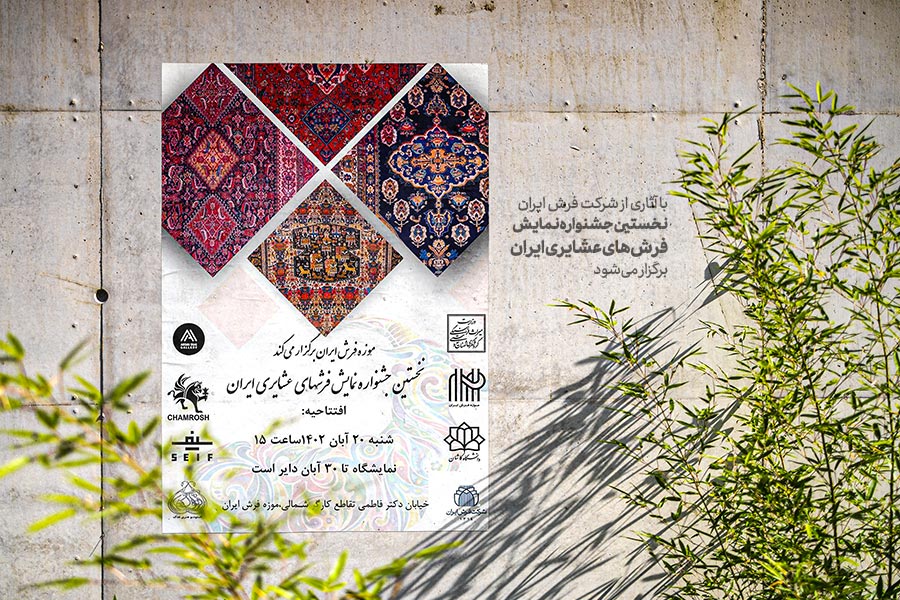
From November 11 to 21, 2023, the Iran Carpet Museum will host the first festival showcasing Iranian tribal carpets. For ten days, visitors can view handwoven works by Iran’s tribal communities.
 Events & Highlights28
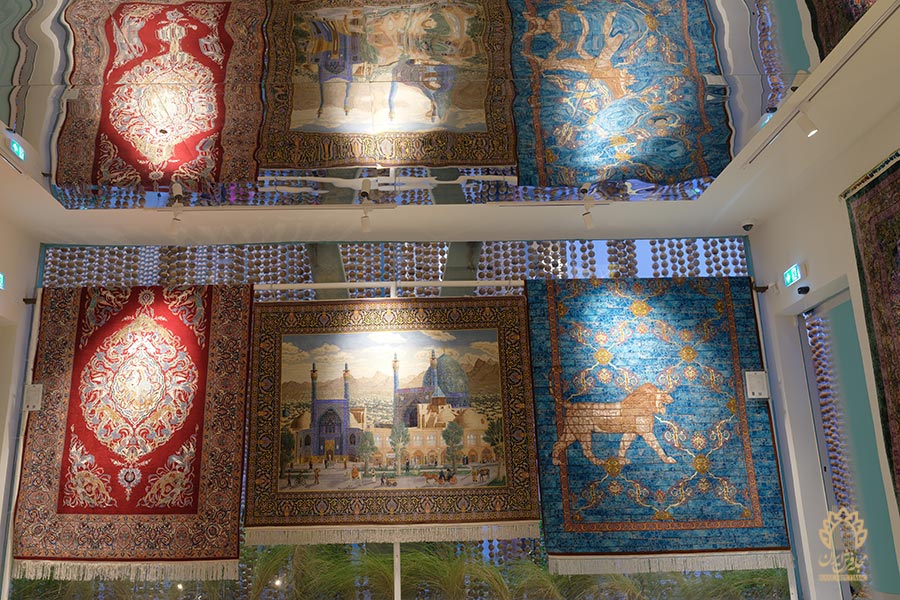
At Expo 2020 Dubai, Iran Carpet Company joined a distinguished group of handwoven carpet brands to present a radiant expression of Iran’s culture and art.