
Corporate News
Masterpieces of Iranian Carpets
Oct 31, 20207 min readIran Carpet Company
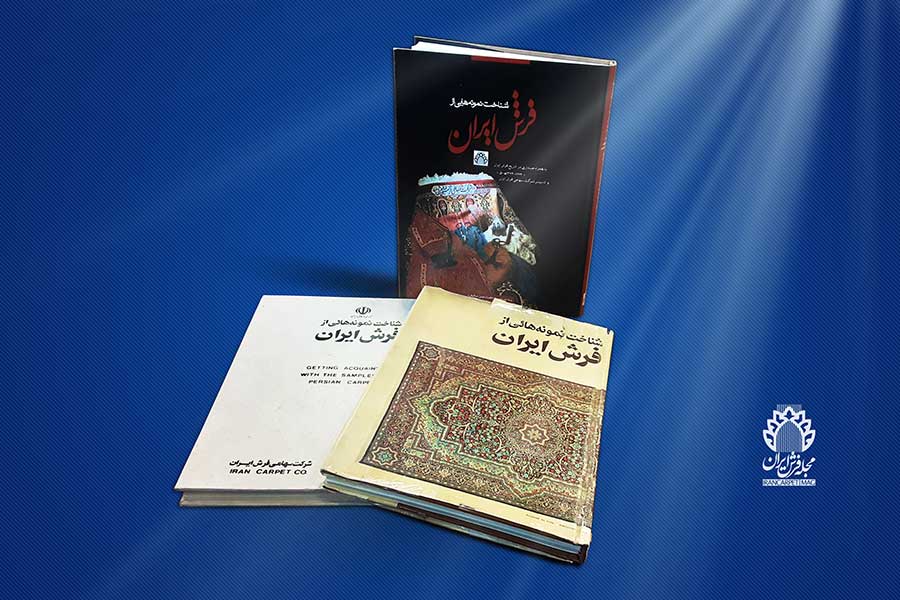
For several decades, Iran Carpet Company has sought to publish books on carpets. An Introduction to Masterpieces of Iranian Carpets is one of the books published to present carpets produced by the Company. Volume 1 of this book was published in Esfand 1351 SH (February–March 1973) by Pishgar Advertising and Publishing Company, and Volume 2 followed in Esfand 1352 SH (February–March 1974).
Mohsen Mohseni, who had worked continuously in various departments of Iran Carpet Company since 1954—including administration, finance and accounting, and commerce—recalled the publication of the book: “In 1973, when I was the Company’s commercial director, we decided to compile designs and carpets from across Iran. After extensive work photographing the carpets and recording their details accurately, we published two sumptuous volumes of *Masterpieces of Iranian Carpets* in Esfand 1351 SH. This very fine collection is still held by Iran Carpet Company and contains hundreds of photographs and descriptions of the Company’s carpets from every region of Iran.”
The book presented, for the first time, Iran Carpet Company’s 19-part classification of carpet designs. Under the Company’s system, all Iranian carpet designs are organized into 19 principal groups, each divided into several smaller categories: archaeological monuments and Islamic architecture; Shah Abbasi; arabesque; adapted designs; all-over Afshan motif; repeat (banded) designs; boteh (boteh-jegheh); tree designs; Turkmen; hunting scenes; European floral (Gol-e Farang); panelled (brickwork); vase; Mahi Darham (fish); prayer-niche; striped; geometric; tribal and nomadic; and composite designs.
In Mordad 1363 SH (July–August 1984), the book Masterpieces of Iranian Carpets was republished in two volumes under the title An Introduction to Selected Iranian Carpets. The book’s description explains that this volume and those that followed contain colour photographs, with a brief description of each carpet on the reverse, to help buyers choose a carpet to their liking. Smaller photographs printed on the reverse of each carpet image show a square decimetre of the carpet at actual size, indicating the fineness of the weave and the detail of the design. The volume was prepared in Persian and English so that international admirers of Iranian carpets could also become acquainted with them.
The first volume introduces 100 carpets, and the second presents a further 100. Each entry begins with a complete photograph of the carpet, followed on the next page by a description of its design. The details of each carpet—including its code number, design name, dimensions, place of weaving, knot count per square decimetre, and the proportions of the materials used—are presented separately. The carpets are made of wool and silk and feature designs including arabesque medallion and corner (Lachak-Toranj), Shah Abbasi with trailing vines, Shah Abbasi Afshan, Shah Abbasi medallion and corner, banded bouquets, bouquet medallions, medallion and vines or tapestry, arabesque medallion, arabesque with medallion, Turkmen Akhal (Bukhara), Mahi Darham, vase prayer-niche, Gol-e Farang medallion and corner, verdant tree, geometric medallion and corner, pendant medallion, Ilati Heybatlu, Caucasian-inspired, Turkmen spoon, panelled, boteh-jegheh, and others. The carpets were woven in many of Iran’s principal carpet-producing regions, including Kerman, Qom, Shahreza, Hamadan, Kashan, Malayer, Tabriz, Gorgan, Semnan, Isfahan, Abadeh, Mashhad, Gonabad, Ardabil, Birjand, Nain, Rafsanjan, Tehran, Saruq, Mahallat, Sanandaj, Qazvin, and Arak. A small photograph of each carpet was also included, taken from the reverse over an area of one square decimetre at actual size. Its purpose was to show the carpet’s knot count and raj, as well as to give an indication of its quality.
Each carpet entry also emphasizes that all rights relating to the design, colour scheme, printing, and publication of the pattern belong to Iran Carpet Company. Copying or adapting any part or all of it, in any form or for any purpose, is prohibited without the Company’s permission. To increase production and expand exports, the weaving pattern and high-quality, standardized raw materials for making the carpet would be made available to producers at a reasonable price and on accessible terms.
The third volume in the series, also titled An Introduction to Selected Iranian Carpets, was published in 2005 to mark the 70th anniversary of Iran Carpet Company’s founding. The book’s first section, “With an Essay on the History of Iranian Carpets (1264–1364 AH) and the Founding of Iran Carpet Company,” was written by Touraj Juleh. Speaking about the book’s publication, Juleh said: “From the time I joined Iran Carpet Company in 1991 until 1997, this book was always an open project on the desks of Mohammad Reza Abed and Reza Allahdad. For various reasons, publication was repeatedly delayed. Then, in late 2004, when Ali Karimi became the Company’s managing director, he revived the project. At the time, he appointed me as an adviser to the managing director on production for one year. During that period, he asked me to help publish the book. We brought it out to mark the 70th anniversary of Iran Carpet Company’s founding. The carpets that had been photographed were no longer available, and the photographs were neither a brochure nor a catalogue. I suggested that we write a scholarly text for the book, giving it an academic dimension. I proposed covering the hundred-year period leading up to the founding of Iran Carpet Company. I wrote the text, and it was approved. Ultimately, the book was published under my supervision and with my close involvement.”
The second section of An Introduction to Selected Iranian Carpets contains photographs of 87 carpets from Iran Carpet Company’s collection, taken by Abbas Nasrollah Gharai. Ali Hasuri wrote descriptions for 60 carpets, and Ja’far Pakdast for the remaining 27. The descriptions appear in Persian, English, and German. Each entry begins with a complete photograph of the carpet. The following page gives its details, including the design name, dimensions, place of weaving, field and border colours, materials used in the warp, weft, and pile, and knot count, followed by a description of the design and border. The carpets are made of wool, cotton, and silk. Their designs include Afshan, plain field with medallion, boteh-jegheh, medallion and corner, hunting scene, panelled, tree design with medallion, Turkmen panelled, Gol-e Farang medallion and corner, Kolah Farangi, Heybatlu medallion and corner, plain-field medallion and corner, tree design, Mostowfi banded, Afshan, banded medallion, Afshan with medallion, panelled with medallion, tree prayer-niche, and others. The carpets were woven in Isfahan, Hamadan, Qom, Bijar, Rafsanjan, Yazd, Nain, Sarab, Borujen, Tabriz, Mashhad, Shahr-e Kord, Natanz, Gorgan, Sanandaj, Abadeh, Kashan, Malayer, Mahallat, Kerman, Arak, Golpayegan, Zabol, Ilam, Kashmar, Ravar, and other cities.
Touraj Juleh spoke about photographing and describing the carpets: “All the carpets in the third volume belong to Iran Carpet Company, and they were photographed at the Company itself. Descriptions were also written for the photographs and translated into English and German. The translations were then reviewed by Siavash Azadi and Ali Hasuri. Both found many problems in them. They explained that the issue was not with the translator, but with the Persian writing: the text had not been written in a way that made it suitable for translation. Ali Hasuri gave the example of a translator rendering ‘a bird that is singing melodiously on this carpet’ so literally that it sounded as if a bird were sitting on the carpet and singing. This kind of writing causes problems and does not translate well. It was decided that new descriptions should be written for the carpets. Ja’far Pakdast and Ali Hasuri wrote them over the course of about three or four months.”
 Corporate News
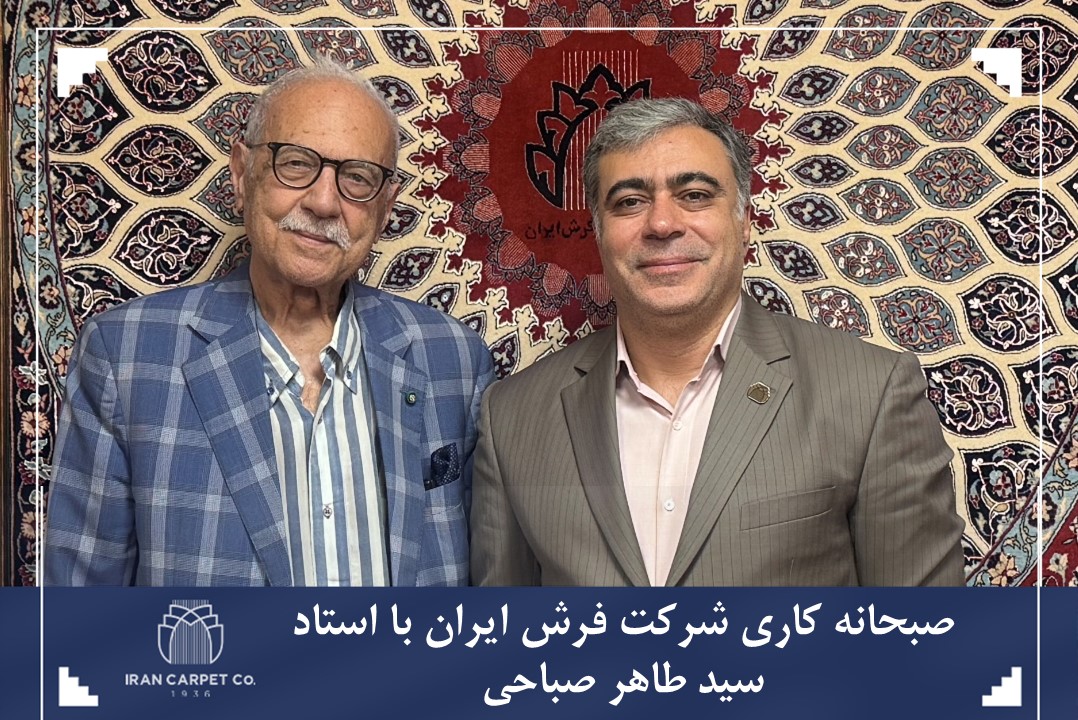
Master Seyyed Taher Sabahi, the renowned Iranian researcher, author, collector, and carpet scholar, was a guest of Iran Carpet Company this morning. During the cordial meeting, the participants explored opportunities for collaboration on reweaving distinguished historic works, publishing specialist books and journals on carpets, and holding joint training courses with academic and educational institutions in Iran and Italy.
 Corporate News6
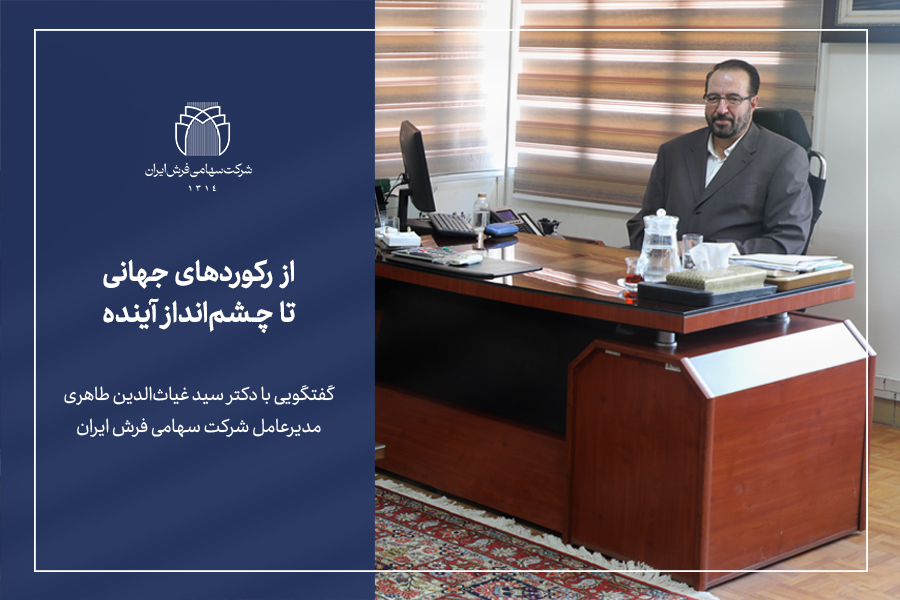
In this candid conversation, the CEO of Iran Carpet Company reflects on the brand’s history and global achievements, from producing some of the world’s largest handwoven carpets to bespoke projects for international hotels.
 Corporate News10
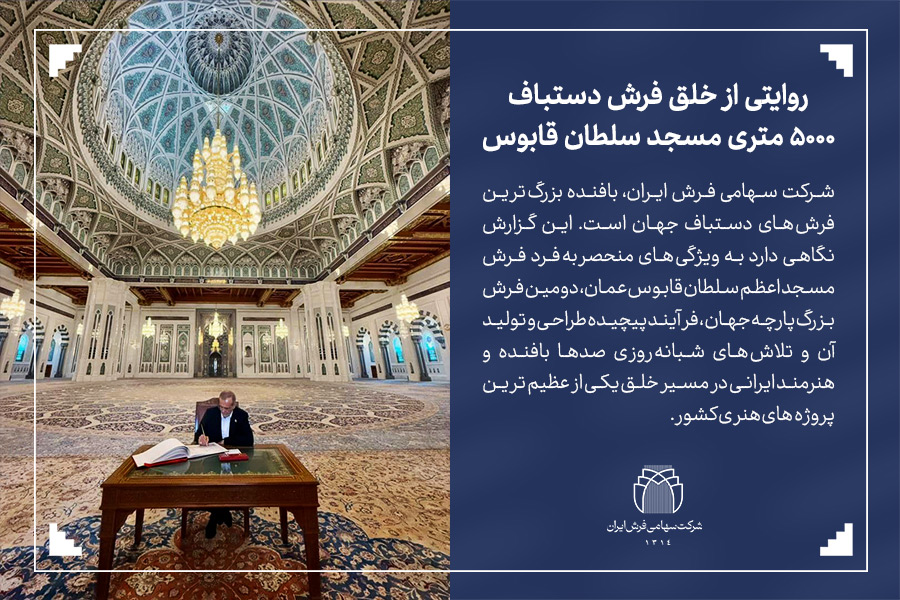
Iran Carpet Company is the maker of some of the world’s largest handwoven carpets. This report explores the exceptional features of the Sultan Qaboos Grand Mosque carpet in Oman, the world’s second-largest single-piece handwoven carpet.