Adventures of a Modern Marco Polo
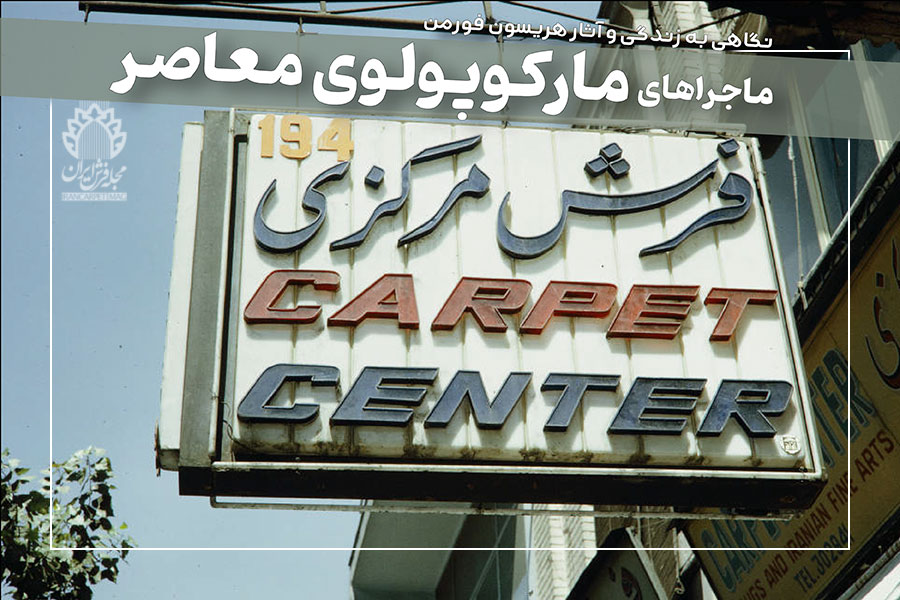
Thirty-four years after the Library of the American Geographical Society received Harrison Forman’s photographic collection, his photographs became fully accessible online in May 2021. The collection was donated by Harrison’s wife, Sandra Carlisle Forman, in 1987. It includes photographic prints, black-and-white and colour negatives, 35 mm colour slides, colour slides, and motion-picture films documenting his many journeys around the world between 1920 and 1970.
Forman travelled to Iran in 1967 (1346 in the Solar Hijri calendar) and took 820 remarkable colour photographs of everyday life in cities across the country, as well as of Iran’s historic monuments and natural landscapes. Harrison Forman (1904–1978) was an American explorer, aviator, photographer, journalist, and author. He was born in Milwaukee, Wisconsin, on 15 June 1904. He studied Oriental languages at the University of Wisconsin. In the early 1930s, he went to China to sell American aircraft and train Chinese pilots. He contributed to numerous newspapers and magazines, including The London Times, The New York Times, Cosmopolitan, Harper’s, Life, and National Geographic.
While in China, he heard a rumour that a mysterious mountain in Tibet was supposedly taller than Mount Everest. Forman travelled to Tibet and, although he never found the mountain he was seeking, became known as one of the first Western explorers to visit the region. This experience led to his appointment as technical director of the Oscar-winning film Lost Horizon in 1937.
His photographs of Iranian carpet weavers are among his most notable works, giving researchers valuable insight into carpet-making practices of the period. In the late 1930s, Forman covered the Sino-Japanese conflict as a cameraman for newsreel services. He became best known at the time for his coverage of the Battle of Shanghai in 1937 and the Nazi invasion of Poland in 1939. He was also one of the most important photographers of the Second World War. Perhaps his most significant journalistic work, however, was his 1944 interview with Mao Zedong.
After the Second World War, Harrison Forman became an important authority on Far Eastern affairs and focused much of his work on travel, ethnography, and nature photography. He also published several books, the best-known of which include Forbidden Tibet, Adventures of a Modern Marco Polo, Report from Red China, How to Make Money with Your Camera?, and Land and People of Nigeria.
Forman travelled to Iran in 1967 (1346 in the Solar Hijri calendar) and took 820 remarkable colour photographs of everyday life in cities across the country, as well as of Iran’s historic monuments and natural landscapes. He viewed his surroundings through an anthropologist’s eyes, fascinated by the life, culture, economy, governments, and infrastructure of each place. His photographs of Iranian carpet weavers are among his most notable works, giving researchers valuable insight into carpet-making practices of the period.
Forman died in New York on 31 January 1978.
Compiled by: Dr Davoud Shadlou Faculty member, Department of Carpet, Shiraz University of Arts